
HERBARIUM / ADVANCED PLANT MONOGRAPH
Lemon Balm
Melissa officinalis L.
A lemon-scented perennial herb of consolation, gentle clarity, hospitality, sweetness, restoration, and the living relationship between flower and bee.
MONOGRAPH PROFILE
Quick Reference
- Botanical Name
- Melissa officinalis
- Botanical Authority
- L.
- Plant Family
- Lamiaceae
- Primary Planetary Ruler
- Jupiter
- Historical Zodiac Attribution
- Cancer in Culpeper’s system
- Alternative Attributions
- Moon, Venus, or Mercury in some later systems
- Element
- Water in common modern correspondence; Air also appears
- Metal
- Tin through Jupiterian correspondence
- Tria Prima Emphasis
- Mercury / Sulfur
- Parts Used
- Primarily the leaves; flowering aerial portions may appear in some preparations
- Plant Condition
- Fresh or dried
- Primary Preparations Discussed
- Leaf infusion, liquid extract, capsules, culinary and aromatic preparations
- Safety Classification
- General Caution; may impair driving or machinery use
- Conservation / Sourcing
- Widely cultivated; verify species, plant part, origin, and regional spread
ENTRY SUMMARY
Lemon Balm at a Glance
Lemon balm, Melissa officinalis L., is a bushy aromatic perennial in the mint family, Lamiaceae. Plants of the World Online accepts the species name and records a native range extending from the Mediterranean region into Central Asia. The plant is now widely cultivated and naturalized beyond that range.
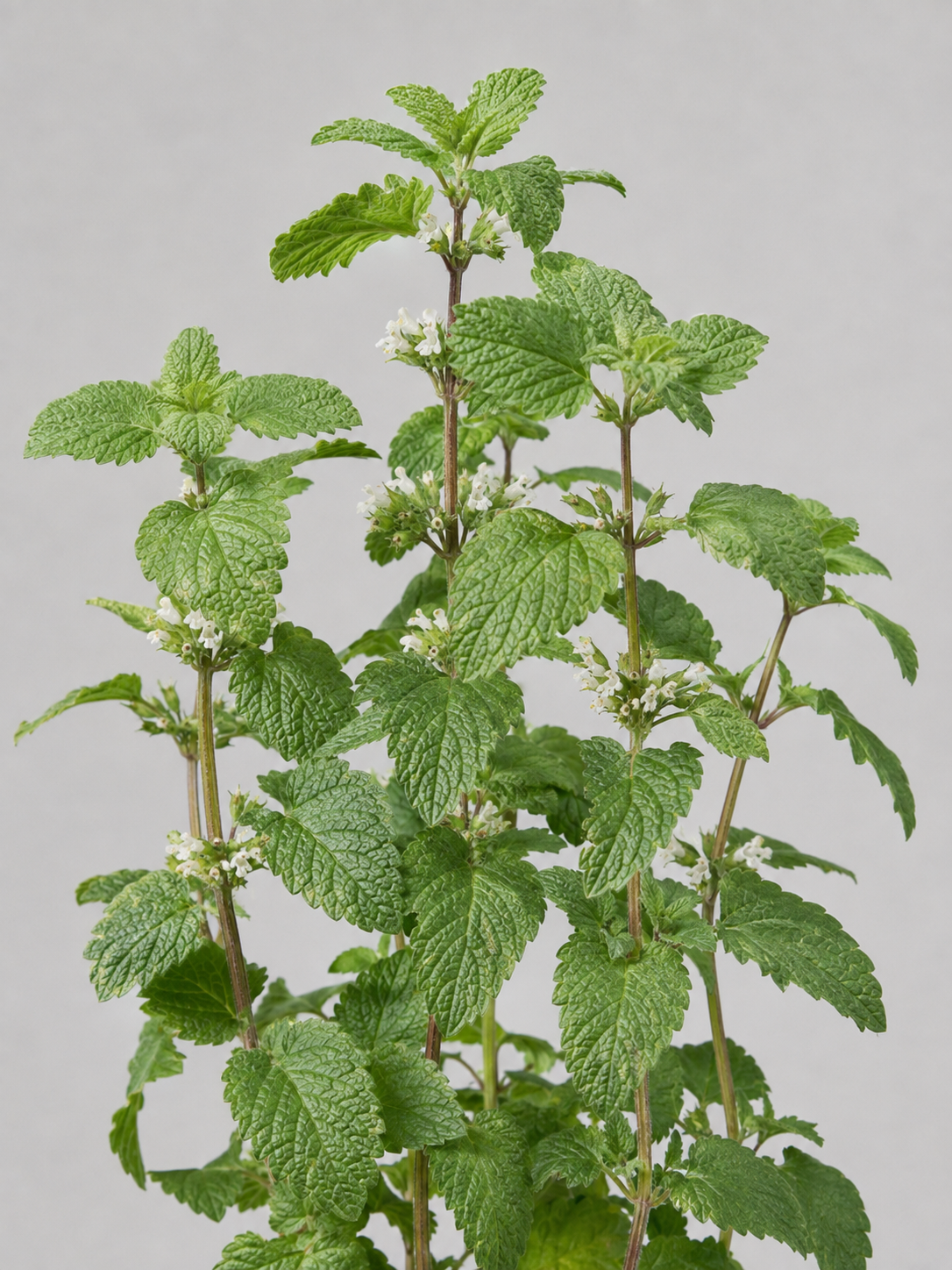
Its opposite, softly textured leaves are broadly ovate to heart-shaped, prominently veined, and toothed along the margins. When bruised, the leaves release a characteristic lemon fragrance. Small pale flowers arise near the leaf axils and attract bees, a relationship reflected in the genus name Melissa, traditionally associated with the honey bee.
Nicholas Culpeper placed Balm under Jupiter and Cancer. This Jupiterian attribution is historically documented within his seventeenth-century astrological-herbal system. Later symbolic traditions emphasize comfort, sweetness, friendship, emotional restoration, dream, lunar receptivity, and peaceful domestic space.
The European Medicines Agency recognizes melissa leaf within a traditional-use framework for relief of mild symptoms of mental stress, to aid sleep, and for mild digestive complaints including bloating and flatulence. This classification rests on long-standing use and does not establish that every commercial lemon balm product has identical composition, evidence, or safety.
Within HRMTC ALKMY ™, lemon balm is studied as a plant of gentle restoration, aromatic communication, bee symbolism, hospitable boundaries, and the disciplined separation of historical use, clinical evidence, Hermetic interpretation, and commercial product information.
In This Monograph
01
Botanical Identity and Authentication
The common name “balm” may refer to unrelated aromatic plants, resins, or topical preparations. This entry concerns Melissa officinalis L. specifically and should not be confused with bee balm species in the genus Monarda.
Botanical Profile
- Common Name
- Lemon balm
- Accepted Botanical Name
- Melissa officinalis
- Botanical Authority
- L.
- Plant Family
- Lamiaceae
- Other Common Names
- Balm, common balm, balm mint
- Growth Form
- Bushy herbaceous perennial
- Parts Used
- Primarily leaves; sometimes flowering aerial portions
- Plant Condition
- Fresh or dried
Geographic Profile
- Native Range
- Mediterranean region to Central Asia.
- Cultivated Range
- Widely cultivated and naturalized in temperate regions.
- Preferred Habitat
- Gardens, field margins, open woodland edges, disturbed ground, and moist but well-drained sites.
- Climate
- Temperate.
- Soil Preference
- Well-drained soil in sun to partial shade; established plants can tolerate some drought.
Harvest Profile
Harvest Season
Leaf material is commonly gathered during active vegetative growth; exact timing should match the preparation standard and source tradition.
Harvest Stage
Young leaves and material gathered before or around flowering may differ in aroma and composition from mature or late-season material.
Collection Conditions
Use authenticated, uncontaminated material from a documented cultivated or responsibly managed source.
Identification
General Appearance
A branching, bushy herbaceous perennial that forms rounded clumps and may spread through seed and underground growth.
Leaves
Opposite, broadly ovate to heart-shaped leaves with prominent veins, softly wrinkled surfaces, and rounded toothed margins.
Stems
Square in cross-section, branching, and characteristic of the mint family.
Aroma
Fresh lemon-like fragrance released most strongly when the leaf is bruised or rubbed.
Flowers
Small white, cream, or pale yellowish flowers arising in clusters near the leaf axils and attractive to bees.
Fruit
The fruit divides into four small nutlets, as is common within Lamiaceae.
Root and Spread
A perennial root system supports regrowth; the plant may self-seed and spread beyond intended garden boundaries.
Taste
Aromatic, mildly bitter, lemon-like, and slightly astringent. Taste should not be used as a field-identification method.
Commonly Confused Material
Bee balm, lemon verbena, catnip, mints, and other lemon-scented herbs may be confused with lemon balm. Confirm leaf arrangement, stem structure, aroma, flower form, and the complete botanical name.
Known Substitution Concerns
Powders and extracts cannot be authenticated by appearance alone. Prefer products that disclose botanical name, plant part, extraction details, lot identity, and quality documentation.
02
Ethical Sourcing and Conservation
- Wildcrafted or Cultivated
- Commonly cultivated; naturalized collection occurs regionally.
- Conservation Status
- No prominent global scarcity concern identified in the sources reviewed.
- Primary Sourcing Concern
- Correct identity, contamination, regional spread, freshness, and extract quality.
- Preferred Source
- Documented cultivated material with transparent plant-part and lot information.
Sustainable Harvesting Considerations
Leaf harvesting can be compatible with vigorous regrowth when established plants are not stripped excessively. Leave sufficient foliage for continued growth and pollinator support. Avoid spreading seed or root fragments where the plant is locally aggressive.
Quality and Ethical Considerations
Lemon balm’s volatile aroma diminishes with poor drying and prolonged storage. Ethical sourcing should therefore consider freshness, pesticide and contaminant control, worker conditions, geographic transparency, and truthful labeling of extracts and multi-ingredient products.
03
Hermetic Correspondences
- Primary Planetary Ruler
- Jupiter
- Historical Zodiac Attribution
- Cancer in Culpeper’s system
- Element
- Water in common modern correspondence; Air appears in some systems
- Metal
- Tin through Jupiterian correspondence
- Primary Symbolic Themes
- Consolation, joy, hospitality, sweetness, friendship, restoration, abundance
- Editorial Classification
- Historically documented Jupiter attribution; later elemental and symbolic readings labeled separately
Historically Documented Attribution
Historically Documented
Nicholas Culpeper wrote that Balm is “an herb of Jupiter, and under Cancer.” This provides a direct early-modern source for the Jupiterian and Cancerian correspondence.
Correspondence Rationale
Jupiterian readings may emphasize generosity, restoration, social warmth, optimism, growth, and the herb’s long association with the heart made “merry.” Cancerian and watery readings emphasize nourishment, household refuge, emotional memory, receptivity, and soothing containment. These are historical and symbolic classifications rather than medical evidence.
Conflicting Attributions
Later systems sometimes assign the Moon because of sleep, dream, and emotional associations; Venus because of sweetness, affection, and bees; or Mercury because of lemon fragrance, cognition, and aromatic mobility. HRMTC ALKMY ™ retains Jupiter as primary because Culpeper’s attribution is explicit and historically traceable.
04
The Tria Prima
This section presents philosophical and material interpretation while withholding laboratory and spagyric procedures reserved for later publication.
SULFUR
Soul
Philosophical Expression: Cheerfulness, aromatic individuality, warmth, sweetness, attraction, and restorative presence.
Material Expression: A low-yield but highly characteristic volatile oil containing lemon-scented aldehydes and related aromatic constituents.
Interpretation: Lemon balm’s Sulfur is gentle rather than forceful: identity revealed through sweetness, freshness, and immediate scent.
MERCURY
Spirit
Philosophical Expression: Movement, communication, attention, mediation, mood, memory, and fragrance carried through air.
Material Expression: Volatile aromatic compounds disperse readily and can be lost through heat, drying, storage, or unsuitable processing.
Interpretation: Mercury appears in the swift movement of lemon aroma and in the plant’s symbolic association with communication between flower, bee, garden, and household.
SALT
Body
Philosophical Expression: Soft structure, rooted return, garden continuity, boundary, and the body that holds volatile fragrance.
Material Expression: Fibrous leaf and stem tissue, fixed mineral residue, perennial roots, and the textured architecture of the living herb.
Interpretation: Salt is visible in the plant’s recurring body: a stable garden presence capable of renewing delicate aroma.
05
Doctrine of Signatures
Doctrine-of-signatures material is historical or symbolic interpretation. It is not independent proof of medical effectiveness.
Interpretive Meaning
Modern Symbolic Interpretation
The softly heart-shaped leaf invites associations with emotional restoration and hospitality. A bright fragrance released through touch suggests hidden sweetness becoming communicable through relationship. The plant’s attraction for bees supports themes of cooperation, abundance, exchange, and the gathering of sweetness.
06
Botanical and Chemical Profile
Major Constituent Groups
- Hydroxycinnamic acids, including rosmarinic acid
- Flavonoids
- Triterpenes
- Volatile oil constituents
- Tannins and other polyphenolic compounds
Volatile Components
Lemon balm contains a relatively small amount of essential oil whose composition may include citral-related aldehydes such as geranial and neral, citronellal, and other terpenoid constituents. Composition varies with chemotype, geography, cultivation, harvest, drying, storage, and extraction.
Solubility Considerations
- Water-Soluble Emphasis
- Many polar phenolic constituents and components extracted in infusion.
- Alcohol-Soluble Emphasis
- A broader range of phenolic and aromatic constituents depending on alcohol percentage.
- Volatile / Easily Lost
- Essential-oil constituents may diminish through heat, prolonged drying, or poor storage.
- Product Variability
- Whole leaf, tincture, capsule, standardized extract, combination formula, and essential oil are materially different.
Known Variability
Meaningful variation may arise from subspecies or cultivar, plant part, fresh versus dried material, harvest stage, geography, soil, climate, drying conditions, storage age, extraction solvent, and standardization method.
Chemical Literature Current Through: July 2026
07
Traditional and Contemporary Virtues
Authoritative Traditional Uses
Authoritative Monograph Established Traditional Use
The European Medicines Agency recognizes melissa leaf, on the basis of long-standing use, for relief of mild symptoms of mental stress, to aid sleep, and for mild digestive disorders including bloating and flatulence.
Contemporary Research Context
Human studies have investigated lemon balm for stress, anxiety, mood, sleep, cognition, and several metabolic or neurological contexts. Reviews generally describe promising signals but emphasize small samples, heterogeneous extracts, variable doses, mixed populations, and the need for better standardized trials.
Energetic Qualities
System: Later Western herbal interpretation.
- Temperature
- Often described as gently warming or neutral
- Moisture
- Often interpreted as gently relaxing without strongly drying
- Tonicity
- Relaxing with mild uplifting or restorative character
- Movement
- Dispersing tension while settling and centering
Psychological and Ritual Associations
Traditional and later practitioner descriptions associate lemon balm with cheerfulness, consolation, emotional ease, restful transition, friendship, sweetness, and the restoration of a hospitable inner atmosphere. These descriptions must remain separate from clinical claims.
08
Evidence Classification
Human trials exist for stress, mood, sleep, cognition, and other outcomes, but results are limited by heterogeneity, small samples, and preparation-specific differences.
Laboratory and preclinical research investigates GABAergic, cholinergic, antioxidant, antiviral, and other mechanisms. These findings do not establish ordinary product efficacy.
EMA recognizes limited traditional-use indications for melissa leaf.
Long European culinary, aromatic, cordial, digestive, and calming use is documented.
Culpeper and later herbals preserve many claims that should not be repeated as contemporary treatment guidance.
Jupiterian, Cancerian, watery, bee-centered, consoling, and restorative readings belong to symbolic interpretation.
09
Therapeutic and Preparation Context
Preparation Forms
- Fresh culinary leaf
- Dried leaf infusion
- Liquid extract or tincture
- Capsules or powdered leaf
- Standardized extract
- Combination sleep or stress formula
- Topical preparation
- Essential oil
- Aromatic or ritual material
Preparation Distinctions
Fresh leaf, dried tea, liquid extract, capsule, standardized extract, combination formula, and essential oil are not interchangeable. Their constituent profiles, concentrations, excipients, intended uses, evidence, and safety may differ substantially.
Situations Requiring Professional Guidance
Seek individualized guidance before supplemental use during pregnancy or lactation; for children; when using sedating medicines or substances; before driving or operating machinery; with significant allergies; or when using multi-ingredient products for ongoing health conditions.
10
Safety Profile
Prominent Safety Summary
The EMA melissa-leaf monograph states that use in children under 12 has not been established, safety during pregnancy and lactation has not been established, and medicinal use may impair driving or machinery operation. The monograph lists no known undesirable effects and no interaction data, but limited data do not prove that adverse effects or interactions are impossible.
Pregnancy
Medicinal or supplemental use is not recommended because adequate safety data are lacking.
Lactation
Medicinal or supplemental use is not recommended because adequate safety data are lacking.
Children
The EMA monograph does not establish use in children under 12 because adequate data are lacking.
Driving and Machinery
Medicinal lemon balm preparations may impair the ability to drive or operate machinery. Do not drive if drowsy or otherwise affected.
Allergy and Sensitization
Individuals with known hypersensitivity to lemon balm or related Lamiaceae plants should avoid use and review product excipients.
Drug and Supplement Interactions
The EMA monograph reports no data. Use caution with sedating medicines, alcohol, or multi-ingredient calming products because combined effects may be difficult to predict.
Liquid Extracts
Some tinctures and liquid extracts contain ethanol. Review alcohol content, serving information, age restrictions, and individual contraindications.
Essential Oil
Essential oil is a concentrated preparation and should not be treated as equivalent to leaf tea, liquid extract, capsules, or culinary use.
Product-Specific Review
Always review the exact label, complete ingredient list, botanical name, plant part, extraction ratio, standardization, excipients, serving information, warnings, and manufacturer documentation. Multi-ingredient products require evaluation of every ingredient, not only lemon balm.
Safety Literature Current Through: July 2026
11
Historical, Cultural, and Ritual Context
Historical Record
Lemon balm has a long European record as a garden, culinary, aromatic, cordial, and medicinal herb. Historical claims should be preserved as evidence of past practice rather than repeated as contemporary treatment instructions.
Bee and Garden Associations
The genus name Melissa is traditionally connected with the honey bee. The plant’s small flowers attract pollinators, while its place in household herb gardens supports themes of hospitality, sweetness gathered through community, and the cultivated relationship between human dwelling and living landscape.
Carmelite Water and Cordial Traditions
Lemon balm became associated with aromatic cordial preparations, including traditions surrounding Carmelite water. These preparations varied historically and should not be treated as a single standardized formula.
Culpeper’s Jupiterian Balm
Culpeper placed Balm under Jupiter and Cancer and described it as strengthening nature. His medical claims belong to seventeenth-century history; the planetary attribution remains relevant to the archive’s correspondence study.
12
Symbolic Reading
Primary Symbolic Themes
Botanical Symbolism
Lemon balm holds bright fragrance within soft, ordinary-looking leaves and releases it through touch. Its flowers are modest but deeply useful to bees. These characteristics support a symbolic reading in which value is not announced through display, but revealed through relationship, nearness, and service.
Hermetic Interpretation
Hermetic Interpretation
As a Jupiterian plant, lemon balm may be contemplated as benevolence given form: expansion that shelters rather than dominates, joy that restores rather than distracts, and abundance measured by what can be shared. Cancer adds the image of a protected interior where sweetness and memory can be renewed.
Shadow or Counter-Reading
Comfort can become avoidance. Gentleness can become passivity. Hospitality can dissolve necessary boundaries. Expansion can become uncontrolled spread, while sweetness can obscure the need for discernment.
13
Study Questions
- Which features distinguish Melissa officinalis from bee balm, lemon verbena, and other lemon-scented herbs?
- Why is the complete botanical name necessary on product and archive records?
- What makes Culpeper’s Jupiter and Cancer attribution historically documented?
- How does the plant’s relationship with bees contribute to its symbolic reading?
- Which EMA statements represent traditional use rather than well-established clinical efficacy?
- Why must promising clinical findings remain tied to the exact preparation studied?
- How do Sulfur, Mercury, and Salt appear in lemon balm without disclosing laboratory procedure?
- Why are liquid extract, capsules, tea, fresh leaf, and essential oil not interchangeable?
- Which safety considerations matter before driving, combining sedating products, or using supplements during pregnancy?
- How can a product resource remain subordinate to scholarship and safety?
15
References and Source Record
Botanical References
Professional and Regulatory Monographs
Clinical, Chemical, and Safety Reviews
Historical and Correspondence Sources
Product Resources
- Herb Pharm — Lemon Balm liquid extract, linked through Fullscript.
- Planetary Herbals — Lemon Balm Full Spectrum™ capsules, linked through Fullscript.
Archive Notes
Lemon balm demonstrates how an ordinary garden herb can hold several distinct records at once: accepted botanical identity, pollinator relationship, household cultivation, traditional medicine, regulatory monograph, historical planetary attribution, emotional symbolism, and modern commerce.
The work of the archive is not to turn every record into one promise. It is to preserve the differences, identify the sources, and allow sweetness to remain disciplined by evidence and care.
Revealed in Practice.