
HERBARIUM / ADVANCED PLANT MONOGRAPH
Sage
Salvia officinalis L.
An aromatic evergreen subshrub of preservation, discernment, memory, cultivated wisdom, household medicine, and the disciplined limits of concentrated use.
MONOGRAPH PROFILE
Quick Reference
- Botanical Name
- Salvia officinalis
- Botanical Authority
- L.
- Plant Family
- Lamiaceae
- Primary Planetary Ruler
- Jupiter in Culpeper’s system
- Alternative Attributions
- Mercury or the Sun in some later systems; attribution is not standardized
- Element
- Air in common modern correspondence; Earth also appears
- Metal
- Tin through Jupiterian correspondence
- Tria Prima Emphasis
- Sulfur / Mercury
- Parts Used
- Primarily the leaves
- Plant Condition
- Fresh or dried
- Primary Preparations Discussed
- Culinary herb, infusion, liquid extract, capsules, gargle, rinse, and aromatic preparations
- Safety Classification
- Significant Caution for high-dose, prolonged, concentrated, or pregnancy-related use
- Primary Safety Concern
- Thujone-containing preparations may be unsafe in high doses or with prolonged use
- Conservation / Sourcing
- Widely cultivated; verify species because “sage” refers to many different Salvia plants
ENTRY SUMMARY
Sage at a Glance
Sage, Salvia officinalis L., is an aromatic evergreen or semi-evergreen subshrub in the mint family, Lamiaceae. Plants of the World Online accepts the species name and records a native range from southwestern Germany through southern Europe. The plant is now cultivated and introduced widely beyond that range.
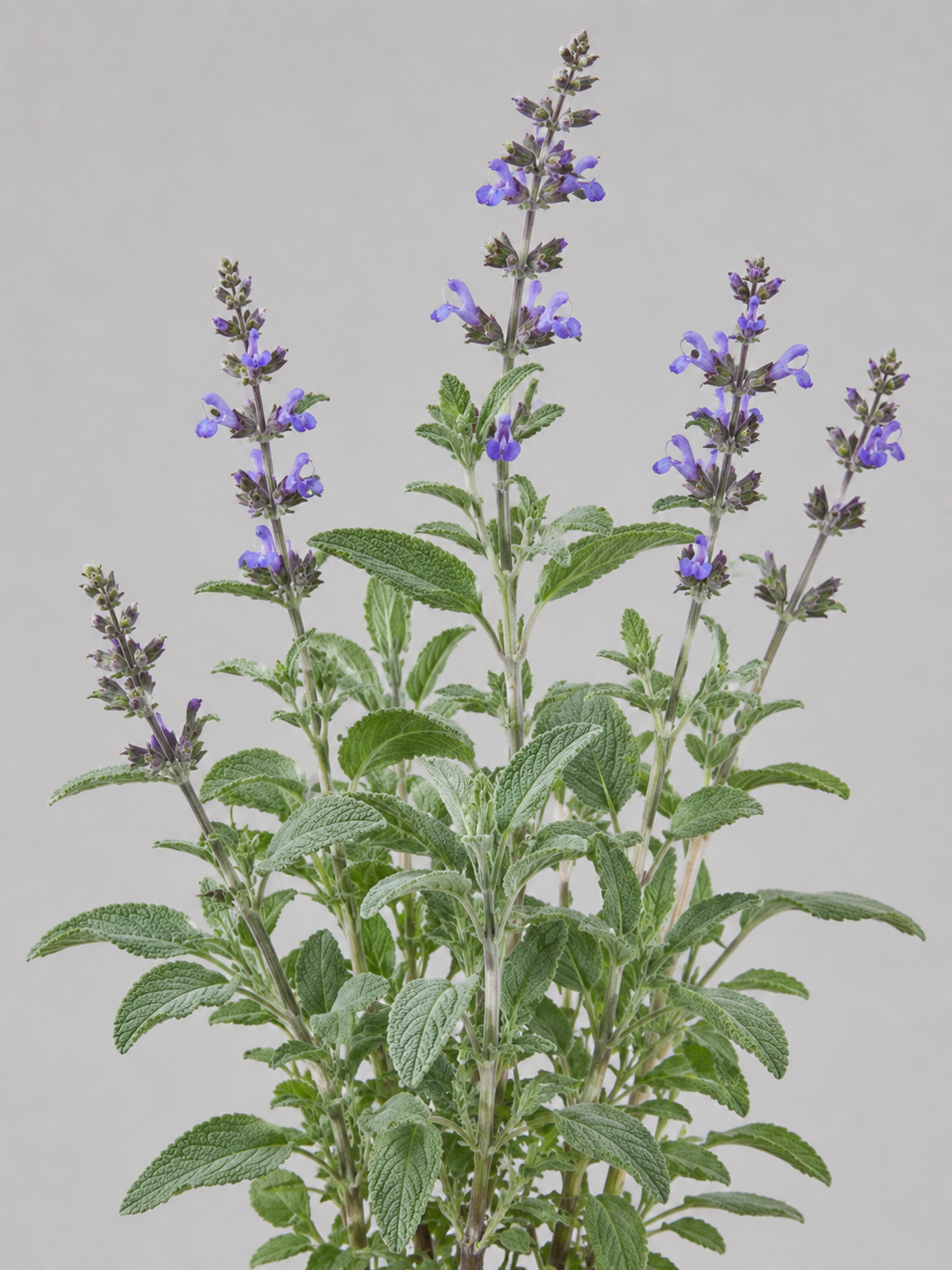
Common sage is recognized by opposite grey-green leaves with a wrinkled or pebbled surface, soft hairs, strongly aromatic oils, and stems that become woody with age. Purple to blue-violet flowers are borne in upright clusters and attract pollinators. Numerous culinary and ornamental cultivars differ in leaf color, size, and habit.
Nicholas Culpeper placed sage under Jupiter. His entry also preserves an early-modern connection between sage and memory, the senses, household medicine, and bodily strengthening. Those statements are historical records and should not be repeated as modern clinical conclusions.
Modern professional and governmental sources distinguish traditional use from clinical proof. The European Medicines Agency records sage leaf in therapeutic areas involving gastrointestinal complaints, mouth and throat disorders, and minor skin conditions. NCCIH notes that small studies have investigated cognition and blood lipids, but the evidence remains limited.
Within HRMTC ALKMY ™, sage is studied as a plant of preservation, clear speech, memory, cultivated authority, aromatic protection, and the responsibility to distinguish ordinary culinary use from concentrated supplementation.
In This Monograph
01
Botanical Identity and Authentication
The common name “sage” applies to many species in the genus Salvia and to unrelated plants outside the genus. This entry concerns common or garden sage, Salvia officinalis L., specifically.
Botanical Profile
- Common Name
- Sage, common sage, garden sage, culinary sage
- Accepted Botanical Name
- Salvia officinalis
- Botanical Authority
- L.
- Plant Family
- Lamiaceae
- Growth Form
- Aromatic evergreen or semi-evergreen subshrub
- Parts Used
- Primarily the leaves
- Plant Condition
- Fresh or dried
- Taxonomic Warning
- Do not substitute other culinary, ornamental, ceremonial, or wild sages without species-specific review
Geographic Profile
- Native Range
- Southwestern Germany through southern Europe.
- Introduced Range
- Widely cultivated and naturalized in temperate regions.
- Preferred Habitat
- Dry, open, sunny, rocky, or scrub-like habitats; cultivated plants prefer good drainage.
- Climate
- Temperate, with particular affinity for warm, relatively dry growing conditions.
- Soil Preference
- Well-drained soil; prolonged waterlogging can damage established plants.
Harvest Profile
Harvest Season
Leaf material is commonly gathered during active growth. Timing should match the intended culinary, professional, or manufacturing specification.
Harvest Stage
Pre-flowering, flowering, and late-season leaves may differ in aroma and volatile composition. Record the stage when it is known.
Collection Conditions
Use authenticated, uncontaminated material from a documented cultivated or responsibly managed source.
Identification
General Appearance
A compact, branching subshrub that commonly reaches approximately one to three feet and becomes woody with age.
Leaves
Opposite, oblong to narrowly ovate, grey-green, strongly veined, wrinkled or pebbled, and softly hairy.
Stems
Young stems show the square profile typical of the mint family; older stems become woody.
Aroma
Strong, penetrating, resinous, warm, camphoraceous, and unmistakably aromatic when the leaf is rubbed.
Flowers
Two-lipped flowers, commonly blue-violet to purple, arranged in upright whorled clusters and attractive to bees.
Fruit
The fruit divides into four small nutlets, consistent with Lamiaceae morphology.
Root and Persistence
A perennial root system supports repeated seasonal growth; woody crowns may become less productive with age.
Taste
Strongly aromatic, bitter, warming, and astringent. Taste should not be used as a field-identification method.
Commonly Confused Material
Spanish sage, clary sage, white sage, meadow sage, ornamental salvias, and products identified only by the common name “sage.” Each may differ substantially in chemistry, traditional use, conservation status, and safety.
Known Substitution Risk
Commercial products may use different Salvia species or blends. Record the botanical name, plant part, extract ratio when available, solvent, lot number, country of origin, and supplier documentation.
02
Ethical Sourcing and Conservation
Common sage is widely cultivated, making traceable cultivated leaf the preferred source for supplements, culinary products, and publication work. Widespread sale does not remove the need for botanical verification, clean cultivation, testing, and transparent origin records.
Preferred Source
Authenticated cultivated Salvia officinalis leaf from a documented grower or supplier.
Primary Sourcing Risks
Species substitution, undeclared blends, pesticide residue, poor storage, excessive volatile loss, and confusion with culturally distinct sages.
Harvest Considerations
Leaf harvest can be renewable when plants are not stripped excessively and enough growth remains to maintain plant health and flowering.
Cultural Considerations
Common European culinary sage should not be presented as interchangeable with white sage or with Indigenous ceremonial plants and practices.
03
Hermetic Correspondences
- Primary Planetary Ruler
- Jupiter
- Historical Source
- Nicholas Culpeper
- Element
- Air in common modern systems; Earth also appears
- Metal
- Tin by Jupiterian correspondence
- Physiological Sphere
- Historically associated with strengthening, digestion, throat, memory, and the senses
- Symbolic Sphere
- Wisdom, preservation, counsel, memory, authority, speech, longevity, and discernment
Sources and Classification
[Historically Documented] Culpeper writes that Jupiter claims sage. His entry preserves historical claims concerning the liver, blood, wounds, mouth and throat, memory, and the senses. These are evidence of an early-modern correspondence system, not proof of modern medical effectiveness.
[Common in Later Western Herbalism] Sage is frequently associated with wisdom, household protection, preservation, counsel, longevity, and clear speech.
[Modern Hermetic Interpretation] Air is used here to emphasize aroma, voice, communication, thought, memory, and the rapid movement of volatile fragrance. Earth is a reasonable secondary reading through the plant’s woody persistence, dryness, domestic cultivation, and conserving character.
Correspondence Rationale
Jupiterian symbolism appears through abundance of use, cultivated authority, preservation, counsel, and the herb’s historical reputation as a broad household strengthening plant. The grey-green leaf, powerful fragrance, drying astringency, and long culinary record support a symbolic reading of mature discernment rather than uncontrolled expansion.
Conflicting Attributions
Some modern systems assign sage to Mercury because of memory, cognition, speech, and Air. Others assign solar qualities through warmth, vitality, and purification. These are later interpretive systems and should not displace Culpeper’s explicitly documented Jupiterian attribution.
04
The Tria Prima
This section interprets the plant through Sulfur, Mercury, and Salt without publishing laboratory procedures or spagyric preparation methods.
SULFUR
Soul
Philosophical Expression: Aromatic identity, warmth, bitterness, preserving intensity, authority, and the force by which sage remains recognizable in food, smoke, and dried leaf.
Material Expression: Volatile oil containing variable proportions of thujones, camphor, 1,8-cineole, and related aromatic constituents.
Interpretation: Sage’s Sulfur is concentrated and commanding. Its usefulness and its caution arise from the same aromatic intensity.
MERCURY
Spirit
Philosophical Expression: Communication, voice, cognition, memory, transmission, scent, and movement between household practice and written tradition.
Material Expression: Rapidly dispersed aromatic compounds and preparation-dependent movement of water- and alcohol-soluble constituents.
Interpretation: Mercury appears in the leaf’s fragrance and in sage’s long symbolic relationship with speech, memory, counsel, and the senses.
SALT
Body
Philosophical Expression: Structure, preservation, dry boundary, mature form, domestic continuity, and the memory held in repeated cultivation.
Material Expression: Woody stems, fibrous leaf tissue, mineral ash, tannins, and less-volatile phenolic compounds.
Interpretation: Salt is visible in the plant’s conserving, drying, astringent, and increasingly woody character.
05
Doctrine of Signatures
Doctrine-of-signatures material is presented as historical and symbolic interpretation. It is not independent evidence of medical effectiveness.
Interpretive Meaning
[Modern Symbolic Interpretation] The grey-green leaf suggests age, restraint, maturity, and preserved knowledge. Its deeply marked surface resembles a written or weathered record. The movement from green square stems into woody branches suggests knowledge becoming embodied through repetition and time.
The plant’s strong aroma may be read as a signature of clear declaration: sage does not disappear into a preparation unnoticed. Its drying and astringent sensory character supports symbolic associations with boundaries, conservation, discernment, and the removal of excess.
06
Botanical and Chemical Profile
Major Constituent Groups
- Volatile oils
- Monoterpenes and oxygenated monoterpenes
- Phenolic acids, including rosmarinic acid
- Diterpenes, including carnosic-acid-related compounds
- Flavonoids
- Tannins
- Triterpenes
- Bitter principles
Volatile Profile
Commonly reported volatile constituents include α-thujone, β-thujone, camphor, and 1,8-cineole. Proportions vary according to cultivar, geography, plant part, harvest stage, drying, storage, and extraction method.
Potentially Concerning Constituents
Thujone is the principal safety concern in concentrated or prolonged use. A product’s total risk cannot be inferred from the plant name alone because preparation and concentration matter.
Water-Soluble Emphasis
Infusions emphasize water-soluble phenolics and tannins while capturing only part of the volatile fraction.
Alcohol-Soluble Emphasis
Liquid extracts may capture a different balance of aromatic and phenolic constituents depending on solvent strength and extraction ratio.
Known Variability
Sage chemistry varies by subspecies, cultivar, chemotype, geography, climate, soil, leaf age, harvest timing, drying temperature, storage, and extraction. Whole culinary leaf, tea, tincture, capsule, standardized extract, mouth rinse, and essential oil must not be treated as chemically identical.
Chemical literature reviewed through: August 2026.
07
Traditional and Contemporary Virtues
Traditional Actions
[Established Traditional Use / Authoritative Monograph] European professional monographs record traditional sage-leaf use in mild dyspeptic complaints, excessive sweating, inflammation of the mouth and throat, and minor skin inflammation.
[Historical Claim] Culpeper records sage for a wide range of internal and external uses and specifically associates it with memory, the senses, mouth and throat preparations, and bodily strengthening. These claims are preserved as historical documentation rather than presented as current treatment advice.
Contemporary Herbal Context
Contemporary products may be marketed for cognitive support, menopausal sweating or hot flashes, digestive comfort, oral and throat care, antioxidant support, or general wellness. Evidence and safety cannot be generalized across products because species, extract, dose, and combination ingredients differ.
Energetic Qualities
- System
- Later Western herbal interpretation
- Temperature
- Warming
- Moisture
- Drying
- Tonicity
- Toning and stimulating
- Movement
- Dispersing, clarifying, and consolidating
- Taste
- Aromatic, bitter, and astringent
Spiritual and Ritual Associations
[Historical and Modern Symbolic Use] Sage has been associated with wisdom, longevity, household protection, remembrance, purification, counsel, mourning, blessing, and the preservation of knowledge. The particular species and cultural context must always be named.
08
Evidence Classification
Small human studies have examined cognition, memory, lipids, glucose, sweating, and menopausal symptoms. Findings are not sufficient to establish broad or product-independent conclusions.
Laboratory and preclinical studies report antioxidant, antimicrobial, anti-inflammatory, cholinesterase-related, and other activities. Mechanistic findings do not by themselves prove clinical benefit.
The EMA has published a European Union herbal monograph and assessment material for Salvia officinalis leaf.
Long-standing European use is documented for digestive, perspiration, oral, throat, and minor topical contexts.
Culpeper and other historical herbals preserve claims concerning memory, senses, wounds, digestion, and household applications.
Jupiterian, elemental, Tria Prima, and symbolic readings belong to the interpretive archive and are not medical evidence.
09
Therapeutic and Preparation Context
Preparation Forms
Culinary Leaf
Fresh or dried leaf used in food. Culinary amounts should not be equated with concentrated supplemental dosing.
Infusion
Water preparation emphasizing water-soluble constituents and some aromatic fraction. Strength and duration still matter.
Liquid Extract
Alcohol-water extracts vary by ratio, solvent, plant part, and serving size. Follow the specific label and professional guidance.
Capsules
May contain powdered leaf, dry extract, standardized extract, or combinations. Milligram values are not interchangeable across formats.
Gargle or Rinse
Topical oral and throat preparations have a different route, exposure pattern, and purpose than swallowed supplements.
Essential Oil
A highly concentrated aromatic preparation requiring separate safety evaluation. It should not be swallowed or substituted for whole leaf.
When Additional Guidance Is Appropriate
Seek individualized guidance before supplemental use during pregnancy or lactation; in children; with seizure disorders; when using prescription medicines; when using products for persistent sweating, cognitive change, glucose or lipid concerns; or when selecting concentrated or multi-ingredient preparations.
10
Safety Profile
Food Use
Sage is likely safe in amounts commonly found in food.
High Dose or Prolonged Use
May be unsafe because common sage can contain thujone, which is toxic in sufficiently large amounts.
Pregnancy
Medicinal or supplemental use may be unsafe. Seek qualified medical guidance and do not rely on culinary familiarity as proof of safety.
Lactation
Safety information is limited. Professional guidance is appropriate before supplemental use.
Children and Adolescents
Use only according to an age-appropriate product label and qualified guidance. Do not extrapolate adult supplement use to children.
Seizure Risk
Concentrated thujone-containing products warrant particular caution in people with seizure disorders or other neurological risk factors.
Drug Interactions
Reliable interaction data are incomplete. Discuss supplemental sage with a healthcare professional when using medicines or other concentrated botanicals.
Allergy
People sensitive to sage or other members of Lamiaceae may experience allergic reactions.
Digestive Effects
Concentrated products may cause adverse effects not encountered with ordinary culinary use.
Essential Oil
Do not ingest sage essential oil. Concentrated aromatic products require separate route-specific safety review.
Topical or Oral Rinse
Follow the exact product directions. A rinse intended to be spat out is not an internal supplement.
Duration
Avoid assuming that a product appropriate for short-term use is appropriate indefinitely.
Regulatory and Editorial Note
Dietary supplements are not evaluated in the same way as approved medicines before sale in the United States. Review botanical identity, serving size, extract details, warnings, and all other ingredients. The presence of a Fullscript link does not certify that a product is suitable for a particular person or condition.
Safety literature reviewed through: August 2026.
11
Historical, Cultural, and Ritual Context
Historical Record
Sage has a long European record as a culinary, household, garden, and medicinal plant. The species name officinalis reflects its place within the historical medicinal storeroom and professional materia medica.
Culpeper’s seventeenth-century entry assigns sage to Jupiter and records its use in decoctions, gargles, external applications, and preparations connected with memory and the senses. These claims should remain situated within early-modern medicine.
Culinary and Domestic Context
Fresh and dried sage leaf has been used to season rich foods, breads, sauces, stuffing, meats, legumes, and preserved preparations. Its strong aroma and drying character allow a relatively small quantity to define an entire dish.
Ritual and Symbolic Context
European and later Western sources associate sage with wisdom, longevity, protection, remembrance, funerary symbolism, household blessing, purification, and the authority of elders or counselors.
Cultural Caution
Do not use the broad term “sage” to collapse common sage, white sage, desert sages, ornamental salvias, and Indigenous ceremonial traditions into one universal practice. Botanical and cultural precision are both forms of respect.
12
Symbolic Reading
Primary Symbolic Themes
- Wisdom
- Memory
- Preservation
- Discernment
- Clear speech
- Counsel
- Longevity
- Boundary
- Household protection
- Mature authority
- Purification
- Remembrance
Botanical Symbolism
The leaf appears old even when alive: grey-green, furred, wrinkled, and strongly veined. It therefore lends itself to symbolism of memory carried in the body, knowledge marked by use, and wisdom that becomes textured rather than ornamental.
Sage’s aroma is forceful, but its color is restrained. This balance supports a reading of authority without spectacle: a plant that announces itself through presence rather than brightness.
Hermetic Interpretation
[Hermetic Interpretation] Sage may be read as the preservation of Mercury within Salt: thought, speech, and aromatic movement held inside a dry, durable, cultivated body. Jupiter gives breadth, counsel, and authority; the leaf’s astringency imposes limit and judgment upon that expansion.
Shadow or Counter-Reading
Wisdom can harden into certainty. Preservation can become stagnation. Purification can become obsession, exclusion, or cultural appropriation. Strong aroma can become overexposure, and a familiar kitchen herb can be mistaken for a harmless supplement at every dose.
13
Study Questions
- Why is the common name “sage” insufficient for botanical authentication?
- Which features help distinguish Salvia officinalis from other salvias?
- What makes Culpeper’s Jupiter attribution historically important?
- How does the plant’s grey, wrinkled leaf contribute to later wisdom and memory symbolism?
- Which uses belong to authoritative traditional-use monographs, and which remain historical claims?
- Why can culinary sage not be used as a safety model for concentrated extracts or essential oil?
- How do Sulfur, Mercury, and Salt appear in the plant without revealing laboratory methods?
- What does thujone change about the editorial treatment of sage supplements?
- Why should common sage not be conflated with white sage or Indigenous ceremonial practice?
- What does sage teach about the relationship between preserved knowledge and responsible limits?
15
References and Source Record
Botanical References
Professional and Governmental Sources
Clinical, Chemical, and Safety Reviews
Historical and Correspondence Sources
Product Resource
- Herb Pharm — Sage liquid extract, linked through Fullscript.
Archive Notes
Sage demonstrates the editorial challenge presented by familiar plants. Its culinary use may feel ordinary, while its concentrated chemistry, species diversity, historical authority, ritual symbolism, and modern supplement market demand exact distinctions.
The archive preserves sage not as a universal answer, but as a lesson in mature judgment: identify the plant, identify the preparation, identify the source, preserve the history, and respect the limit.
Revealed in Practice.