
HERBARIUM / ADVANCED PLANT MONOGRAPH
Stinging Nettle
Urtica dioica L.
A vigorous perennial herb of contact, boundary, nourishment, defense, circulation, seasonal renewal, and the disciplined transformation of a stinging plant into food, fiber, and traditional materia.
MONOGRAPH PROFILE
Quick Reference
- Botanical Name
- Urtica dioica
- Botanical Authority
- L.
- Plant Family
- Urticaceae
- Primary Planetary Ruler
- Mars in Culpeper’s system
- Alternative Attributions
- Saturn and Venus appear in some later symbolic systems; not historically standardized
- Element
- Fire in common later Western correspondence; Earth may also be assigned
- Metal
- Iron through Martial correspondence
- Tria Prima Emphasis
- Sulfur / Salt
- Parts Used
- Leaf and flowering aerial herb in this entry; root and seed require separate treatment
- Plant Condition
- Fresh or dried, depending on preparation
- Primary Preparations Discussed
- Infusion, liquid extract, dried leaf, powder, capsule, food, and topical or historical preparations
- Safety Classification
- Significant Caution
- Primary Safety Concern
- Contact urticaria, allergy, fluid-management restrictions, pregnancy/lactation uncertainty, and preparation-specific use
- Conservation / Sourcing
- Generally widespread; regional subspecies, habitat, contamination, and harvesting ethics require attention
ENTRY SUMMARY
Stinging Nettle at a Glance
Stinging nettle, Urtica dioica L., is a perennial or rhizomatous geophyte in the Urticaceae family. Plants of the World Online accepts the species name and records an Old World native range extending from Europe through Siberia and western China, with northwestern Africa also included. North American taxonomic treatments recognize native and introduced infraspecific forms within the broader U. dioica complex, making regional identification more complicated than the species-level range alone suggests.
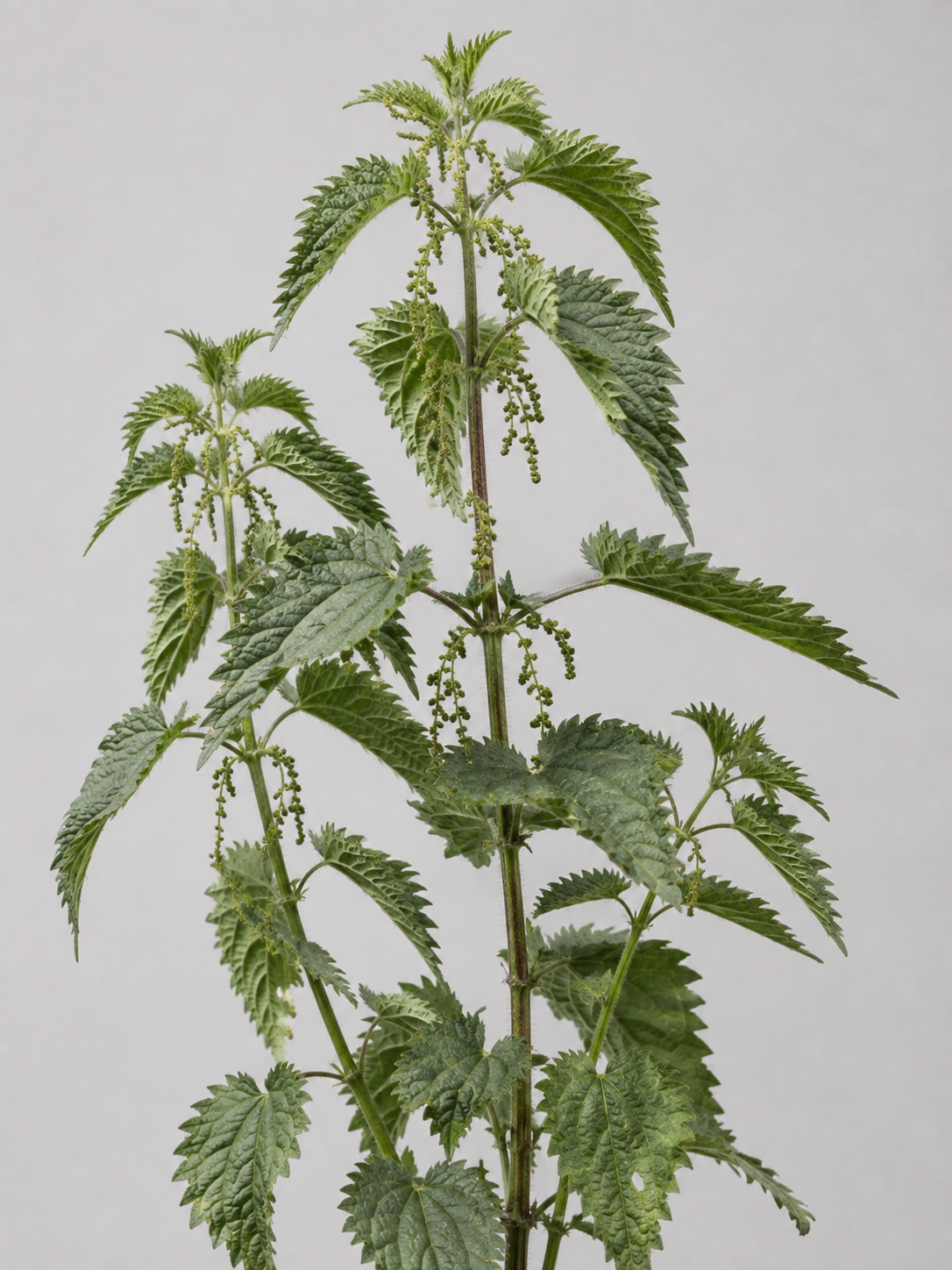
The plant is recognized by erect stems, opposite coarsely serrated leaves, greenish flowers in drooping or spreading axillary clusters, persistent rhizomes, and specialized stinging hairs on much of the above-ground growth. It commonly favors rich, moist soils along streams, ditches, meadows, woodland openings, waste ground, and disturbed habitats, where it may form extensive colonies.
Nicholas Culpeper assigned nettles to Mars and interpreted their heat, dryness, sting, and spring emergence through his early-modern astrological-medical framework. That Martial attribution is historically documented. Modern elemental, mineral, and psychological readings are classified separately as later Hermetic interpretation.
The European Medicines Agency’s revised nettle-herb monograph recognizes traditional-use preparations for minor urinary complaints alongside sufficient fluid intake, minor articular pain, and seborrhoeic skin conditions. These are traditional-use conclusions based on long-standing use, not broad proof that every nettle supplement is clinically effective for every promoted purpose.
Within HRMTC ALKMY ™, stinging nettle is studied as a plant of guarded nourishment: a mineral-rich green protected by immediate contact, a persistent rhizome beneath vigorous growth, and a material whose safe handling changes with drying, cooking, extraction, and concentration.
In This Monograph
01
Botanical Identity and Authentication
This entry concerns Urtica dioica L. leaf and flowering aerial herb. Nettle root, nettle seed, short nettle, wood nettle, false nettle, and multi-species products should not be silently treated as equivalent.
Botanical Profile
- Common Name
- Stinging nettle, common nettle
- Accepted Botanical Name
- Urtica dioica
- Botanical Authority
- L.
- Plant Family
- Urticaceae
- Growth Form
- Erect rhizomatous herbaceous perennial
- Other Common Names
- Nettle, burn nettle, European stinging nettle; regional names vary
- Parts Used
- Leaf and flowering aerial herb in this monograph
- Plant Condition
- Fresh or dried, with handling and chemistry changing by condition
Geographic Profile
- Kew-Recorded Native Range
- Europe to Siberia and western China, with northwestern Africa included.
- North American Context
- Regional treatments recognize native and introduced subspecies or closely related infraspecific forms within the U. dioica complex.
- Preferred Habitat
- Moist rich soils, streambanks, ditches, meadows, woodland openings, waste ground, riparian sites, and disturbed areas.
- Climate
- Primarily temperate; growth is vigorous where moisture and soil fertility are sufficient.
- Growth Character
- Spreads by seed and rhizomes and may form dense clonal patches.
Harvest Profile
Harvest Season
Young leaves and aerial growth are traditionally gathered before or around flowering depending on the intended food, tea, extract, or professional monograph specification.
Harvest Stage
Record whether material is young leaf, mature leaf, flowering aerial herb, root, seed, or another part. Products and references using different parts are not interchangeable.
Collection Conditions
Wear protective gloves. Use authenticated material gathered legally and away from roads, sprayed ground, sewage, animal waste, industrial contamination, and polluted waterways.
Identification
General Appearance
An erect perennial that commonly reaches approximately one to two meters and forms colonies through shallow and deeper rhizomes.
Leaves
Opposite, petiolate, egg-shaped to lance-shaped, with a rounded or heart-shaped base, sharply pointed tip, and coarse serrations.
Stems
Upright and often four-angled, bearing both ordinary hairs and specialized stinging hairs depending on subspecies and plant part.
Stinging Hairs
Brittle trichomes act as minute piercing structures that produce mechanical and chemical irritation when touched.
Flowers
Small greenish flowers occur in loose to dense clusters arising from the leaf axils. Plants may bear male and female flowers on separate plants or show regional variation.
Fruit
A small dry one-seeded achene.
Roots and Rhizomes
Rhizomes spread horizontally and allow the plant to persist, regenerate, and form dense patches.
Aroma and Taste
The dried leaf is green, vegetal, mildly bitter, and mineral-like. Taste should not be used as a field-identification method.
Commonly Confused Material
False nettle (Boehmeria cylindrica) lacks stinging hairs; wood nettle (Laportea canadensis) has a different leaf arrangement and growth pattern; dead-nettles (Lamium species) do not sting and have showier bilabiate flowers; short or burning nettle (Urtica urens) is a separate species used in some professional monographs.
Commercial Identity Risk
Products may contain leaf, whole aerial herb, root, seed, juice, powder, tincture, dry extract, or combination formulas. Record the complete botanical name, plant part, extraction ratio, solvent, standardization when supplied, lot number, and all additional ingredients.
02
Ethical Sourcing and Conservation
Stinging nettle is widespread and often abundant, but abundance does not remove the need for ethical sourcing. Riparian habitat, regional subspecies, wildlife use, contamination risk, harvesting pressure, and landowner permission remain relevant.
- Wildcrafted or Cultivated
- Both; cultivated material offers stronger traceability for supplements
- Global Conservation Concern
- No broad global scarcity concern identified in the cited botanical sources
- Primary Sourcing Concern
- Identity, contamination, habitat disturbance, regional taxonomy, and legal collection
- Regeneration
- Rhizomes permit vigorous regrowth, but repeated removal can still disturb soil and associated habitat
Sustainable Harvesting Considerations
Harvest selectively from robust populations and leave sufficient growth for flowering, seed production, insects, and continued stand health. Avoid uprooting rhizomes when leaf or aerial herb is the intended material. Do not assume that an abundant roadside patch is suitable for food or medicine.
Ecological Relationships
Nettles provide cover and habitat and may serve as host plants for butterfly larvae and other insects. Dense stands can also behave as weeds in managed landscapes. Ethical practice requires reading the local ecology rather than treating the plant as either universally beneficial or universally invasive.
Cultural and Regional Considerations
Nettle has distinct food, fiber, medicinal, and ceremonial histories across Europe, Asia, and numerous Indigenous North American communities. Document uses by named people, region, source, and taxon. Do not collapse separate traditions into a generic claim.
03
Hermetic Correspondences
- Primary Planetary Ruler
- Mars
- Element
- Fire in common later Western correspondence
- Metal
- Iron through Martial correspondence
- Alternative Attributions
- Earth, Saturn, or Venus appear in some later systems
- Physiological Sphere
- Contact, circulation, elimination, tone, and boundary in traditional symbolic language
- Psychological / Spiritual Sphere
- Defense, vitality, courage, honest contact, resilience, and disciplined limits
Historically Documented Attribution
[Historically Documented] Nicholas Culpeper identifies nettles as an herb claimed by Mars and interprets their hot, dry, stinging, and springtime character through that planetary system.
Later Elemental and Metal Attributions
[Common in Later Western Herbalism / Modern Hermetic Interpretation] Fire follows naturally from sting, heat, irritation, vigorous emergence, and Martial rulership. Iron is assigned through the conventional planetary-metal correspondence with Mars, not because the plant’s measured mineral content alone proves an occult attribution.
Correspondence Rationale
The sting creates immediate boundary awareness. The plant’s rapid spring emergence, upright growth, vigorous rhizomes, and ability to occupy rich disturbed ground reinforce themes of force, defense, vitality, and persistence. Its transformation from painful fresh plant into cooked green, fiber, tea, or extract introduces a second theme: disciplined preparation converts guarded material into useful form.
Conflicting Attributions
Some modern writers emphasize Earth because of mineral content, food value, and rhizomatous persistence; Saturn may appear through austerity, boundary, and fiber; Venus may appear through nourishment or fertility symbolism. These later systems should not erase the historically documented Martial attribution.
04
The Tria Prima
This section distinguishes philosophical interpretation from observable material characteristics. It does not disclose laboratory or spagyric procedures.
SULFUR
Soul
Philosophical Expression
Sting, heat, irritation, vigorous identity, sharp boundary, and immediate response.
Material Expression
Stinging trichomes, volatile and lipid-soluble fractions, pigments, and bioactive constituents associated with the living aerial plant.
Interpretation
[Hermetic Interpretation] Sulfur is visible in nettle’s unmistakable contact: the plant announces itself before it is possessed.
MERCURY
Spirit
Philosophical Expression
Movement, circulation, transmission, rapid sensation, spring ascent, and exchange through water.
Material Expression
Water-soluble fractions, expressed juice, liquid extracts, and the mobility implied by traditional urinary-flushing preparations.
Interpretation
[Hermetic Interpretation] Mercury appears in the movement from root to shoot, skin contact to sensation, and plant material into aqueous or hydroalcoholic form.
SALT
Body
Philosophical Expression
Mineral body, fiber, structure, persistence, boundary, nourishment, and memory in the rhizome.
Material Expression
Ash, minerals, chlorophyll-rich tissue, protein, fiber, fixed residue, and resilient underground growth.
Interpretation
[Hermetic Interpretation] Salt is unusually visible in nettle’s reputation as a nutritive green and textile fiber and in its capacity to return from persistent rhizomes.
05
Doctrine of Signatures
Doctrine-of-signatures material is historical or symbolic interpretation. It is not independent evidence of medical effectiveness.
- Growth Habitat
- Rich, moist, disturbed, riparian, and edge environments
- Growth Pattern
- Upright, colonial, and rhizomatous
- Leaf Form
- Opposite, pointed, and sharply serrated
- Surface
- Guarded by ordinary and stinging hairs
- Color
- Deep green aerial growth; pale greenish flowers
- Texture
- Soft-looking yet capable of painful contact
- Seasonal Cycle
- Strong spring emergence followed by tall summer growth
- Ecological Pattern
- Forms boundaries, patches, and dense stands
Interpretive Meaning
[Modern Symbolic Interpretation] The pointed, toothed leaf and stinging surface create an obvious signature of defense and discernment. The plant appears lush and nourishing, yet demands correct contact. Its form teaches that abundance does not cancel boundary.
The rhizome suggests continuity beneath injury. Cutting the visible stems does not necessarily end the stand; the hidden body preserves the pattern and returns.
Historical and Folk Associations
Nettle has been associated with spring renewal, courage, protection, purification, textile strength, household economy, and the painful activation of circulation through the historical practice of urtication. Such material belongs to history and folklore, not modern treatment advice.
06
Botanical and Chemical Profile
Major Constituent Groups
- Flavonoids and flavonoid glycosides
- Phenolic acids
- Chlorophylls and carotenoids
- Minerals and ash
- Proteins and amino acids
- Polysaccharides and fiber
- Organic acids
- Sterols and lipid-soluble constituents
- Lectins and other proteins in selected plant parts
- Stinging-hair mediators and irritants
Plant-Part Distinction
Leaf / Aerial Herb
Contains chlorophyll-rich tissue, minerals, flavonoids, phenolic compounds, protein, fiber, and constituents represented in food, tea, powder, juice, and extract preparations.
Root
Has a distinct chemical and professional-monograph profile and is commonly discussed in urinary and prostate contexts. Root evidence must not be transferred automatically to leaf products.
Stinging Hairs
Deliver mechanical and chemical irritation. Reported mediators include histamine, acetylcholine, serotonin, and other irritant compounds, with composition and interpretation varying among studies.
Solubility and Preparation Considerations
- Water-Soluble Fractions
- Many minerals, polysaccharides, selected phenolics, and other polar constituents
- Alcohol-Soluble Fractions
- Selected phenolics, pigments, sterols, and less-polar constituents depending on solvent strength
- Heat Effects
- Cooking and drying alter enzymes, texture, sensory qualities, and the practical sting; heat-sensitive constituents may be reduced
- Powdered Material
- Visual authentication is limited once the leaf is milled
- Liquid Extracts
- Composition depends on plant part, ratio, solvent, alcohol percentage, and manufacturing process
- Capsules
- May contain powdered leaf, dry extract, blends, excipients, or standardized material
Known Variability
Composition varies with subspecies, plant part, sex of the plant, geography, soil fertility, harvest stage, season, fresh or dried condition, processing, storage, extraction solvent, and product specification. Food, tea, tincture, expressed juice, dry extract, root product, and seed product should not be treated as equivalent.
Chemical literature reviewed through: August 2026.
07
Traditional and Contemporary Virtues
This section documents traditions and contemporary practice without converting them into guarantees of efficacy.
Traditional Actions
ESTABLISHED TRADITIONAL USE European professional monographs recognize nettle herb preparations for minor urinary complaints alongside sufficient fluid intake, minor articular pain, and seborrhoeic skin conditions.
HISTORICAL CLAIM Early-modern European herbals record spring food use and a wide range of respiratory, urinary, bleeding, reproductive, and topical claims that should not be repeated as modern treatment instructions.
CULINARY TRADITION Properly prepared young nettle has long been eaten as a cooked green, soup ingredient, infusion, or seasonal food in multiple regions.
MATERIAL TRADITION Nettle fiber has been used for cordage, nets, cloth, and household materials.
Contemporary Herbal Actions
Modern herbal practice commonly describes nettle leaf as nutritive, mineral-rich, mildly diuretic, supportive of seasonal comfort, and useful in musculoskeletal or skin contexts. The strength of evidence differs by preparation and claim. Seasonal-allergy marketing, for example, should not be presented as established simply because nettle leaf is widely sold for that purpose.
Energetic Qualities
- System
- Later Western herbal interpretation
- Temperature
- Often described as cooling as prepared leaf, while the fresh sting is experienced as hot and irritating
- Moisture
- Drying or neutral depending on preparation and framework
- Tonicity
- Toning and nutritive
- Movement
- Circulating, eliminating, and consolidating
- Taste
- Green, mineral, mildly bitter, and slightly salty
Psychological and Spiritual Associations
[Modern Hermetic Interpretation] Stinging nettle is associated with courage, directness, self-protection, resilience, anger made conscious, and the capacity to receive nourishment without abandoning discernment.
08
Evidence Classification
European Nettle Herb Monograph
The revised European Union monograph classifies nettle-herb indications as traditional use based on long-standing use. It does not list a well-established-use indication.
Minor Urinary Complaints
Recognized only alongside sufficient fluid intake and with specific warnings for fluid-restricted patients and urinary red flags.
Minor Articular Pain
Recognized as a traditional-use context. Swelling, redness, fever, or persistent pain requires medical assessment.
Seborrhoeic Skin Conditions
Recognized for specified powdered-herb preparations in the EMA monograph, not for every tea, tincture, or capsule.
Preclinical Research
Extract and constituent studies report anti-inflammatory, antioxidant, metabolic, and other biological activity. Preclinical activity does not establish clinical benefit from ordinary retail products.
Broader Modern Claims
Evidence for seasonal allergy, blood-sugar, blood-pressure, “detox,” anemia, or generalized immune claims is preparation-specific, limited, inconsistent, or insufficient for broad conclusions.
09
Therapeutic and Preparation Context
Traditional and Professional-Monograph Contexts
- Minor urinary complaints with adequate fluid intake
- Minor articular pain
- Seborrhoeic skin conditions for specified preparations
- Seasonal food and nutritive use
- Historical topical, fiber, and household use
Preparation Forms
Infusion
Usually prepared from dried leaf or aerial herb. Composition depends on cut size, amount, steeping conditions, and material identity.
Liquid Extract
May use fresh or dried aerial herb and varying water-alcohol ratios. Review the plant part, extraction ratio, solvent, serving size, and alcohol content.
Capsule or Powder
May contain powdered nettle leaf, dry extract, or a blend. Milling removes many visual authentication cues.
Food
Young leaves are traditionally cooked or otherwise prepared to reduce practical stinging risk. Culinary use is not equivalent to concentrated supplementation.
Topical / Hair Product
May contain powdered herb, aqueous extract, alcohol extract, or multi-ingredient cosmetic material. Skin tolerance and intended route matter.
Root or Seed Product
Requires a separate monograph. Root and seed chemistry, evidence, indications, and dosing cannot be inferred from leaf information.
When Additional Guidance Is Appropriate
Seek individualized guidance before supplemental use during pregnancy or lactation; in children; with kidney, heart, urinary, fluid-balance, or edema concerns; when a clinician has restricted fluid intake; with recurrent allergy or urticaria; when taking prescription medicines; before surgery; or when symptoms are persistent, severe, unexplained, or worsening.
10
Safety Profile
Contact With Fresh Plant
Stinging hairs may cause burning, itching, redness, wheals, and contact urticaria. Wear gloves and avoid eyes, face, mucous membranes, and broken skin.
Contraindications
Hypersensitivity to nettle or the active preparation is a formal contraindication in the EMA monograph.
Fluid Restriction
Urinary-use preparations require adequate fluid intake and are not recommended when a medical condition requires reduced fluid intake.
Urinary Red Flags
Fever, painful urination, urinary spasm, blood in the urine, worsening symptoms, or symptoms persisting beyond the monograph’s stated interval require professional evaluation.
Pregnancy
Safety has not been established. The current European Union monograph does not recommend use during pregnancy.
Lactation
Safety has not been established. The current European Union monograph does not recommend use during lactation.
Children and Adolescents
Age restrictions vary by preparation and indication. Some preparations are not recommended below age 12, while others are not recommended below age 18.
Adverse Effects
The EMA monograph lists nausea, vomiting, diarrhea, allergic itching, rash, and urticaria with unknown frequency.
Drug Interactions
The EMA monograph reports none. This does not prove absence of interaction for every retail product, dose, combination, or medically complex patient.
Joint Symptoms
Articular pain with joint swelling, redness, or fever should be examined by a clinician.
Ethanol-Containing Extracts
Liquid extracts and tinctures may contain alcohol. Review alcohol percentage, serving amount, age restrictions, pregnancy status, liver concerns, and medication context.
Surgery and Chronic Disease
Disclose supplement use before surgery and seek professional review when managing kidney, heart, blood-pressure, glucose, edema, or fluid-balance conditions.
Regulatory and Product Notes
Dietary supplements are not evaluated in the same way as approved medicines before sale in the United States. Review the complete ingredient list, botanical name, plant part, extract ratio, solvent, warnings, serving size, allergens, excipients, and manufacturer information. A Fullscript link does not certify suitability for a particular person or condition.
Safety literature reviewed through: August 2026.
11
Historical, Cultural, and Ritual Context
Historical Record
Nettle appears in European foodways, domestic medicine, textile history, seasonal practice, and agricultural life. Culpeper’s entry identifies nettle with Mars and interprets spring nettle tops through the hot-and-dry logic of early-modern medicine.
Food and Famine Context
Properly prepared young nettles have been eaten as greens, soup, pottage, tea, and seasonal food. Historical food use includes ordinary nourishment as well as periods of scarcity. Culinary history should not be used to imply that every raw or concentrated preparation is safe.
Fiber and Material Culture
Nettle bast fiber has been used for cordage, nets, thread, cloth, and household materials in multiple regions. The plant therefore belongs not only to herbal history but to technologies of binding, carrying, fishing, weaving, and survival.
Urtication and Ritualized Contact
Deliberate striking or rubbing with fresh nettles, commonly called urtication, appears in historical medical and folk contexts. It is included here as documentation, not as a recommendation. The practice can cause pain, skin injury, and allergic reaction.
Cultural Caution
Indigenous North American food, fiber, and medicinal uses should be documented by named nation, community, region, and taxon. Avoid presenting diverse traditions as one universal “Native American use.”
12
Symbolic Reading
Primary Symbolic Themes
- Boundary
- Defense
- Courage
- Vitality
- Contact
- Discernment
- Nourishment
- Transformation
- Persistence
- Purification
- Fiber and binding
- Hidden continuity
Botanical Symbolism
Stinging nettle places nourishment behind a living boundary. The green leaf is edible only after identification and appropriate preparation; the fiber is useful only after processing; the colony persists through a body hidden underground. Each gift is real, but none is available through careless contact.
The opposite leaves create paired order along the stem, while the serrated margins and stinging hairs establish a guarded perimeter. The plant’s architecture joins symmetry with defense.
Hermetic Interpretation
[Hermetic Interpretation] Nettle may be read as Mars disciplined by Salt. Mars gives sting, heat, vigor, and immediate boundary; Salt gives mineral body, fiber, persistence, and nourishment. Mercury mediates the preparation that converts guarded matter into another form.
Shadow or Counter-Reading
Defense can become hostility. Courage can become needless provocation. Purification can become obsession, and “natural vitality” can become an excuse to ignore contraindications. The deeper lesson is not to eliminate boundaries but to make them intelligent, proportionate, and capable of relationship.
13
Study Questions
- Why is the common name “nettle” insufficient for publication-grade authentication?
- How do opposite leaves help distinguish Urtica dioica from wood nettle?
- Why must leaf, aerial herb, root, seed, and stinging hairs be treated separately?
- What makes Culpeper’s Mars attribution historically significant?
- How does the plant combine defense with nourishment?
- Which EMA indications are classified as traditional use?
- Why is adequate fluid intake central to the urinary-use warning?
- How do cooking, drying, powdering, and extraction change practical risk and composition?
- What ecological questions arise when harvesting from riparian or dense wild stands?
- What does stinging nettle teach about the difference between a healthy boundary and aggression?
15
References and Source Record
Botanical References
- Royal Botanic Gardens, Kew — Plants of the World Online: Urtica dioica L.
- North Carolina State University Extension — Urtica dioica plant profile.
- U.S. Forest Service — Fire Effects Information System species review for Urtica dioica.
- Michigan State University — Stinging nettle identification profile.
Professional and Governmental Sources
Chemical, Pharmacological, and Safety Reviews
Historical and Correspondence Sources
Product Resources
- Wise Woman Herbals — Stinging Nettle Extract, linked through Fullscript.
- Gaia Herbs — Nettle Leaf capsules, linked through Fullscript.
Archive Notes
Stinging nettle carries a paradox that is only apparent from a distance: the plant protects nourishment with pain, preserves continuity beneath the ground, and yields different forms only through correct handling.
The archive therefore treats nettle as a lesson in intelligent contact. Identification comes before gathering, preparation before use, evidence before claim, and safety before symbolism. The sting is not the whole plant, but it is the boundary through which the whole plant must be approached.
Revealed in Practice.