
HERBARIUM / ADVANCED PLANT MONOGRAPH
Skullcap
Scutellaria lateriflora L.
A North American perennial of quieting, boundary, lateral flowering, guarded receptivity, and the disciplined distinction between American skullcap, Chinese skullcap, other Scutellaria species, and germander adulteration.
MONOGRAPH PROFILE
Quick Reference
- Botanical Name
- Scutellaria lateriflora
- Botanical Authority
- L.
- Plant Family
- Lamiaceae
- Primary Editorial Ruler
- Mercury — modern Hermetic interpretation
- Historical Attribution Status
- No premodern European planetary attribution is claimed in this monograph
- Element
- Air through nervous movement and communication; Water through moist habitat, quieting, and receptivity
- Metal
- Mercury / quicksilver within the modern correspondence used here
- Tria Prima Emphasis
- Mercury / Salt
- Primary Part Used
- Aerial parts or herb top
- Plant Condition
- Fresh or dried; Health Canada’s monograph specifies dry herb top
- Preparations Discussed
- Liquid extract, capsules, infusion, dry herb, and combination formulas
- Safety Classification
- Significant Caution
- Primary Safety Concerns
- Drowsiness, driving impairment, pregnancy and breastfeeding, adult-only regulatory context, rare liver injury reports, and species or germander adulteration
- Conservation / Sourcing
- Native from Canada through the United States; cultivated material with verified identity is strongly preferred
ENTRY SUMMARY
Skullcap at a Glance
American skullcap, Scutellaria lateriflora L., is an accepted perennial species in the Lamiaceae family. Plants of the World Online records its native range from Canada through the United States and places it primarily within the temperate biome.
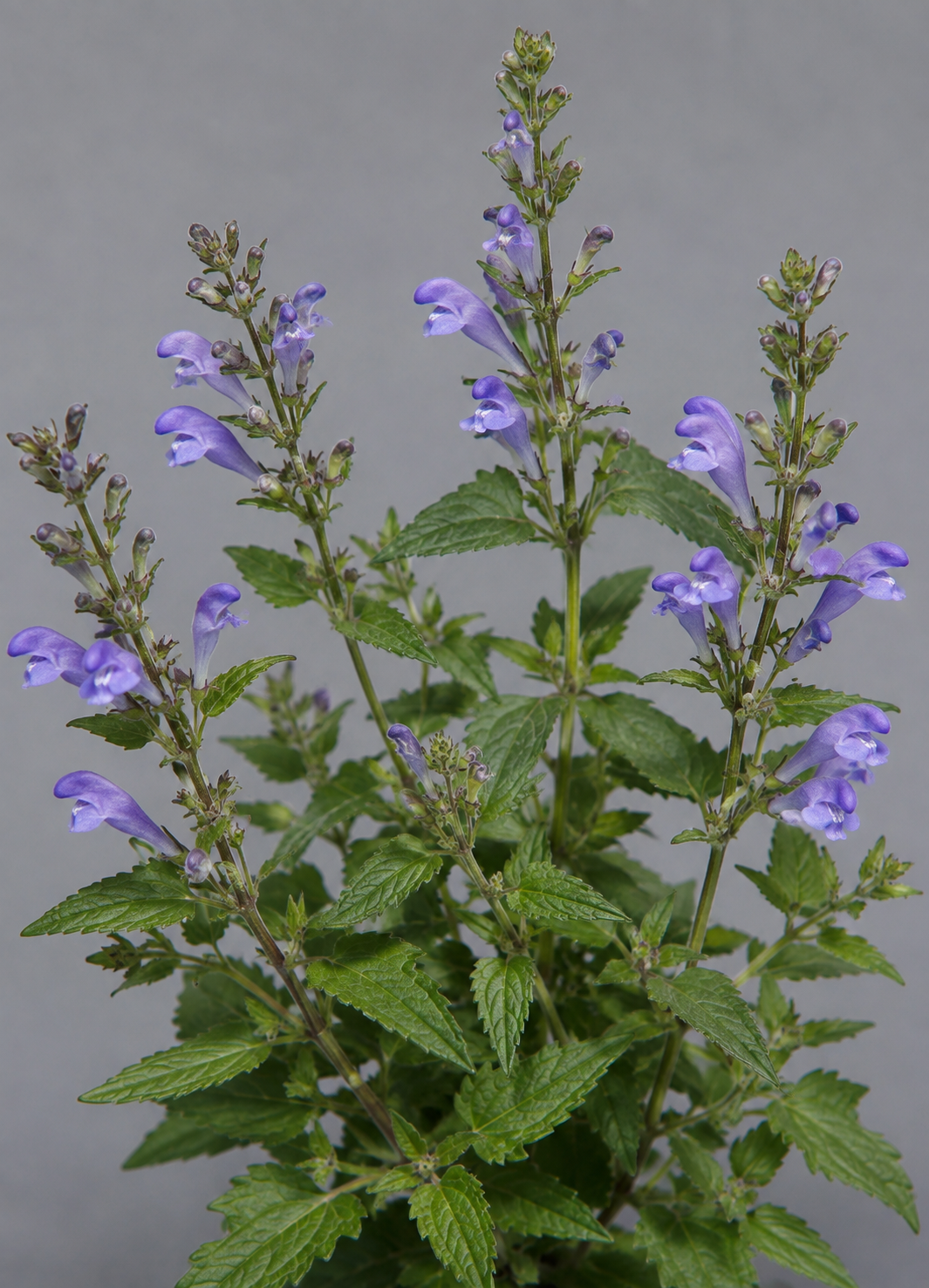
The plant typically grows in moist meadows, wetlands, stream margins, low woods, and similar habitats. It bears square stems, opposite leaves, and small blue-violet flowers arranged in lateral clusters. The distinctive raised appendage on the fruiting calyx resembles a small cap or helmet and gives the genus its name.
Health Canada’s 2024 natural-health-product monograph defines the medicinal source as dry herb top and permits adult traditional-use claims for relief of restlessness or nervousness that helps promote sleep and for menstrual pain. This is a regulatory traditional-use framework, not proof that skullcap treats anxiety disorders, insomnia, or gynecologic disease.
Human evidence remains limited. A small randomized crossover trial in healthy volunteers found no significant difference from placebo on its primary anxiety measure, although mood scores improved and important study limitations were acknowledged. Larger, replicated trials in clinically relevant populations are needed.
Authentication is central to this monograph. American Herbal Pharmacopoeia materials describe persistent confusion involving other Scutellaria species and the potentially hepatotoxic germander genus Teucrium. LiverTox records rare liver-injury reports associated with skullcap products but notes frequent use of multiple botanicals and cases of adulteration or mislabeling.
Because S. lateriflora is a North American species, this entry does not invent a Culpeper-era planetary attribution. Mercury is used as an explicitly modern Hermetic reading based on mediation, nervous movement, lateral branching, and the transition from agitation toward quiet.
In This Monograph
01
Botanical Identity and Authentication
This entry concerns American skullcap, Scutellaria lateriflora L. The unqualified common name “skullcap” may refer to hundreds of species in the genus or to commercial mixtures whose identity is uncertain.
Botanical Profile
- Common Names
- American skullcap, blue skullcap, mad-dog skullcap, Virginian skullcap, helmet flower
- Botanical Name
- Scutellaria lateriflora
- Botanical Authority
- L.
- Plant Family
- Lamiaceae
- Taxonomic Status
- Accepted species in Plants of the World Online
- Primary Medicinal Material
- Aerial parts or herb top
- Health Canada Source Material
- Dry herb top
- Excluded by Identity
- Chinese skullcap root, germander, and unidentified mixed skullcap species
Geographic Profile
- Native Range
- Canada through the United States according to Kew.
- Biome
- Temperate.
- Preferred Habitat
- Moist meadows, marsh edges, stream margins, low woods, thickets, and damp disturbed ground.
- Growth Form
- Rhizomatous or short-rooted herbaceous perennial with branching square stems.
- Ecological Relationships
- Flowers are visited by insects; moist-habitat populations may be vulnerable to drainage, trampling, and destructive harvest.
Harvest Profile
Plant Part
Harvest clean aerial growth according to the intended pharmacopoeial or supplier specification. Record whether stems, leaves, and flowering tops are included.
Harvest Stage
Commercial herb is commonly gathered near flowering, but developmental stage should be documented rather than assumed.
Collection Conditions
Avoid polluted waterways, sprayed sites, excessive wetland disturbance, mold, mixed species, and material collected before confident flowering-stage identification.
Identification
Stems
Slender, branching, square stems typical of the mint family, generally lacking the strongly aromatic character of many culinary Lamiaceae.
Leaves
Opposite, short-stalked leaves are ovate to lanceolate, often with shallow teeth and a somewhat pointed tip.
Growth Pattern
Flowers arise from the leaf axils and form one-sided or lateral raceme-like clusters, reflected in the epithet lateriflora.
Aroma
Weakly aromatic to nearly odorless compared with many mint-family herbs.
Flowers
Small blue to violet, tubular, two-lipped flowers with a hooded upper lip and broader lower lip.
Calyx
The calyx develops a distinctive shield- or cap-like projection that inspires the name skullcap.
Fruit
As in other Lamiaceae, the mature fruit separates into four small nutlets.
Taste
Mildly bitter and herbaceous. Taste cannot authenticate a powdered or extracted product.
Commonly Confused Species
S. galericulata, S. incana, S. baicalensis, and other skullcaps may enter commerce. Some may be chemically related, but they are not automatically interchangeable.
Germander Adulteration
Teucrium canadense, T. chamaedrys, and other germanders have historically adulterated skullcap. Germander is associated with serious hepatotoxicity. Require identity testing capable of distinguishing genera and species.
02
Ethical Sourcing and Conservation
- Wildcrafted or Cultivated
- Both; cultivated material is strongly preferred for identity and habitat protection
- Conservation Context
- Broad native distribution does not guarantee abundance at a particular wetland or local population
- Primary Sourcing Concern
- Wetland damage, species substitution, germander adulteration, pesticide residues, microbial contamination, and weak traceability
- Recommended Practice
- Use verified cultivated aerial herb with lot-specific testing
Habitat Protection
Moist meadows, stream margins, and wetlands are easily damaged by trampling, drainage, soil compaction, and indiscriminate collection. Avoid harvest from small or vulnerable populations.
Cultivation
Cultivation can provide authenticated seed or propagation stock, controlled agricultural inputs, known harvest stage, and reduced pressure on wild populations. Verify starter material because incorrect species may enter cultivation.
Supplier Documentation
Prefer suppliers that provide botanical name, plant part, country and region of origin, cultivated or wild status, harvest date, extraction details, lot number, and testing for identity, germander adulteration, microbes, pesticides, heavy metals, and other contaminants.
03
Hermetic Correspondences
- Primary Editorial Ruler
- Mercury — modern interpretation
- Historical Attribution Status
- No premodern European planetary claim is made for this North American species
- Primary Elemental Reading
- Air through nervous movement, thought, mediation, and lateral branching
- Secondary Elemental Reading
- Water through moist habitat, quiet receptivity, and emotional settling
- Metal
- Mercury / quicksilver within the modern correspondence system
- Symbolic Sphere
- Quieting, mediation, boundary, lateral attention, containment, sleep threshold, and release of excess vigilance
Editorial Method
Modern Hermetic Interpretation This entry does not assign a false Culpeperian ruler. Mercury is selected transparently as a contemporary correspondence based on nervous-system tradition, mediation between agitation and quiet, the plant’s lateral flowering pattern, and the cap-like boundary of the calyx.
Mercurial Rationale
Mercury governs movement, communication, transition, and the coordination of many signals. Skullcap’s historical nervine reputation and subtle, nonaromatic mint-family form support this reading without converting symbolism into medical proof.
Lunar and Saturnian Alternatives
The Moon may be invoked through sleep, water, receptivity, and night. Saturn may be invoked through containment and restraint. These remain alternative modern readings rather than documented historical attributions.
04
The Tria Prima
This section separates observable qualities from Hermetic interpretation and does not disclose laboratory or spagyric procedures.
SULFUR
Soul
Philosophical Expression
Blue-violet flowering identity, bitterness, subtle individuality, and the tension between quiet appearance and historically potent reputation.
Material Expression
Flavonoid aglycones, phenolic fractions, small volatile components, pigments, and preparation-specific lipophilic matter.
Interpretation
Skullcap’s Sulfur is restrained rather than flamboyant: a quiet flowering signature held within moist green growth.
MERCURY
Spirit
Philosophical Expression
Nervous movement, mediation, lateral attention, transition toward sleep, and translation among fresh herb, dried herb, infusion, tincture, and capsule.
Material Expression
Solvent-dependent flavonoids including scutellarin-, baicalin-, baicalein-, and wogonin-related compounds and other mobile extractive fractions.
Interpretation
Mercury is dominant in the interpretive scheme because the plant’s traditional identity concerns modulation rather than blunt suppression.
SALT
Body
Philosophical Expression
Calyx boundary, square stem, moist-ground anchoring, containment, form, and the structure that distinguishes authentic herb from adulterant.
Material Expression
Fibrous aerial tissues, cell walls, minerals, ash, carbohydrates, and nonvolatile structural matter.
Interpretation
Salt is the principle of authentication. Without accurate form and identity, the desired Mercury can be replaced by a dangerous substitute.
05
Doctrine of Signatures
Doctrine-of-signatures material is symbolic interpretation, not evidence of efficacy or safety.
Interpretive Meaning
Modern Symbolic Interpretation The helmet-like calyx suggests protection of the head, but this visual resemblance must not be converted into neurological proof. More responsibly, it symbolizes discernment at the boundary of thought.
Lateral Flowering
The flowers emerge to the side, suggesting attention that does not always advance directly forward. Symbolically, skullcap allows perception to widen and move away from a single agitated line.
Counter-Reading
Quiet can become suppression. Protection can become withdrawal. Sleep can become avoidance. A calming symbol must not conceal persistent anxiety, trauma, depression, or a serious sleep disorder.
06
Botanical and Chemical Profile
Major Constituent Groups
Frequently Reported Flavonoids
Research on authenticated S. lateriflora reports flavonoids such as scutellarin, scutellarein, baicalin, baicalein, wogonin, wogonoside, and related compounds. Their presence and relative abundance differ from Chinese skullcap root and vary with plant material and analytical method.
Authentication through Chemistry
Phenolic and chromatographic profiles can help distinguish American skullcap from germander. Chemical testing should complement botanical and genetic methods rather than excuse weak supply-chain documentation.
Solubility Considerations
- Water-Accessible Fractions
- Flavonoid glycosides, phenolic acids, minerals, carbohydrates, and limited aromatic matter
- Alcohol-Accessible Fractions
- Broader flavonoid and phenolic fractions depending on solvent strength and extraction ratio
- Fresh versus Dried Herb
- Moisture, enzymatic change, and drying conditions can alter constituent profiles
- Storage Sensitivity
- Heat, light, oxygen, humidity, and prolonged storage may degrade color and chemical quality
Known Variability
Composition varies with genotype, geography, cultivation, harvest stage, leaf-to-stem ratio, drying, storage, extraction solvent, ratio, and adulteration. Published chemistry may also be unreliable when the original plant was misidentified.
Chemical and safety literature reviewed through: August 2026.
07
Traditional and Contemporary Virtues
Canadian Traditional-Use Context
Established Traditional Use Health Canada permits adult product claims stating that skullcap is traditionally used in herbal medicine to help relieve restlessness or nervousness that helps promote sleep and to help relieve pain associated with menstruation.
Historical American Context
Historical Claim Nineteenth- and early twentieth-century American herbal and Eclectic literature used skullcap for nervousness, involuntary movement, sleep difficulty, menstrual complaints, and the discredited historical claim associated with rabies or “mad-dog” bite.
Contemporary Herbal Context
Modern practitioners commonly describe American skullcap as a nervine, calmative, antispasmodic, or sleep-support herb. These traditional terms should not be expanded into claims that it treats anxiety disorders, epilepsy, movement disorders, rabies, or chronic insomnia.
Energetic Qualities
- System
- Later Western herbal interpretation
- Temperature
- Cooling to neutral
- Moisture
- Neutral to gently moistening
- Tonicity
- Relaxing and quieting
- Movement
- Settling, softening, and laterally dispersing
- Primary Traditional Affinity
- Nervous tension and sleep threshold within traditional herbal frameworks
Spiritual and Ritual Associations
Modern Hermetic Interpretation Protection of attention, quiet boundaries, release of excessive vigilance, receptive listening, dream threshold, and the return of scattered signals to coherent form.
08
Evidence Classification
Government Monograph
Health Canada’s 2024 monograph defines dry herb top, oral adult use, traditional claims, drowsiness warning, pregnancy and breastfeeding contraindication, and product-quality requirements.
Traditional Use
Adult traditional-use claims concern restlessness or nervousness that helps promote sleep and menstrual pain. They do not establish treatment of diagnosed psychiatric, neurologic, or gynecologic conditions.
Human Clinical Evidence
A small randomized crossover trial in 43 healthy volunteers found no significant difference on its anxiety measure but reported improved overall mood. Carryover, low baseline anxiety, and group differences limited interpretation.
Pharmacological Evidence
Laboratory work identifies flavonoids and possible GABA-related mechanisms. Mechanistic findings do not prove clinical benefit, appropriate dose, or safety in combination with sedatives.
Safety Evidence
LiverTox classifies skullcap as a very likely but rare cause of clinically apparent liver injury while emphasizing multi-ingredient exposure, mislabeling, and adulteration in reported cases.
Historical Claim
Claims for rabies, epilepsy, chorea, and other serious diseases are historical and should not be revived as modern indications.
Hermetic Interpretation
Mercury, Air, Water, quieting, and lateral attention are modern correspondence-based readings, not historical medical evidence.
09
Therapeutic and Preparation Context
Health Canada Traditional-Use Contexts
- Adult oral use of dry herb top preparations.
- Traditional relief of restlessness or nervousness that helps promote sleep.
- Traditional relief of pain associated with menstruation.
- Medical consultation if symptoms persist or worsen.
Preparation Forms
Liquid Extract
Confirm species, aerial plant part, fresh or dried status, extraction ratio, alcohol content, serving, age directions, and warnings.
Herb Capsules
Confirm powdered aerial herb versus extract, amount per serving, excipients, testing, and drowsiness warning.
Infusion
A water preparation of authenticated aerial herb. It is not equivalent to a hydroalcoholic extract or capsule.
Combination Calmative
Products containing valerian, hops, passionflower, or other sedating ingredients require evaluation of the complete formula.
Fresh Herb Product
Fresh aerial-herb preparations differ from Health Canada’s dry-herb-top monograph and must be labeled separately.
Chinese Skullcap Product
S. baicalensis root is not an alternative form of American skullcap and should have its own monograph.
When Professional Evaluation Is Appropriate
Seek professional guidance for persistent anxiety, panic, depression, chronic insomnia, severe menstrual pain, neurologic symptoms, liver disease, use of sedatives, pregnancy, breastfeeding, children, or any product intended to replace prescribed care.
10
Safety Profile
Drowsiness and Impairment
Health Canada requires caution when driving or operating machinery because drowsiness may occur. Avoid safety-sensitive activity until the individual effect is known.
Alcohol and Sedating Products
Because skullcap is used as a calmative and may cause drowsiness, combining it with alcohol, prescription sedatives, antihistamines, sleep products, or multiple sedating herbs warrants professional review.
Pregnancy and Breastfeeding
Health Canada’s monograph states not to use skullcap during pregnancy or breastfeeding.
Adults Only
Health Canada’s compendial context is limited to adults eighteen years and older. Do not transfer adult product directions to children or adolescents.
Rare Liver Injury
LiverTox links skullcap products to rare clinically apparent liver injury, usually involving other botanicals, mislabeling, or adulteration. Some reported cases were severe.
Liver Warning Signs
Stop use and seek prompt care for jaundice, dark urine, pale stool, persistent nausea, unusual fatigue, itching, or right-upper-abdominal pain.
Germander Adulteration
Germander can cause serious liver injury. Select products with identity testing rather than relying on common name, appearance, or supplier reputation alone.
Chinese Skullcap Confusion
Chinese skullcap has its own liver-injury reports and interaction concerns. A product containing S. baicalensis should not be evaluated under this American-skullcap entry.
Persistent Symptoms
Health Canada advises consultation when symptoms persist or worsen. Ongoing anxiety, sleep disturbance, menstrual pain, or neurologic symptoms require appropriate evaluation.
Product Quality
Review botanical name, aerial plant part, extraction, alcohol, excipients, lot testing, and manufacturer contact information. Avoid products that list only “skullcap blend.”
Route- and Product-Specific Safety
- Liquid Extract
- Review species, aerial part, fresh or dried status, alcohol content, serving, drowsiness, pregnancy, and liver warnings
- Capsules
- Review herb versus extract, amount per serving, species authentication, excipients, and combination ingredients
- Combination Formula
- Assess the full formula for additive sedation and ingredients associated with liver injury
- Unverified Bulk Herb
- Avoid when species and germander exclusion cannot be documented
11
Historical, Cultural, and Ritual Context
North American Botanical Context
American skullcap is native to Canada and the United States. Its medical history should therefore not be forced into a premodern European planetary lineage that predates European knowledge of the species.
Indigenous and Settler Records
Historical summaries report Indigenous and later settler use for menstrual, nervous, digestive, kidney, and related complaints. Specific community knowledge should be cited carefully and not treated as a single universal “Native American use.”
Eclectic and Physiomedical Traditions
American nineteenth-century herbal schools developed skullcap’s reputation as a nervine and antispasmodic. Historical claims also included epilepsy, chorea, hysteria, and other conditions that require modern medical care.
The “Mad-Dog” Name
The name mad-dog skullcap reflects a historical reputation for rabies treatment. Skullcap does not prevent or treat rabies. Any possible rabies exposure is a medical emergency requiring immediate evidence-based post-exposure care.
Cultural Caution
Do not merge American skullcap, Chinese Scutellaria root traditions, European germander, modern supplement marketing, and contemporary Hermetic interpretation into one undifferentiated lineage.
12
Symbolic Reading
Botanical Symbolism
The plant’s small hooded flowers do not dominate the landscape. They appear laterally, close to the stem, suggesting intelligence that listens beside the main line rather than seeking constant display.
Hermetic Interpretation
Mercury is expressed as mediation among signals. Water receives; Air moves; Salt defines the true plant. The correspondence therefore joins quieting with discernment rather than simple sedation.
The Lesson of Authentication
Skullcap’s commercial history demonstrates a profound Hermetic principle: likeness is not identity. Two mint-family herbs may resemble one another while differing radically in safety.
Shadow or Counter-Reading
Quiet can become numbness. Protection can become isolation. Receptivity can become passivity. A desire for natural calm can become avoidance of needed psychiatric, neurologic, or sleep care.
13
Study Questions
- What features distinguish Scutellaria lateriflora from Chinese skullcap?
- Why is the aerial herb the relevant medicinal material in this monograph?
- What is germander, and why is its adulteration clinically important?
- Which uses and warnings appear in Health Canada’s 2024 monograph?
- What did the small randomized mood trial find, and what limited it?
- How should rare liver-injury reports be interpreted?
- Why is Mercury labeled as a modern interpretation rather than a historical ruler?
- How do Mercury and Salt interact in the themes of nervous movement and authentication?
- Why must the historical rabies claim be explicitly rejected?
- What does skullcap teach about resemblance, identity, and responsible calm?
15
References and Source Record
Botanical References
Governmental and Safety Sources
Clinical and Chemical Research
Product Resources
- Herb Pharm — Skullcap liquid extract, linked through Fullscript.
- Nature’s Way — Skullcap Herb capsules, linked through Fullscript.
Archive Notes
Skullcap makes authentication part of philosophy. The cap-like calyx marks a boundary, the lateral flowers redirect attention, and the history of adulteration warns that resemblance cannot replace knowledge.
The archive must therefore practice quiet precision. It should preserve traditional use without inflating evidence, offer products without weakening caution, and use Hermetic correspondence without inventing a history the plant did not possess.
Revealed in Practice.