
HERBARIUM / ADVANCED PLANT MONOGRAPH
Licorice
Glycyrrhiza glabra L.
A deep-rooted perennial legume of Mercury, sweetness, mediation, moistening tradition, subterranean expansion, and the disciplined distinction between ordinary glycyrrhizin-containing root and deglycyrrhizinated licorice.
MONOGRAPH PROFILE
Quick Reference
- Botanical Name
- Glycyrrhiza glabra
- Botanical Authority
- L.
- Plant Family
- Fabaceae
- Primary Planetary Ruler
- Mercury
- Element
- Water through moistening sweetness; Earth through deep root, stolons, and fixed body
- Metal
- Mercury / quicksilver by planetary correspondence
- Tria Prima Emphasis
- Mercury / Salt
- Primary Part Used
- Root and subterranean stolons
- Plant Condition
- Fresh or dried; peeled and unpeeled root require documentation
- Preparations Discussed
- Liquid extract, root capsules, tea, decoction, soft extract, and DGL
- Safety Classification
- Practitioner Guidance Recommended
- Primary Safety Concerns
- Hypertension, potassium loss, fluid retention, cardiac rhythm disturbance, kidney or cardiovascular disease, pregnancy, medicine interactions, high salt intake, and prolonged use
- Conservation / Sourcing
- Cultivated and wild-harvested; deep-root harvest, species substitution, glycyrrhizin standardization, pesticide residues, and extract quality require attention
ENTRY SUMMARY
Licorice at a Glance
Glycyrrhiza glabra L. is an accepted perennial herb or subshrub in the Fabaceae family. Plants of the World Online records its native range from the central Mediterranean through Mongolia and Pakistan and places it primarily within the temperate biome.
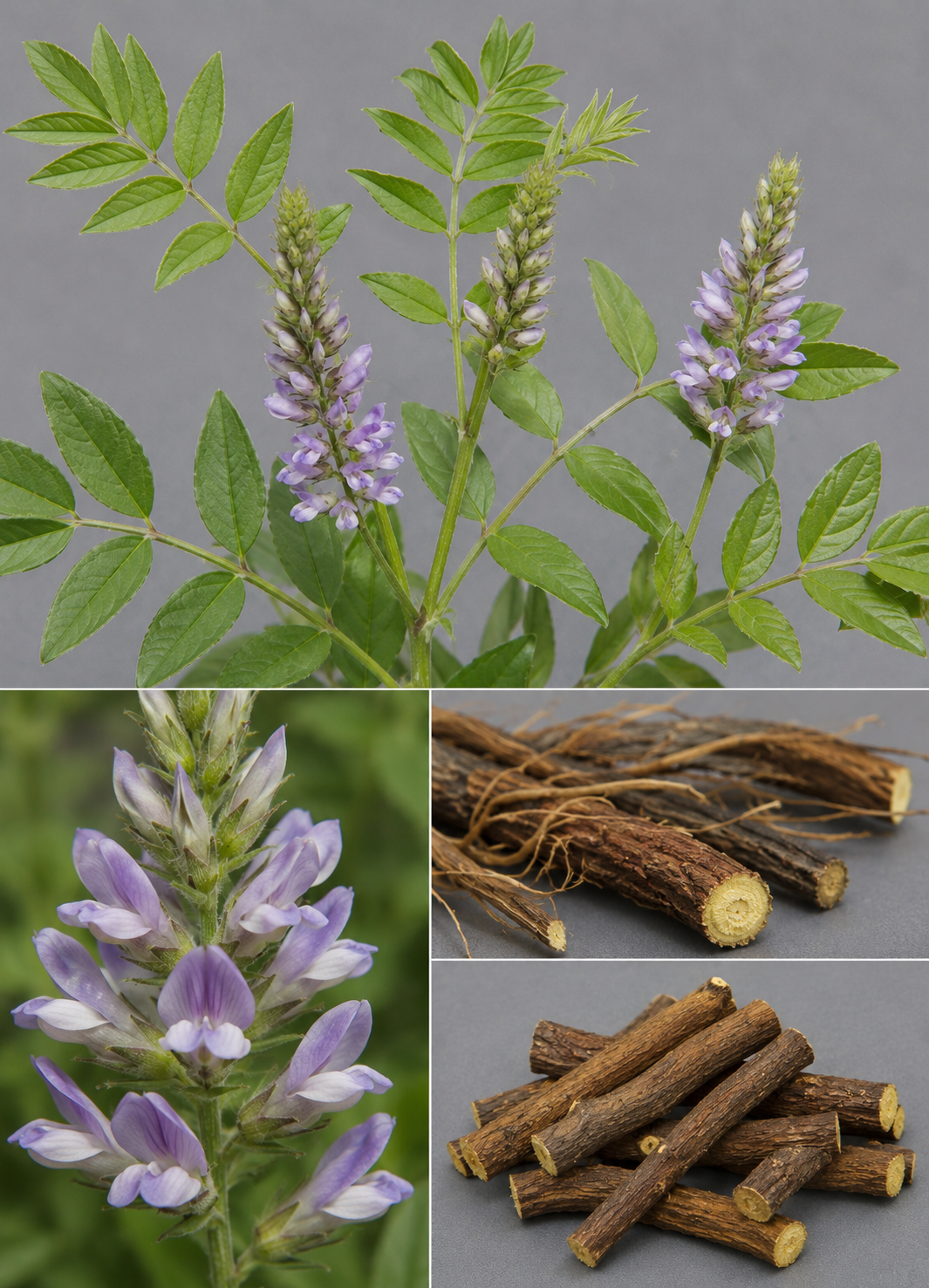
The plant produces erect stems, odd-pinnate leaves with many leaflets, pale violet to bluish pea-like flowers, flattened pods, and an extensive underground system of deep roots and spreading stolons. The yellow interior and pronounced sweetness of authenticated root are characteristic.
Professional licorice-root materials may derive from G. glabra, G. inflata, or G. uralensis. These species overlap in medicine and commerce but should not be silently merged. This monograph uses G. glabra as its primary botanical identity while acknowledging the broader regulatory drug definition.
EMA’s 2026 revised monograph recognizes specified root preparations solely on the basis of traditional use for digestive symptoms including burning sensation and dyspepsia and as an expectorant in cough associated with cold. It restricts use to adults and older adults, sets preparation-specific duration limits, and contains extensive cardiovascular, renal, electrolyte, pregnancy, and interaction warnings.
NCCIH concludes that there is not enough high-quality evidence to clearly support licorice for any health condition. It notes limited findings in oral and topical contexts but emphasizes the serious hazards of glycyrrhizin-containing products.
Culpeper described English licorice as being under Mercury. Within HRMTC ALKMY ™, licorice is studied as a plant of mediated sweetness: a deep, spreading root that softens harshness and combines readily with other materials, yet demands strict limits because sweetness can conceal accumulation.
In This Monograph
01
Botanical Identity and Authentication
This entry concerns Glycyrrhiza glabra L. Commercial “licorice” may instead contain another Glycyrrhiza species, anise flavoring without licorice root, a blend, or a deglycyrrhizinated extract.
Botanical Profile
- Common Names
- Licorice, liquorice, sweet root
- Botanical Name
- Glycyrrhiza glabra
- Botanical Authority
- L.
- Plant Family
- Fabaceae
- Taxonomic Status
- Accepted species in Plants of the World Online
- Related Medicinal Species
- G. inflata and G. uralensis appear in EMA’s licorice-root definition
- Primary Medicinal Material
- Dried root and subterranean stolons, peeled or unpeeled according to specification
- Excluded by Preparation
- DGL, anise-only flavoring, confectionery, tobacco flavor, and unidentified licorice blends
Geographic Profile
- Native Range
- Central Mediterranean to Mongolia and Pakistan according to Kew.
- Cultivated Range
- Cultivated in parts of Europe, western and central Asia, the Middle East, North Africa, and other temperate regions.
- Preferred Habitat
- Sunny open ground, river valleys, alluvial soils, steppe margins, and deep soils where roots and stolons can expand.
- Growth Form
- Rhizomatous or stoloniferous perennial herb or subshrub.
- Ecological Relationships
- Legume-family root associations, insect-pollinated flowers, and strong vegetative spread through underground stems.
Harvest Profile
Root Age
Commercial roots are harvested after sufficient perennial development. Age, season, irrigation, and soil affect sweetness and constituent profile.
Root and Stolon
Record whether the material includes true roots, subterranean stolons, peeled root, or unpeeled root.
Post-Harvest Handling
Wash, cut, and dry under controlled conditions. Avoid mold, soil residue, pesticide contamination, excessive heat, and exhausted material.
Identification
Stems
Upright, branching, somewhat woody or herbaceous stems arise from a spreading underground system.
Leaves
Odd-pinnate leaves bear multiple oval to oblong leaflets and a terminal leaflet. Surfaces may feel slightly sticky from glandular material.
Flowers
Pale violet, lilac, or bluish pea-like flowers occur in upright racemes.
Pods
Flattened oblong legumes contain several hard seeds and vary in hairiness among forms and related species.
Root Exterior
Brown to gray-brown, longitudinally wrinkled, and fibrous when broken.
Root Interior
Yellow to yellow-orange, fibrous, and strongly sweet when genuine glycyrrhizin-containing root is tasted.
Aroma
Mild, earthy, and characteristic rather than strongly anise-like.
Taste
Markedly sweet, persistent, and mildly bitter or earthy. Taste is supportive but not sufficient for authentication.
Commonly Confused Materials
G. uralensis, G. inflata, other sweet roots, anise, star anise, fennel flavoring, and artificial licorice flavor may enter products described simply as licorice.
Adulteration and Mislabeling
Powders and extracts may contain another species, undeclared carriers, exhausted root, added sweetener, incorrect glycyrrhizin claims, or DGL represented ambiguously. Require species, plant part, extraction, assay, lot, and contaminant documentation.
02
Ethical Sourcing and Conservation
- Wildcrafted or Cultivated
- Both; cultivated material is preferred for commercial traceability and root-harvest management
- Conservation Context
- Regional status varies; underground harvest can deplete wild stands even where the species is broadly distributed
- Primary Sourcing Concern
- Destructive root harvest, species substitution, labor conditions, pesticide residues, soil contaminants, and inconsistent glycyrrhizin standardization
- Recommended Practice
- Use documented cultivated root or verified sustainable harvest with regeneration planning
Underground-Part Harvest
Root and stolon collection removes stored perennial tissue and can disrupt soil. Commercial harvest should retain regeneration stock, avoid vulnerable wild populations, and document the cultivation or rotation system.
Soil and Water
Deep roots may encounter accumulated soil contaminants. Suppliers should assess agricultural chemicals, heavy metals, irrigation quality, and prior land use.
Product Traceability
Prefer products that disclose species, country of origin, cultivated or wild status, root age, peeled or unpeeled state, extraction solvent, ratio, glycyrrhizin or glycyrrhizic-acid status, serving, and independent testing.
03
Hermetic Correspondences
- Primary Planetary Ruler
- Mercury
- Historically Documented Source
- Culpeper’s Liquorice entry
- Metal
- Mercury / quicksilver
- Primary Elemental Reading
- Water through sweetness, soothing, moistening, blending, and flow
- Secondary Elemental Reading
- Earth through deep roots, stolons, persistence, and accumulation
- Symbolic Sphere
- Mediation, sweetness, eloquence, blending, softening, subterranean connection, nourishment, and the danger of concealed excess
Historical Attribution
Historically Documented Culpeper explicitly states that licorice is under the dominion of Mercury and emphasizes the medicinal root, its deep growth, and its historical use in cough and urinary preparations.
Correspondence Rationale
Mercury appears through licorice’s role as a harmonizing or mediating ingredient, its capacity to modify taste, its extensive underground communication through stolons, and its traditional relationship with voice and breath.
Alternative Attributions
Venus or Jupiter may be invoked in later systems because of sweetness, pleasure, abundance, and generosity. These may be useful secondary readings but should not replace Culpeper’s documented Mercury attribution.
04
The Tria Prima
This section separates observable material qualities from Hermetic interpretation and does not disclose laboratory or spagyric procedures.
SULFUR
Soul
Philosophical Expression
Persistent sweetness, distinctive yellow root, flavor, warmth, and the root’s capacity to transform an entire formula.
Material Expression
Glycyrrhizin, flavonoids, chalcones, isoflavonoids, aromatic traces, and color-bearing phenolic fractions.
Interpretation
Licorice’s Sulfur is seductive rather than fiery: a strong identity expressed through sweetness.
MERCURY
Spirit
Philosophical Expression
Mediation, blending, voice, communication, formula harmonization, transport through stolons, and transformation among root, tea, extract, candy, and DGL.
Material Expression
Water- and alcohol-accessible saponins and flavonoids, soluble sweetness, extractive movement, and metabolic conversion of glycyrrhizin to glycyrrhetinic acid.
Interpretation
Mercury is dominant because licorice changes relationships among materials. It can harmonize flavor while also altering physiological and medicinal relationships.
SALT
Body
Philosophical Expression
Deep root, accumulation, water retention, boundary, stored nourishment, and the fixed consequences of prolonged exposure.
Material Expression
Fibrous root, starches, polysaccharides, minerals, ash, cell walls, and nonvolatile structural matter.
Interpretation
Salt reveals the shadow of sweetness: what is repeatedly welcomed may accumulate until balance is altered.
05
Doctrine of Signatures
Doctrine-of-signatures material is symbolic or historical interpretation. It is not evidence of efficacy or safety.
Interpretive Meaning
Modern Symbolic Interpretation Many leaflets held upon one axis and many shoots joined through one underground system suggest coordination, mediation, and the gathering of distinct elements into relationship.
Sweetness and Voice
The root’s enduring sweetness and historical use in preparations for hoarseness support a symbolism of persuasive speech, softened expression, and the responsible use of pleasing language.
Counter-Reading
Harmony can become concealment. Sweetness can become manipulation. Moistening can become fluid retention. A pleasant taste can obscure serious physiological risk.
06
Botanical and Chemical Profile
Major Constituent Groups
Glycyrrhizin
Glycyrrhizin, also called glycyrrhizic acid, is a sweet triterpenoid saponin and central safety constituent. Intestinal metabolism produces glycyrrhetinic acid, which can inhibit an enzyme that normally protects mineralocorticoid receptors from cortisol. Excess exposure may therefore produce sodium and water retention, potassium loss, hypertension, weakness, and cardiac rhythm disturbance.
Flavonoid and Phenolic Profile
Reported compounds include liquiritin, isoliquiritin, liquiritigenin, isoliquiritigenin, glabridin, and related flavonoids and isoflavonoids. Profiles differ among Glycyrrhiza species and extraction methods.
DGL
Deglycyrrhizinated licorice is processed to remove most glycyrrhizin. It is therefore a different preparation with a different safety and evidence profile. “DGL” should not be inferred unless the current label explicitly states deglycyrrhizination and provides product-specific information.
Solubility and Preparation
- Water Preparation
- Extracts glycyrrhizin, sugars, polysaccharides, and multiple water-accessible flavonoid glycosides
- Alcohol Preparation
- Solvent strength broadens extraction of flavonoids, chalcones, isoflavonoids, and other less polar constituents
- Soft Extract
- EMA’s monograph defines specific water soft extracts with specified drug-extract ratios
- DGL Processing
- Reduces glycyrrhizin but may also change the relative composition and required serving of the finished product
Known Variability
Composition varies with species, geography, cultivar, root age, peeled or unpeeled state, harvest season, drying, storage, extraction solvent, ratio, glycyrrhizin assay, and deglycyrrhizination. Root powder, tincture, soft extract, tea, and DGL are not interchangeable.
Chemical and regulatory literature reviewed through: August 2026.
07
Traditional and Contemporary Virtues
EMA Traditional-Use Contexts
Established Traditional Use EMA recognizes specified licorice-root preparations for relief of digestive symptoms including burning sensation and dyspepsia and as an expectorant in cough associated with cold.
Historical Claims
Historical Claim Culpeper described licorice preparations for dry cough, hoarseness, wheezing, shortness of breath, urinary heat, and other conditions. These claims belong to seventeenth-century medicine.
Contemporary Supplement Context
Licorice is promoted for digestive comfort, respiratory support, “adrenal support,” energy, skin conditions, and formula harmonization. NCCIH concludes that high-quality evidence is insufficient to clearly support licorice for any health condition.
DGL Context
DGL is commonly marketed for digestive or mucosal support. Evidence attached to DGL cannot be transferred to ordinary licorice root, and ordinary-root cardiovascular risks should not be dismissed merely because DGL products exist.
Energetic Qualities
- System
- Later Western herbal interpretation
- Temperature
- Neutral to warming
- Moisture
- Moistening
- Tonicity
- Toning, harmonizing, and building in traditional language
- Movement
- Soothing, downward into root, and outward through voice and formula blending
- Primary Traditional Affinity
- Digestive and respiratory spheres, with strong preparation and safety limits
Spiritual and Ritual Associations
Hermetic Interpretation Eloquence, sweetness, reconciliation, mediation, attraction, subterranean connection, nourishment, and the ethical use of pleasing influence.
08
Evidence Classification
Authoritative Monograph
EMA adopted a revised 2026 European Union herbal monograph covering defined root preparations, adult use, traditional indications, duration, contraindications, interactions, and overdose effects.
Traditional Use
Specified preparations have long-standing use for burning sensation and dyspepsia and as an expectorant in cough associated with cold.
Clinical Evidence
NCCIH reports insufficient high-quality evidence to clearly support licorice for any health condition.
Limited Oral / Topical Findings
Small studies suggest possible benefits in canker-sore rinses, peri-intubation throat products, and selected topical contexts, but these findings do not validate oral root capsules for unrelated conditions.
Safety Evidence
Glycyrrhizin exposure is linked to hypertension, potassium loss, water retention, irregular heartbeat, and cardiac arrest, with increased vulnerability in high-salt intake, hypertension, heart disease, and kidney disease.
Historical Claim
Culpeper’s respiratory, urinary, eye, and other claims remain historically labeled.
Hermetic Interpretation
Mercury is historically documented; Water, Earth, mediation, eloquence, and concealed accumulation are correspondence-based readings.
09
Therapeutic and Preparation Context
EMA Traditional-Use Contexts
- Relief of digestive symptoms including burning sensation and dyspepsia.
- Expectorant use in cough associated with cold.
- Adult and older-adult use only in the revised monograph.
- Preparation-specific duration: digestive use not longer than four weeks; medical consultation if digestive symptoms persist beyond two weeks or cough beyond one week.
Preparation Forms
Liquid Extract
Confirm species, root or stolon part, extraction ratio, alcohol, serving, glycyrrhizin status, duration, and medicine warnings.
Root Capsules
Confirm powder versus extract, amount per serving, glycyrrhizin or glycyrrhizic-acid statement, excipients, and cumulative daily exposure.
Tea or Decoction
A water preparation of authenticated root. EMA provides specific adult traditional-use parameters that should not be generalized to every loose tea.
Soft Extract
Defined water soft extracts appear in EMA’s monograph with specific drug-extract ratios and dose limits.
DGL
A deglycyrrhizinated preparation that requires explicit labeling and should not be treated as ordinary licorice root.
Food and Confectionery
Food products may contain licorice extract, anise flavor only, or both. Repeated food exposure may add to supplement exposure.
When Professional Guidance Is Essential
Seek clinician or pharmacist guidance for hypertension, kidney disease, liver disease, heart disease, low potassium, edema, high salt intake, pregnancy, breastfeeding, use of any prescription medicine, long-term use, multiple licorice products, or symptoms such as weakness, palpitations, swelling, or severe headache.
10
Safety Profile
Hypertension
Licorice may raise blood pressure and can counteract antihypertensive medicines. EMA does not recommend licorice medicines in people with hypertension.
Potassium Loss
Glycyrrhizin can cause hypokalemia. Warning signs may include weakness, cramps, fatigue, constipation, palpitations, or rhythm disturbance.
Fluid Retention
Sodium and water retention may produce swelling, rapid weight gain, worsening heart failure, or increased blood pressure.
Heart and Kidney Disease
NCCIH reports severe effects even at smaller amounts in susceptible people. EMA does not recommend licorice medicines in cardiovascular or kidney disorders.
Liver Disease
EMA’s revised monograph does not recommend licorice medication in liver disorders. Underlying disease and medicine use may increase complexity.
Pregnancy
EMA does not recommend use during pregnancy or in women of childbearing potential not using contraception. NCCIH reports that large oral-extract exposure during pregnancy is unsafe and may increase preterm-delivery risk.
Breastfeeding
EMA does not recommend use during breastfeeding; glycyrrhizin has been detected in breast milk and infant effects remain uncertain.
Children and Adolescents
EMA’s revised monograph does not recommend use under eighteen because adequate data are lacking.
Duration and Overdose
EMA reports overdose with prolonged use beyond four weeks or high amounts, producing water retention, hypokalemia, hypertension, rhythm disturbance, and hypertensive encephalopathy.
Cumulative Exposure
Do not combine multiple licorice medicines or supplements. Candy, tea, tobacco flavoring, and compound herbal formulas may add additional glycyrrhizin.
Medicine Interactions
Diuretics
Concomitant use is not recommended when electrolyte imbalance may be aggravated.
Cardiac Glycosides
Potassium loss may increase toxicity risk; concomitant use is not recommended.
Corticosteroids
NCCIH and EMA report interaction concerns. Combined effects on fluid and electrolyte balance require professional review.
Stimulant Laxatives
Additional potassium loss or electrolyte disturbance may occur; concomitant use is not recommended.
Antihypertensives
Licorice may counteract blood-pressure-lowering therapy.
CYP3A4 Substrates
EMA advises caution because licorice preparations may modestly alter exposure to medicines metabolized through CYP3A4.
Urgent Warning Signs
Stop use and seek urgent care for fainting, chest pain, severe palpitations, marked weakness, paralysis, confusion, severe headache, sudden swelling, shortness of breath, or a very high blood-pressure reading.
Route- and Product-Specific Safety
- Liquid Extract
- Review glycyrrhizin status, alcohol, extract ratio, serving, duration, cumulative exposure, blood pressure, potassium, and medicines
- Capsules
- Review root powder versus extract, amount, glycyrrhizin statement, serving, duration, excipients, and other licorice sources
- DGL
- Confirm explicit deglycyrrhizination; DGL reduces but does not eliminate the need for product-specific ingredient and medicine review
- Food / Candy
- Determine whether true licorice extract is present and include it when considering cumulative glycyrrhizin exposure
11
Historical, Cultural, and Ritual Context
Ancient and Cross-Cultural Record
Licorice root has a long history across Assyrian, Egyptian, Greek, Arab, Chinese, Tibetan, Indian, and European medicine and food culture. Specific species, formulas, theories, and processing traditions should not be treated as identical.
Culpeper’s Liquorice
Culpeper described English cultivation, ash-like pinnate leaves, pale blue pea flowers, deep spreading roots, yellow interior, Mercury rulership, and historical use in respiratory and urinary preparations.
Food, Candy, and Flavor
Licorice has flavored confectionery, drinks, tobacco, medicines, and compound formulas. In the United States, products with a licorice-like taste may rely primarily on anise rather than true licorice root.
Formula Harmonization
Several medical traditions use licorice as a modifying or harmonizing ingredient within formulas. This cultural role should not be interpreted as proof that licorice neutralizes all toxicity or medicine interactions.
Cultural Caution
Do not merge European G. glabra, Chinese G. uralensis, Central Asian G. inflata, candy flavoring, tobacco exposure, DGL, and modern “adrenal support” marketing into one undifferentiated licorice tradition.
12
Symbolic Reading
Botanical Symbolism
Multiple shoots arise from one connected underground system. Above ground, many leaflets are coordinated along one axis. Licorice therefore embodies relationship organized through a hidden common root.
Hermetic Interpretation
Mercury mediates and translates. Water softens; Earth stores. The sweet root moves between these poles, making hard materials more acceptable while retaining the capacity to accumulate.
The Lesson of Sweetness
Sweetness is not identical to harmlessness. Licorice teaches that a pleasing quality can be medicinal, culinary, persuasive, and dangerous depending on duration and context.
Shadow or Counter-Reading
Mediation can become manipulation. Harmony can conceal conflict. Nourishment can become retention. A desire for “natural support” can obscure a rising blood pressure or falling potassium level.
13
Study Questions
- Which botanical features identify Glycyrrhiza glabra?
- Which related species appear in EMA’s licorice-root definition?
- What is glycyrrhizin, and why is it clinically important?
- How does DGL differ from ordinary licorice?
- Which traditional indications does EMA recognize?
- Which people are especially vulnerable to severe adverse effects?
- Which medicine combinations does EMA advise against?
- Why must cumulative food, tea, candy, and supplement exposure be considered?
- How do Mercury and Salt appear in mediation and accumulation?
- What does licorice teach about sweetness, persuasion, and limits?
15
References and Source Record
Botanical References
Professional and Governmental Sources
Historical and Correspondence Sources
Product Resources
- Herb Pharm — Licorice liquid extract, linked through Fullscript.
- Nature’s Way — Licorice Root capsules, linked through Fullscript.
Archive Notes
Licorice demonstrates how sweetness, mediation, and danger may occupy the same root. Its pleasant taste made it food, medicine, and formula companion; its glycyrrhizin content makes duration and context matters of genuine clinical importance.
The archive must therefore refuse the assumption that familiar flavor means low risk. It should preserve Mercury’s art of mediation while also preserving Salt’s demand for boundary, measure, and consequence.
Revealed in Practice.