
HERBARIUM / ADVANCED PLANT MONOGRAPH
Mugwort
Artemisia vulgaris L.
An aromatic perennial herb of boundary, movement, protection, traditional women’s herbalism, and later visionary symbolism.
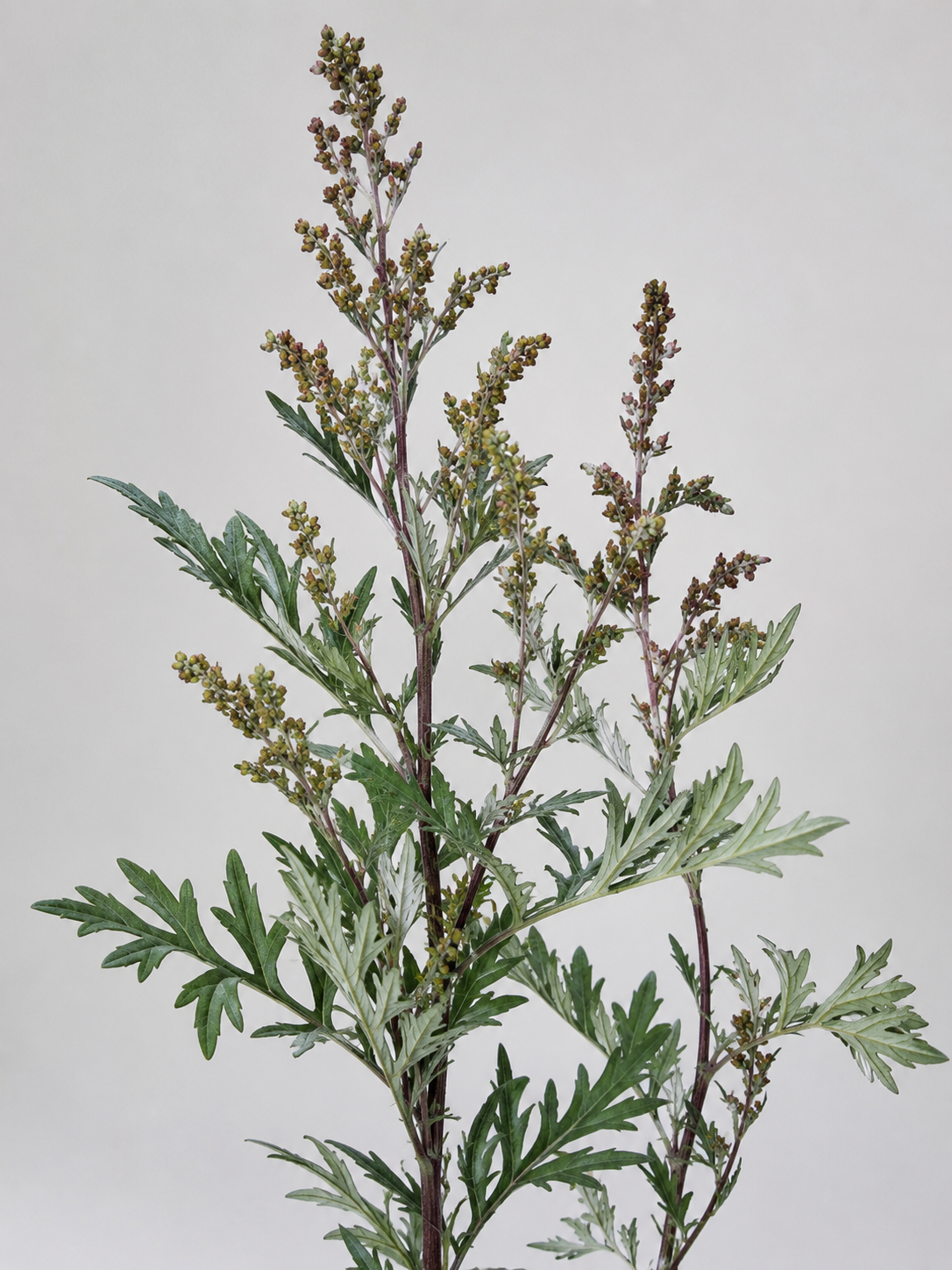 Artemisia vulgaris.
MONOGRAPH PROFILE
Quick Reference
- Botanical Name
- Artemisia vulgaris
- Botanical Authority
- L.
- Plant Family
- Asteraceae
- Primary Planetary Ruler
- Venus
- Alternative Attribution
- Moon in later and modern esoteric systems
- Element
- Earth in common later Western esoteric correspondence
- Metal
- Copper through Venusian correspondence
- Tria Prima Emphasis
- Mercury / Sulfur
- Parts Used
- Primarily leaves and flowering aerial parts; roots appear in some historical traditions
- Plant Condition
- Fresh or dried
- Primary Preparations Discussed
- Infusion, dried herb, and aromatic or ritual use
- Safety Classification
- Significant Caution
- Conservation / Sourcing
- Not globally threatened; invasive or regulated in some North American jurisdictions
ENTRY SUMMARY
Mugwort at a Glance
Mugwort, Artemisia vulgaris L., is an aromatic perennial of the Asteraceae family native broadly from temperate Eurasia into parts of Asia and North Africa and introduced widely elsewhere. Kew currently accepts Artemisia vulgaris as the species name and characterizes it as a temperate perennial.
Historically, mugwort has been used in European and Asian traditions for culinary, aromatic, ceremonial, and medicinal purposes. Nicholas Culpeper assigned Mugwort to Venus and Taurus/Libra in his seventeenth-century astrological herbalism.
Modern scientific reviews identify essential oil, flavonoids, sesquiterpene lactones, coumarins, and related compounds in A. vulgaris, but composition varies considerably with geography, plant material, and extraction.
Health claims require substantial restraint. The U.S. National Center for Complementary and Integrative Health states that very little human research exists and that evidence is insufficient to determine whether mugwort is safe or useful for health conditions. Mugwort should not be used during pregnancy.
Within HRMTC ALKMY™ Mugwort is studied as a plant of threshold, discernment, aromatic movement, protection, cyclical symbolism, and the tension between historically documented Venusian attribution and later lunar interpretation.
In This Monograph
01
Botanical Identity and Authentication
Correct botanical identification is the foundation of every HRMTC ALKMY™ plant monograph. The common name “mugwort” may be applied to more than one member of the genus Artemisia. This entry concerns Artemisia vulgaris L. specifically.
Botanical Profile
- Common Name
- Mugwort
- Botanical Name
- Artemisia vulgaris
- Botanical Authority
- L.
- Plant Family
- Asteraceae
- Accepted Synonyms
- Historical synonyms exist; verify against current botanical databases at publication.
- Other Common Names
- Common mugwort, wild wormwood, felon herb, St. John’s plant, sailor’s tobacco.
- Parts Used
- Leaves and flowering aerial portions principally; root appears historically.
- Plant Condition
- Fresh or dried.
Geographic Profile
- Geographic Origin
- Temperate Old World.
- Native Range
- Temperate Eurasia through parts of Indo-China and North Africa.
- Cultivated / Introduced Range
- Widely introduced, including substantial parts of North America.
- Preferred Habitat
- Disturbed ground, roadsides, fields, margins, meadows, and similar open sites.
- Climate
- Temperate.
- Soil Preference
- Tolerates varied soils; commonly successful in disturbed sites.
Harvest Profile
Harvest Season
Commonly gathered during vegetative growth through flowering season depending on intended traditional use.
Harvest Stage
Leaves before or during flowering; traditions vary.
Collection Conditions
Positively identified, uncontaminated plants away from roadsides or chemically treated areas.
Identification
General Appearance
A vigorous herbaceous perennial capable of forming dense colonies through persistent rhizomatous growth.
Leaves
Deeply lobed to pinnately divided, green above and characteristically pale to silvery-white beneath because of dense hairs.
Stem
Often branching and may show purplish or brownish coloration.
Aroma
Strongly aromatic when crushed, often described as sage-like or chrysanthemum-like.
Flowers
Small, relatively inconspicuous flower heads borne in branching clusters.
Roots and Rhizomes
Persistent underground system capable of spreading aggressively.
Taste
Bitter and aromatic. Taste should not be used as a field-identification method.
Commonly Confused Species
Mugwort may be confused with other Artemisia species and superficially similar weeds.
- Artemisia absinthium — wormwood
- Other regional Artemisia species
- Ragweed-like foliage in immature plants
Known Adulterants or Substitutes
Commercial material may be substituted with or confused with other Artemisia species. Record the complete botanical name, plant part, origin, supplier lot, and available testing documents.
02
Ethical Sourcing and Conservation
- Wildcrafted or Cultivated
- Both
- Conservation Status
- Predicted not threatened in current Kew information.
- Primary Conservation Concern
- Generally not scarcity; ecological invasiveness may be the more important regional concern.
In parts of North America, mugwort behaves as an aggressive invasive perennial. Regional regulations should be checked before cultivation, transport, propagation, or collection.
Sustainable Harvesting Considerations
For this plant, sustainability does not necessarily mean protecting scarce wild populations. In introduced regions it may instead mean preventing further spread. Avoid intentionally dispersing seed or rhizome fragments in jurisdictions where mugwort is invasive.
Cultivated or responsibly sourced material provides better traceability for publication and research work.
Ethical and Cultural Considerations
“Mugwort” is not one globally interchangeable tradition. Several Artemisia species are associated with East Asian medicinal and moxibustion traditions, and botanical identity must be preserved rather than collapsing them all into A. vulgaris.
03
Hermetic Correspondences
- Primary Planetary Ruler
- Venus
- Alternative Planetary Attribution
- Moon
- Element
- Earth in common later Western esoteric classification
- Metal
- Copper through Venusian correspondence
- Zodiac Signs
- Taurus and Libra in Culpeper’s system
- Psychological / Spiritual Sphere
- Boundary, receptivity, protection, memory, liminality, dream symbolism, movement between states
Sources of Correspondence
Renaissance and Early Modern Sources
Nicholas Culpeper explicitly classified Mugwort as an herb of Venus and connected it with Taurus and Libra. That attribution is historically documented within his astrological-medical system.
Historically Documented Venus — Culpeper
Later and Modern Esoteric Sources
Lunar correspondences appear frequently in later modern esoteric and magical literature, particularly around dream, intuition, divination, and the silver underside of the foliage.
Modern Hermetic Interpretation Moon
Earth attribution is also common in later Western magical herbalism.
Correspondence Rationale
Venus is the strongest documented planetary choice for a historically grounded HRMTC ALKMY™ profile because Culpeper states it directly. The Moon should therefore be presented as an alternative later attribution, not silently substituted for Venus.
Conflicting Attributions
Modern sources frequently elevate the Moon to primary rulership because of mugwort’s association with dreamwork, cycles, Artemis/Diana symbolism, and silvery foliage. The historical Culpeperian system, however, is explicitly Venusian. These systems should remain visibly distinct rather than forced into agreement.
04
The Tria Prima
This section preserves philosophical and material interpretation while withholding laboratory and spagyric procedures reserved for later publication.
SULFUR
Soul
Philosophical Expression
Mugwort’s Sulfur may be read through its strong aromatic identity, bitterness, volatile character, and unmistakable presence when crushed or burned.
Material Expression
The plant contains volatile oil constituents alongside other aromatic and lipophilic compounds. Reviews report essential oil, flavonoids, sesquiterpene lactones, coumarins, and related constituents, with substantial variation among samples.
Hermetic Interpretation Sulfur appears strongly through aroma and individuality.
MERCURY
Spirit
Philosophical Expression
Mercury appears through movement, scent transmission, volatility, liminality, and the plant’s later symbolic association with dream, perception, travel, and changing states.
Material Expression
Its aromatic volatile fraction readily disperses into air. Essential-oil profiles may contain camphor, thujones, cineole, and other terpenoid constituents, although composition varies greatly by origin and chemotype.
Hermetic Interpretation Mercury is visible in mugwort’s mobility.
SALT
Body
Philosophical Expression
Salt appears in mugwort’s persistent perennial structure, tough rhizomatous habit, capacity to return, and resistance to simple eradication.
Material Expression
Its fixed structural matter, mineral fraction, fibrous tissue, and underground rhizomes belong to the material body of the plant.
Hermetic Interpretation The persistent underground form provides an image of memory held in matter.
05
Doctrine of Signatures
Interpretive Meaning
Modern Symbolic Interpretation
The leaf presents two visual surfaces: green above and pale beneath. This lends itself to symbolic interpretations of visible and hidden worlds, waking and dreaming, surface and interior.
The persistent rhizome suggests memory, recurrence, and return. Its colonization of boundaries and disturbed landscapes lends itself to threshold symbolism.
These are interpretive readings, not evidence of physiological efficacy.
06
Botanical and Chemical Profile
Major Constituent Groups
- Essential oils and other volatile constituents
- Flavonoids
- Sesquiterpene lactones
- Coumarins
- Phenolic compounds
- Other terpenoid constituents
Principal Identified Constituents
The composition of mugwort is highly variable. Reported volatile constituents across different samples include camphor, thujone isomers, 1,8-cineole, and numerous other terpenoids; no single essential-oil profile should be assumed universal.
Known Variability
- Geography
- Chemotype
- Plant part
- Harvest stage
- Fresh versus dried material
- Environment
- Storage
- Processing
- Extraction method
This variability is one reason a whole-herb infusion, essential oil, commercial extract, and ritual smoke should never be treated as equivalent preparations.
Chemical Literature Reviewed Through: July 2026
07
Traditional and Contemporary Virtues
Traditional Actions
Mugwort has a long history in European and Asian traditional medicine. NCCIH notes traditional use for gastrointestinal and gynecological concerns, while historical European herbals attribute a considerably wider range of uses.
Established Traditional Use Historical Claim
These historical claims should not be interpreted as proof of modern clinical efficacy.
Contemporary Herbal Actions
Mugwort continues to be promoted for numerous health purposes, but very little human research has been conducted and evidence is currently insufficient to determine usefulness for health conditions.
Energetic Qualities
- System
- Later Western herbal interpretation
- Temperature
- Commonly described as warming
- Taste
- Bitter / aromatic
- Movement
- Often interpreted as circulating or stimulating
Psychological Associations
Modern Hermetic Interpretation
Later esoteric practice commonly associates mugwort with dreams, inward perception, divination, boundary states, and symbolic imagination. These should remain separate from medicinal indications.
08
Evidence Classification
Clinical Evidence
Very limited.
Pharmacological Evidence
Laboratory and preclinical research exists for extracts and constituents, but this does not establish clinical usefulness of ordinary mugwort preparations.
Established Traditional Use
Substantial historical and ethnobotanical record exists.
Historical Claims
Numerous European herbal claims are documented, including Culpeper’s uses.
Hermetic Interpretation
Strong later symbolic tradition, with historically documented Venusian attribution and later lunar interpretations.
09
Therapeutic and Preparation Context
Traditional Indications
Historical systems have used mugwort for digestive and gynecological purposes and in a variety of external or ceremonial preparations. These remain traditional or historical indications, not treatment recommendations.
Preparation Forms
- Infusion
- Dried herb
- Tincture or extract
- Topical preparation
- Aromatic bundle
- Incense or smoke material
- Essential oil
- Moxibustion material in traditions using appropriate Artemisia species
Botanical species and preparation must be identified because these forms are not interchangeable.
10
Safety Profile
Prominent Safety Summary
There is insufficient evidence to determine whether mugwort is safe when taken orally or used topically. Mugwort should not be used during pregnancy, and little is known about safety during breastfeeding.
Pregnancy
Avoid. Mugwort should not be used during pregnancy.
Lactation
Safety information is inadequate.
Drug and Supplement Interactions
Robust interaction data are limited. People using medicines should discuss herbal products with qualified healthcare professionals.
Allergies and Cross-Reactivity
Mugwort pollen is an important aeroallergen. Cross-reactive allergy patterns may occur in susceptible individuals.
Essential Oil
Essential oil is chemically concentrated and should not be treated as equivalent to whole dried herb. Thujone, camphor, and other potentially adverse volatile constituents may occur, with substantial variation by source.
Inhalation and Ritual Smoke
Smoke may irritate eyes and respiratory tissues. Use ventilation and fire-safe equipment, with particular caution around children, pets, asthma, allergies, and respiratory sensitivities.
Regulatory and Jurisdictional Notes
Botanical and environmental regulation differs by jurisdiction. Check current regional rules before cultivation, propagation, transport, sale, or collection.
Safety Literature Current Through: July 2026
11
Historical, Cultural, and Ritual Context
Historical Record
Mugwort has a substantial European herbal history. Culpeper described the plant botanically, identified it as an herb of Venus, and recorded several medical applications typical of seventeenth-century herbal practice. These should be preserved as historical documentation rather than repeated as modern therapeutic recommendations.
Cultural Context
The common name “mugwort” spans multiple species and traditions. European Artemisia vulgaris should not automatically be substituted for East Asian species used in culinary, medicinal, or moxibustion traditions.
Folklore and Ritual
European folklore has associated mugwort with protection, thresholds, travel, seasonal observances, and later divinatory and dream-related practice. These uses belong in the cultural and symbolic record rather than the medical evidence section.
12
Symbolic Reading
Primary Symbolic Themes
Botanical Symbolism
Mugwort’s appearance lends itself strongly to symbolic reading. Green upper leaves and pale undersides create a visible duality. The rhizome remains hidden beneath the soil while allowing the plant to return repeatedly. Its strong aroma moves outward even when the source is unseen.
The plant therefore naturally invites symbolic contemplation of visible and invisible, surface and depth, waking and dream, movement and rootedness.
Hermetic Interpretation
Hermetic Interpretation
Mugwort may be read as a plant of the threshold. Its Venusian historical attribution links it to attraction, generation, embodied relationship, and the traditional feminine sphere within Culpeper’s system. Its later lunar interpretation redirects attention toward cycles, receptivity, dream, and reflected perception.
Rather than choosing one system and erasing the other, the tension itself becomes educational.
Shadow or Counter-Reading
Mugwort’s persistence can become invasion. Its liminality can become confusion. Its dream symbolism can become escapism. Its aromatic intensity can become irritation.
Its association with intuition should never be used to justify abandoning historical context, botanical authentication, or evidence.
13
Study Questions
- Which features most reliably distinguish Artemisia vulgaris from other Artemisia species?
- Why should “mugwort” never be treated as a sufficient botanical identification?
- What makes Culpeper’s Venus attribution historically significant?
- Why do modern lunar correspondences conflict with that older system?
- How do the pale leaf underside and persistent rhizome contribute to symbolic interpretation?
- Which medicinal claims are historical, and which have meaningful human evidence?
- Why does preparation form matter so strongly for safety?
- How does an invasive plant complicate the idea of ethical wildcrafting?
- How are Sulfur, Mercury, and Salt visible without revealing laboratory procedures?
- What does Mugwort teach about the difference between tradition and evidence?
15
References and Source Record
Botanical References
- Royal Botanic Gardens, Kew — Plants of the World Online, Artemisia vulgaris L.
- UConn Extension — Common Mugwort (Artemisia vulgaris) identification and invasive-plant information.
Chemical and Pharmacological References
- Ekiert H., Pajor J., Klin P., et al. Review of the history, phytochemistry, and pharmacology of Artemisia vulgaris.
- Additional reviews documenting variation in Artemisia volatile composition and safety concerns involving concentrated volatile constituents.
Professional and Governmental References
- National Center for Complementary and Integrative Health — Mugwort: Usefulness and Safety. Last updated April 2025.
Historical Herbal Sources
- Nicholas Culpeper, The Complete Herbal — Mugwort entry, including Venusian attribution.
Conservation / Invasive-Species References
- Royal Botanic Gardens, Kew — predicted not threatened globally.
- UConn / Connecticut Invasive Plant Working Group — regional invasive and regulatory status.
Archive Notes
Mugwort is a useful test of the mature HRMTC ALKMY™ Herbarium because it refuses simple classification.
It is common yet historically powerful, fragrant yet bitter, rooted yet spreading, Venusian in a documented early-modern system and lunar in much later symbolic interpretation.
Its lesson is therefore not merely one of mystery. It is discernment: between species, between traditions, between historical claim and modern evidence, and between symbolic meaning and material fact.
Revealed in Practice.