
HERBARIUM / ADVANCED PLANT MONOGRAPH
Thyme
Thymus vulgaris L.
An aromatic Mediterranean subshrub of courage, purification, breath, preservation, concentrated heat, and the disciplined distinction between culinary herb, liquid extract, and essential oil.
MONOGRAPH PROFILE
Quick Reference
- Primary Botanical Name
- Thymus vulgaris
- Botanical Authority
- L.
- Plant Family
- Lamiaceae
- Primary Planetary Ruler
- Venus in Culpeper’s system
- Alternative Attributions
- Fire, Air, Mars, and the Sun appear in later symbolic systems; not historically standardized
- Element
- Fire through aromatic heat; Air through volatile fragrance and breath symbolism
- Metal
- Copper through Venusian correspondence
- Tria Prima Emphasis
- Sulfur / Mercury
- Parts Discussed
- Leaves and flowers separated from dried stems; aerial herb and essential oil require separate treatment
- Plant Condition
- Fresh or dried herb; essential oil is a concentrated distillate
- Primary Preparations Discussed
- Liquid extract, infusion, culinary herb, syrup, and essential oil
- Safety Classification
- Significant Caution
- Primary Safety Concern
- Essential-oil concentration, skin irritation, allergy, child safety, pregnancy/lactation uncertainty, and route-specific use
- Conservation / Sourcing
- Widely cultivated; species identity, chemotype, harvest quality, and oil adulteration require attention
ENTRY SUMMARY
Thyme at a Glance
Common thyme, Thymus vulgaris L., is an accepted species in the Lamiaceae family. Plants of the World Online records it as a temperate subshrub native to southwestern Europe and southeastern Italy. Its small opposite leaves, woody branching base, pale flowers, concentrated aroma, and preference for sun and well-drained ground make it characteristic of Mediterranean cultivation and dry aromatic landscapes.
Professional European thyme-herb materials may include the leaves and flowers of T. vulgaris or Thymus zygis. The species, plant part, and preparation must therefore be recorded rather than assumed from the common name alone. Wild thyme, lemon thyme, Spanish thyme, and essential-oil products may differ materially.
The European Medicines Agency concludes that specified thyme-herb preparations may be used on the basis of long-standing traditional use for productive coughs associated with colds. Most such preparations are intended for adults and adolescents over twelve, while some may be used in children over four according to the exact preparation and label.
Nicholas Culpeper described common thyme as a notable herb of Venus. This is treated here as historically documented. Fire and Air correspondences are later interpretive classifications based on pungent warmth, solar habitat, volatile fragrance, and traditional association with breath and fumigation.
The dried herb may contain up to approximately 2.5% essential oil. Regulatory assessment materials identify thymol, carvacrol, p-cymene, γ-terpinene, linalool, and related volatile constituents among its principal components. Composition varies by species, chemotype, geography, harvest, storage, and distillation.
Within HRMTC ALKMY ™, thyme is studied as a plant of concentrated presence: small in leaf and stature, expansive in fragrance, warming in sensory character, and demanding of restraint when transformed from culinary herb into concentrated essential oil.
In This Monograph
01
Botanical Identity and Authentication
Publication-grade identification must distinguish common thyme from other Thymus species, hybrids, cultivars, chemotypes, and commercial materials. The familiar culinary name does not establish the identity of a supplement or essential oil.
Botanical Profile
- Common Name
- Thyme, common thyme, garden thyme
- Primary Botanical Name
- Thymus vulgaris
- Botanical Authority
- L.
- Plant Family
- Lamiaceae
- Taxonomic Status
- Accepted species in Plants of the World Online
- Related Professional-Monograph Species
- Thymus zygis L. may also supply recognized thyme herb or oil under specified standards
- Parts Discussed
- Leaves and flowers, aerial herb, and separately defined essential oil
- Plant Condition
- Fresh or dried herb; distilled oil is a separate concentrated material
Geographic Profile
- Kew-Recorded Native Range
- Southwestern Europe and southeastern Italy, including France, Italy, Spain, and the Balearic Islands.
- Cultivated Range
- Cultivated widely in temperate and Mediterranean-type regions for culinary, aromatic, ornamental, and medicinal use.
- Preferred Habitat
- Sunny, open, dry to moderately dry ground with excellent drainage.
- Growth Form
- Low woody subshrub with many branching stems and small aromatic leaves.
- Ecological Relationships
- Flowers provide nectar and pollen for bees and other insects; aromatic foliage may affect herbivory and neighboring plant relationships.
Harvest Profile
Harvest Season
Aerial herb is commonly gathered near or during flowering, but the exact developmental stage should follow the intended pharmacopoeial, culinary, aromatic, or supplier specification.
Plant Part
Leaves and flowers are the primary professional-monograph material. Woody stems, root, fresh herb, dried herb, and distilled oil must be recorded separately.
Collection Conditions
Use positively identified material from clean, legally permitted sites. Avoid roadside contamination, pesticide exposure, mold, poor drying, and mixed ornamental cultivars of uncertain identity.
Identification
General Appearance
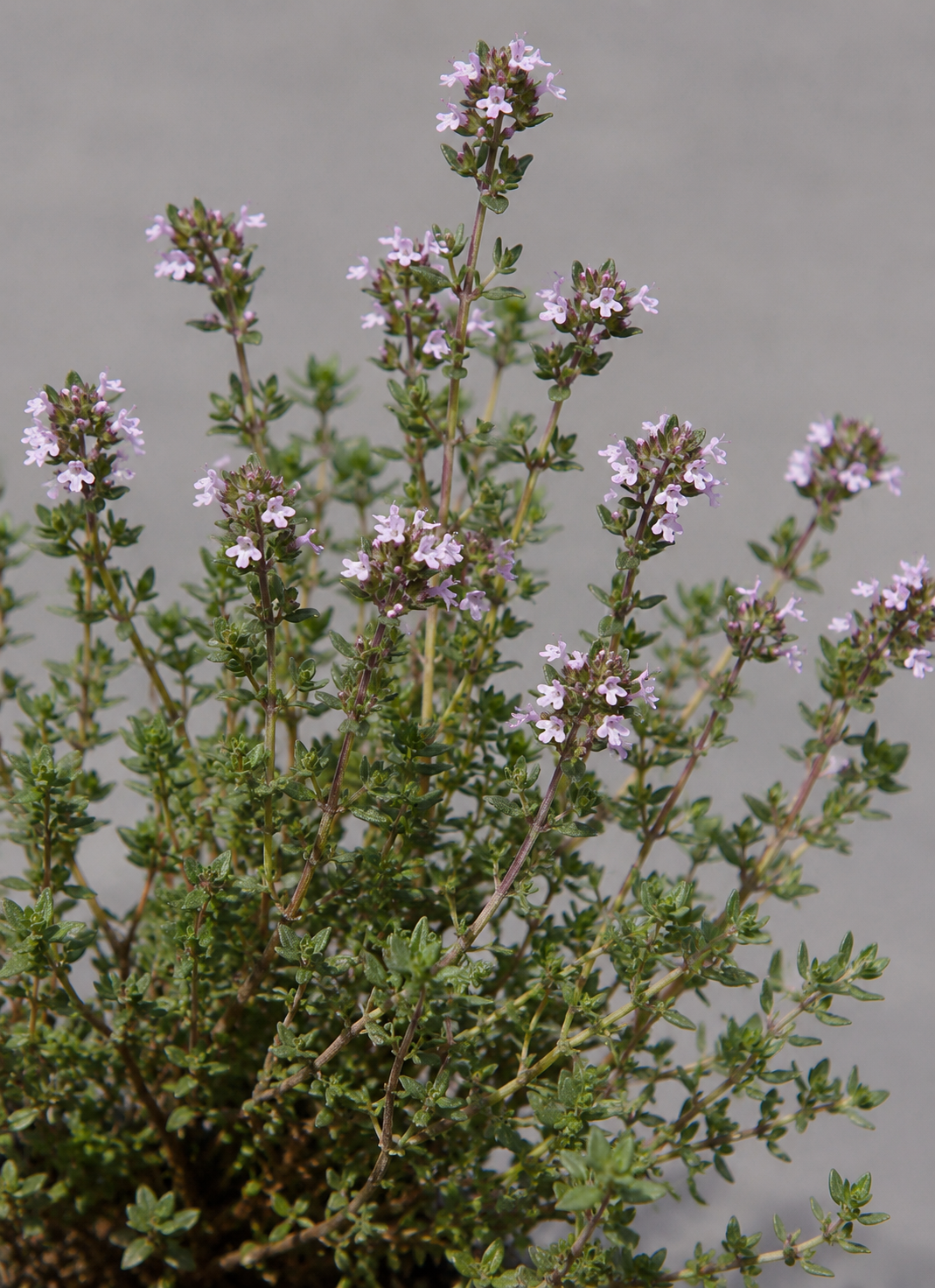
A compact evergreen to semi-evergreen subshrub with a woody base and numerous slender upright or spreading branches.
Leaves
Small, opposite, narrow to elliptic leaves with margins often rolled downward. The surface may be gray-green, and oil glands contribute to the characteristic aroma.
Stems
Young stems are slender and may be softly hairy; older stems become woody and branched.
Aroma
Strongly aromatic, warm, herbaceous, and phenolic to sweet depending on species, chemotype, harvest, and material quality.
Flowers
Small two-lipped flowers typical of the mint family, usually pale pink, lilac, or white, borne in compact clusters near the ends of stems.
Fruit and Seed
As in other Lamiaceae, the fruit separates into four small nutlets.
Root
A branching root system anchors the perennial woody base in dry, well-drained ground.
Taste
Aromatic, warming, pungent, and mildly bitter. Taste should support—not replace—botanical and documentary authentication.
Commonly Confused Materials
Thymus zygis, T. serpyllum, T. pulegioides, lemon-thyme hybrids, ornamental cultivars, and other small-leaved Lamiaceae may be sold or described as thyme. Their identity, chemistry, and intended use may differ.
Adulteration and Substitution
Dried herb may contain excessive stem, foreign matter, exhausted material, or another Thymus species. Essential oil may be diluted, rectified, blended, or labeled without adequate chemotype and batch information. Require current documentation.
02
Ethical Sourcing and Conservation
- Wildcrafted or Cultivated
- Both; cultivated material usually offers stronger traceability and reduced pressure on local wild stands
- Global Conservation Context
- Common thyme is widely cultivated; regional wild populations and dry Mediterranean habitats still require local assessment
- Primary Sourcing Concern
- Species identity, chemotype, pesticide residues, drying quality, oil adulteration, and habitat-sensitive wild collection
- Pollinator Value
- Flowering thyme supports bees and other insects and should not be stripped completely during harvest
Sustainable Harvesting Considerations
Harvest aerial material without uprooting established plants. Leave sufficient flowering growth for pollinators, seed set, and regeneration. Repeated cutting should preserve the woody crown and avoid exposing plants to drought injury.
Cultivation and Traceability
Cultivated thyme can provide documented species, cultivar, harvest date, agricultural inputs, and post-harvest handling. Essential-oil sourcing should additionally record distillation material, origin, batch, analytical profile, and any rectification or blending.
Ethical Product Selection
Prefer suppliers that disclose botanical identity, plant part, country of origin, lot number, extraction or distillation details, allergen information, and current testing. Familiarity as a kitchen herb should not lower authentication standards.
03
Hermetic Correspondences
- Primary Planetary Ruler
- Venus
- Historically Documented Source
- Nicholas Culpeper described common thyme as a notable herb of Venus
- Primary Elemental Reading
- Fire through concentrated warmth, pungency, dryness, and aromatic activation
- Secondary Elemental Reading
- Air through volatile fragrance, breath, voice, diffusion, and fumigation
- Metal
- Copper through Venusian correspondence
- Symbolic Sphere
- Courage, purification, breath, protection, clarity, preservation, and focused vitality
Sources of Correspondence
Historically Documented Culpeper explicitly calls common thyme a notable herb of Venus. His separate entry for wild thyme also assigns Venus and Aries, but that zodiacal statement should not be transferred automatically to T. vulgaris.
Modern Hermetic Interpretation Fire and Air are later interpretive correspondences derived from thyme’s hot aromatic impression, sun-loving habitat, volatile oil, fumigatory history, and association with respiratory tradition.
Correspondence Rationale
Venus may be read through fragrance, culinary pleasure, garden cultivation, attraction of pollinators, and the plant’s long domestic association. Fire appears through aromatic heat and dryness; Air appears through scent dispersal and breath symbolism.
Conflicting Attributions
Modern sources may assign Mars, the Sun, Fire, or Air as primary. These systems should be presented as later classifications rather than silently replacing Culpeper’s documented Venusian rulership.
04
The Tria Prima
The following interpretation distinguishes observable material qualities from Hermetic reading. It does not disclose laboratory or spagyric procedures.
SULFUR
Soul
Philosophical Expression
Warmth, pungency, aromatic identity, combustion, courage, focused vitality, and the plant’s unmistakable sensory character.
Material Expression
Essential oil, thymol- and carvacrol-related aromatic fractions, phenolic intensity, resinous traces, and the concentrated scent released by crushing or heating.
Interpretation
Thyme’s Sulfur is pronounced: a small quantity carries a strong signature. The danger of Sulfur appears when concentrated intensity is mistaken for universal safety.
MERCURY
Spirit
Philosophical Expression
Volatility, diffusion, breath, communication, movement from plant to air, and adaptation across culinary, aromatic, and medicinal contexts.
Material Expression
Volatile terpenes and phenolic compounds that move readily into the atmosphere and vary with chemotype, drying, storage, and distillation.
Interpretation
Mercury appears as fragrance that travels beyond the visible body of the plant. It links thyme to breath and fumigation without proving a medical outcome.
SALT
Body
Philosophical Expression
Woody endurance, compact form, boundary, drought adaptation, structure, and the fixed body that holds volatile intensity.
Material Expression
Fibrous stems, leaf structure, fixed mineral residue, ash, nonvolatile polyphenolic matter, and the perennial woody crown.
Interpretation
Salt restrains Sulfur and Mercury within a small durable form. When the volatile fraction is separated and concentrated, that natural restraint is altered.
05
Doctrine of Signatures
Doctrine-of-signatures material is historical or symbolic interpretation. It is not independent evidence of medical efficacy.
Interpretive Meaning
Modern Symbolic Interpretation Thyme’s small leaves and expansive fragrance suggest concentrated force: little body, far-reaching presence. Its dry sun-facing habitat suggests disciplined heat rather than uncontrolled flame.
Counter-Reading
Concentration may also signify excess. The same aromatic intensity celebrated symbolically can irritate skin, eyes, or airways when removed from the moderating body of the whole plant.
06
Botanical and Chemical Profile
Major Constituent Groups
Principal Volatile Constituents
EMA assessment materials report that dried thyme herb may contain up to approximately 2.5% essential oil and identify thymol, carvacrol, p-cymene, γ-terpinene, linalool, and related volatile compounds among principal components. Exact proportions vary markedly.
Red Thyme Oil
Historical and commercial terminology may describe crude thyme oil as “red thyme oil” because of its deep color. The product name alone does not establish species, chemotype, purity, concentration, route, or safety. Confirm the current Aura Cacia label and batch information.
Solubility Considerations
- Water-Accessible Fractions
- Some phenolic acids, flavonoid glycosides, tannins, and a limited portion of aromatic constituents
- Alcohol-Accessible Fractions
- Broader aromatic and polyphenolic fractions depending on alcohol percentage and extraction ratio
- Oil-Soluble / Volatile Fractions
- Essential-oil constituents including thymol-, carvacrol-, and terpene-rich fractions
- Heat-Sensitive / Easily Lost
- Volatile compounds may evaporate during prolonged heating, open storage, or poor drying
Known Variability
Composition varies with species, subspecies, chemotype, cultivar, geography, soil, climate, plant part, flowering stage, drying, storage, extraction, and distillation. A thymol-rich oil, linalool-rich oil, whole-herb infusion, and liquid extract should not be treated as compositionally equivalent.
Chemical literature and regulatory materials reviewed through: August 2026.
07
Traditional and Contemporary Virtues
Traditional Actions
Established Traditional Use EMA recognizes specified thyme-herb preparations for productive coughs associated with colds on the basis of long-standing use.
Historical Claim Culpeper praised thyme for the lungs and phlegmatic conditions and identified it as a Venusian herb. His additional claims belong to seventeenth-century medicine and are not modern treatment recommendations.
Contemporary Herbal Context
Contemporary practice may describe thyme as an aromatic expectorant, warming respiratory herb, digestive aromatic, culinary antimicrobial, or topical aromatic. These terms describe traditional or practitioner frameworks and should be matched to preparation-specific evidence and safety.
Energetic Qualities
- System
- Later Western herbal interpretation
- Temperature
- Warming to hot
- Moisture
- Drying
- Tonicity
- Stimulating and dispersing
- Movement
- Ascending, outward-moving, and circulating
- Primary Traditional Affinity
- Respiratory and digestive spheres
Spiritual and Ritual Associations
Hermetic Interpretation Later symbolic uses associate thyme with courage, purification, protection, fumigation, clarity, and the strengthening of intention. These meanings are separate from therapeutic indications.
08
Evidence Classification
Authoritative Monograph
EMA has published professional materials for thyme herb and thyme oil. These documents define specific substances, preparations, indications, age limits, warnings, and routes rather than endorsing every thyme product.
Established Traditional Use
Specified thyme-herb preparations have long-standing traditional use for productive coughs associated with colds. This classification does not establish robust clinical efficacy for all forms.
Clinical Evidence
Human evidence is preparation-specific and often involves combination products. Results cannot be transferred automatically to a single-herb liquid extract, culinary thyme, or essential oil.
Pharmacological Evidence
Laboratory and mechanistic research supports biological activity for extracts, essential oil, thymol, carvacrol, and related constituents. Such findings do not determine safe household dosing or prove clinical treatment effects.
Historical Claim
Culpeper and other historical herbals record respiratory, digestive, reproductive, and topical claims. These should be preserved as historical documents, not repeated as contemporary medical advice.
Hermetic Interpretation
Venus is historically documented in Culpeper. Fire, Air, courage, purification, and focused vitality are later symbolic classifications.
09
Therapeutic and Preparation Context
Traditional and Professional-Monograph Contexts
- Specified thyme-herb preparations for productive coughs associated with colds.
- Preparation-specific age limits, with most products intended for adults and adolescents over twelve and some for children over four.
- Culinary use as an aromatic herb in foods.
- Essential-oil use only according to the exact labeled route, concentration, and safety directions.
Preparation Forms
Liquid Extract
Confirm species, plant part, extraction ratio, alcohol content, serving, intended use, age limits, and warning label.
Infusion
A water preparation of authenticated herb. It is not chemically equivalent to essential oil or a standardized extract.
Syrup or Combination Product
Evidence and labeling apply to the named formula. Other botanicals, sweeteners, alcohol, and excipients alter the profile.
Culinary Herb
Food-level use differs from concentrated supplemental or essential-oil use.
Essential Oil
A concentrated volatile fraction requiring route-specific dilution, age restrictions, allergy precautions, and current product instructions.
Topical or Bath Product
Concentration, carrier, skin condition, body area, age, and inhalation exposure all affect safety.
When Additional Guidance Is Appropriate
Seek professional guidance for persistent or severe respiratory symptoms, chronic illness, pregnancy, breastfeeding, use in children, asthma or reactive airways, skin disease, known Lamiaceae allergy, planned internal essential-oil use, or use alongside prescription medicines.
10
Safety Profile
Essential Oil
Do not ingest or apply undiluted merely because thyme is a culinary herb. Use only according to the current product label and qualified guidance. Avoid eye and mucous-membrane exposure.
Babies and Young Children
EMA materials warn that thyme oil should not be applied to the face, particularly near the nose, of babies and infants under two years because of the risk of airway spasm. Follow the stricter current label when it sets a higher age limit.
Children and Adolescents
Most thyme-herb preparations are intended for adults and adolescents over twelve; some specified preparations may be used in children over four. Do not transfer one product’s age range to another form.
Pregnancy and Lactation
Safety has not been adequately established for medicinal thyme-herb or thyme-oil preparations. Regulatory materials do not recommend use when sufficient data are absent. Culinary food use is a separate context.
Allergy and Cross-Reactivity
Hypersensitivity to thyme or other Lamiaceae plants is possible. Thyme dust has been associated with occupational contact dermatitis and asthma, and thyme-oil medicines have been associated with allergic reactions.
Skin Irritation and Sensitization
Thyme oil can irritate skin, especially when concentrated, oxidized, or used on damaged skin. Patch-testing does not guarantee future tolerance and should not replace label directions.
Respiratory Warning Signs
Seek medical evaluation for shortness of breath, wheezing, chest pain, high or persistent fever, bloody or purulent sputum, worsening symptoms, or a cough that persists beyond the product’s recommended duration.
Drug and Supplement Interactions
Reliable interaction data are limited. Discuss concentrated extracts and essential oil with a qualified clinician or pharmacist when prescription medicines, multiple supplements, or significant medical conditions are involved.
Internal Use
Do not assume that an essential oil sold for aromatic use is intended for ingestion. Internal use requires an explicitly labeled product and appropriate professional guidance.
Storage
Keep essential oil tightly closed, protected from heat and light, and away from children and pets. Oxidation and degradation can change aroma and sensitization risk.
Route-Specific Safety
- Oral Herb / Extract
- Follow species-specific product directions, age limits, serving information, duration, and contraindications
- Topical Essential Oil
- Use only at an appropriate labeled dilution; avoid face, eyes, mucosa, damaged skin, and sensitive populations
- Inhalation / Diffusion
- Use ventilation and caution with asthma, children, pets, and respiratory sensitivity; stop if irritation occurs
- Bath Use
- Oil must be dispersed in an appropriate product; undispersed drops can contact skin at high local concentration
Regulatory and Product Notes
Dietary supplements and essential oils may be marketed under different regulatory categories and intended routes. Review the current label rather than inferring safety from the plant name, product color, or retailer category.
11
Historical, Cultural, and Ritual Context
Culinary Record
Thyme has a long Mediterranean and European culinary history as an aromatic seasoning for vegetables, legumes, meats, breads, sauces, preserved foods, and compound herb mixtures. Culinary use should be documented separately from concentrated medicinal preparations.
Historical Herbal Record
Culpeper’s thyme entry emphasizes respiratory, digestive, reproductive, and topical uses within seventeenth-century medicine and identifies the plant as Venusian. These claims are preserved as historical evidence rather than contemporary instructions.
Fumigation and Purification
Thyme’s powerful fragrance has supported later associations with incense, fumigation, purification, domestic protection, and the cleansing of rooms or ritual spaces. Specific cultural claims should be sourced rather than generalized into a universal tradition.
Courage and Remembrance
Later European folklore and literary tradition often connect thyme with courage, vitality, remembrance, and passage. These associations belong to cultural and symbolic study, not medical evidence.
Cultural Caution
Do not merge Mediterranean culinary history, early-modern English herbalism, modern aromatherapy, and contemporary esoteric practice into one undifferentiated lineage. Each has its own sources, terminology, and standards.
12
Symbolic Reading
Botanical Symbolism
Thyme joins small scale with great reach. Its leaves are minute, its form compact, yet its fragrance expands rapidly beyond the plant. This makes it an emblem of concentrated influence and disciplined presence.
Hermetic Interpretation
The Venusian herb is interpreted through Fire and Air without erasing its historical ruler. Venus gives attraction, fragrance, nourishment, and domestic cultivation; Fire gives heat and courage; Air carries scent, breath, and spoken intention.
The Lesson of Concentration
The whole plant contains its volatile principles within living structure. Essential oil removes and concentrates part of that aromatic body. Symbolically, thyme teaches that refinement increases both potency and responsibility.
Shadow or Counter-Reading
Courage can become aggression. Purification can become obsession. Heat can become irritation. Concentration can become overuse. The plant’s strongest symbolic lesson may therefore be proportion.
13
Study Questions
- Why is “thyme” insufficient as a complete product identity?
- How do T. vulgaris, T. zygis, wild thyme, and lemon thyme differ editorially?
- What makes Culpeper’s Venus attribution historically significant?
- Why should Fire and Air be labeled as later interpretations?
- How do chemotype and harvest conditions affect essential-oil composition?
- Why are liquid extract and essential oil not interchangeable?
- What does EMA traditional-use recognition establish, and what does it not establish?
- How do Sulfur, Mercury, and Salt appear in the whole plant?
- What safety responsibilities arise when a familiar culinary herb becomes a concentrated oil?
- How does thyme symbolize disciplined concentration rather than simple potency?
15
References and Source Record
Botanical References
Professional and Regulatory Sources
- European Medicines Agency — Thymi herba herbal medicinal product page.
- EMA — Thyme herbal summary for the public.
- EMA — Assessment report on Thymus vulgaris and Thymus zygis, herba.
- European Medicines Agency — Thymi aetheroleum herbal medicinal product page.
- EMA — Thyme oil herbal summary for the public.
- EMA — Draft revised European Union herbal monograph on thyme oil.
Historical and Correspondence Sources
Product Resources
- Herb Pharm — Thyme liquid extract, linked through Fullscript.
- Aura Cacia — Thyme, Red Essential Oil, linked through Fullscript.
Archive Notes
Thyme demonstrates how a small plant can occupy a large sensory and symbolic field. It gathers sun, dryness, fragrance, culinary memory, breath tradition, and domestic protection into a compact form.
The mature archive does not mistake intensity for permission. Species comes before common name, preparation before claim, chemotype before assumption, safety before purchase, and proportion before potency. In that discipline, thyme becomes not merely strong, but intelligible.
Revealed in Practice.