
HERBARIUM / ADVANCED PLANT MONOGRAPH
Calendula
Calendula officinalis L.
A golden flowering annual of solar correspondence, seasonal return, skin and boundary symbolism, domestic cultivation, and the disciplined separation of herbal extract from homeopathic dilution.
MONOGRAPH PROFILE
Quick Reference
- Botanical Name
- Calendula officinalis
- Botanical Authority
- L.
- Plant Family
- Asteraceae
- Primary Planetary Ruler
- Sun
- Historical Zodiacal Attribution
- Leo in Culpeper’s system
- Element
- Fire through color, radiance, warmth, and solar symbolism
- Metal
- Gold through solar correspondence
- Tria Prima Emphasis
- Sulfur / Salt
- Part Discussed
- Flower heads and florets; whole aerial herb should be identified separately
- Plant Condition
- Fresh or dried flower material
- Preparations Discussed
- Liquid extract, infusion, topical preparations, rinses, oils, salves, and homeopathic pellets
- Safety Classification
- Significant Caution
- Primary Safety Concern
- Asteraceae allergy, pregnancy/lactation uncertainty, route differences, wound severity, and confusion between herbal and homeopathic products
- Conservation / Sourcing
- Widely cultivated; identity, flower quality, pesticide exposure, and substitution with unrelated “marigolds” require attention
ENTRY SUMMARY
Calendula at a Glance
Calendula officinalis L. is an accepted annual or biennial species in the Asteraceae family. Plants of the World Online records its native range in the western Mediterranean and its extensive introduction and cultivation across temperate regions.
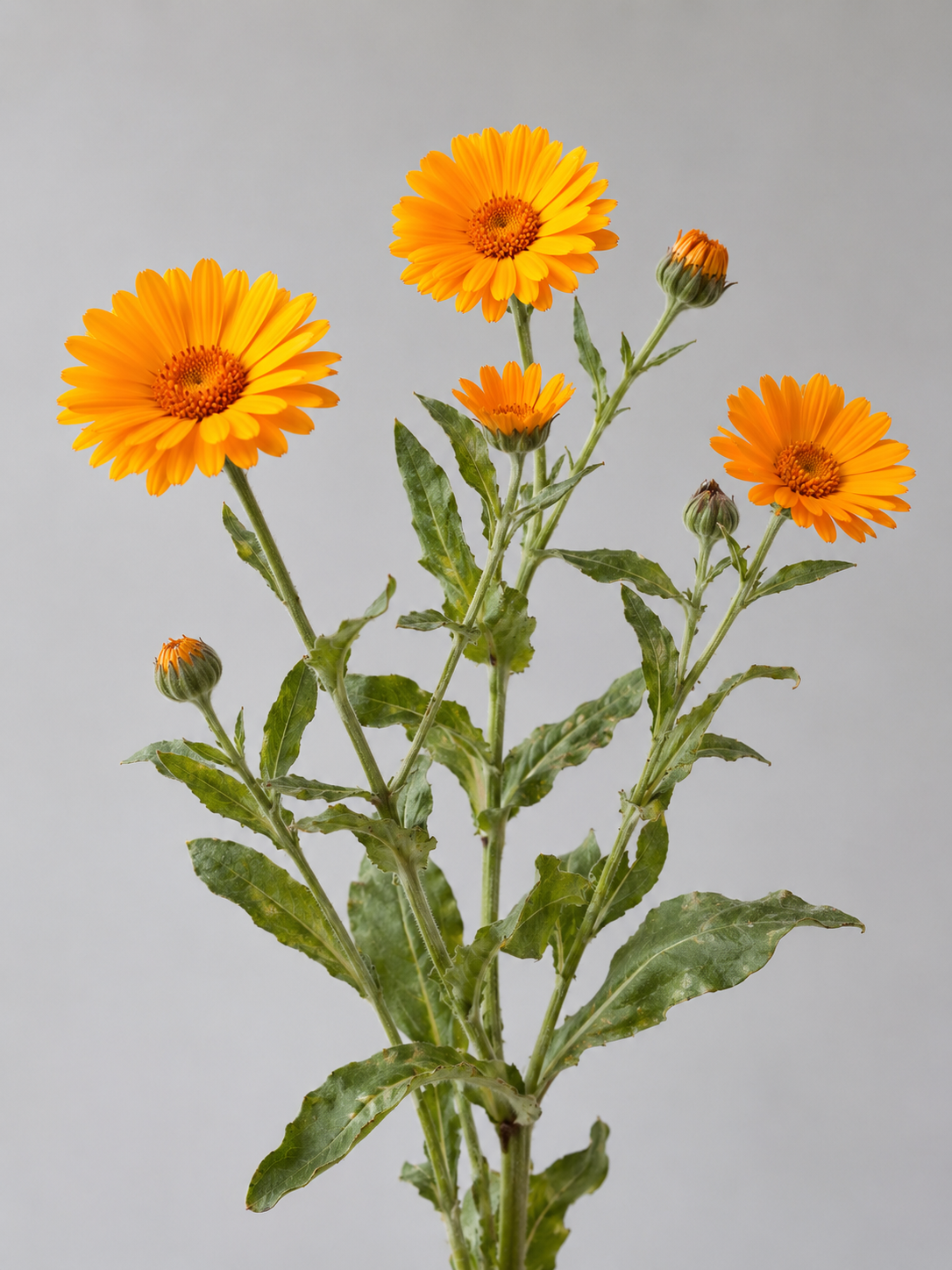
The plant produces bright yellow to orange composite flower heads, oblong to spatulate leaves, branching stems, and distinctive curved achenes. It should not be confused with French, African, or signet marigolds of the genus Tagetes, nor with corn marigold or marsh marigold.
The European Medicines Agency recognizes specified calendula-flower medicines on the basis of traditional use for minor skin inflammation, support in the healing of minor wounds, and minor inflammation of the mouth or throat. These conclusions apply to defined flower preparations and routes, not automatically to oral liquid extracts, cosmetics, supplements, or homeopathic pellets.
Culpeper described marigolds as an herb of the Sun under Leo. This attribution is historically documented within his seventeenth-century system. The flower’s golden color, repeated blooming, sun-facing imagery, and long association with calendrical and devotional symbolism reinforce later solar interpretations.
Calendula flower contains flavonoids, triterpenoid saponins and alcohols, carotenoids, polysaccharides, volatile constituents, and related compounds. Composition varies with cultivar, flower color, plant part, harvest stage, drying, storage, and extraction method.
Within HRMTC ALKMY ™, calendula is studied as a plant of radiant boundary: a cultivated flower whose warm color and repeated flowering suggest renewal, while its traditional external use directs attention toward the surface where inner life meets the world.
In This Monograph
01
Botanical Identity and Authentication
The name calendula should refer here to Calendula officinalis L. The word “marigold” is shared by unrelated plants and cannot authenticate a raw material, supplement, cosmetic, or homeopathic product.
Botanical Profile
- Common Names
- Calendula, pot marigold, garden marigold
- Botanical Name
- Calendula officinalis
- Botanical Authority
- L.
- Plant Family
- Asteraceae
- Taxonomic Status
- Accepted species in Plants of the World Online
- Primary Monograph Part
- Flower heads or florets, depending on the applicable specification
- Other Materials
- Whole aerial herb, leaves, seed, infused oil, and homeopathic preparations must be documented separately
- Plant Condition
- Fresh or dried flower material
Geographic Profile
- Native Range
- Western Mediterranean according to Kew.
- Introduced / Cultivated Range
- Widely cultivated and introduced across temperate regions.
- Preferred Habitat
- Open sunny cultivation in moderately fertile, well-drained soil.
- Growth Form
- Annual or biennial herb with branching stems and repeated seasonal flowering.
- Pollinator Relationship
- Flower heads attract bees, hoverflies, and other beneficial insects.
Harvest Profile
Harvest Season
Flower heads are gathered during active blooming. Repeated picking may encourage continued flowering in cultivation.
Harvest Stage
Use fully developed, clean flower heads appropriate to the intended pharmacopoeial, culinary, or supplier specification.
Collection Conditions
Avoid roadside contamination, pesticide exposure, mold, excessive moisture, mixed ornamental species, and deteriorated flower material.
Identification
General Appearance
An upright to spreading annual or short-lived biennial with branching, somewhat sticky or softly hairy stems.
Leaves
Alternate, simple, oblong to spatulate leaves with entire or slightly toothed margins and a softly textured surface.
Stems
Green, branching, and often glandular or softly hairy.
Aroma
Mildly resinous, green, and characteristic rather than strongly perfumed.
Flowers
Composite daisy-like heads with yellow to deep orange ray florets surrounding central disc florets.
Fruit and Seed
Distinctive curved, hooked, or boat-shaped achenes of different forms within the same flower head.
Root
A branching fibrous to taproot-like annual root system.
Taste
Mildly bitter, resinous, and slightly salty or mucilaginous depending on plant part and preparation.
Commonly Confused Species
French marigold, African marigold, signet marigold, corn marigold, marsh marigold, and field calendula may all create common-name confusion.
Adulteration and Substitution
Flower material may contain excessive receptacle, stem, faded petals, foreign Asteraceae flowers, artificial coloring, pesticide residues, or poorly dried material. Require botanical name, plant part, origin, lot, and testing documentation.
02
Ethical Sourcing and Conservation
- Wildcrafted or Cultivated
- Primarily cultivated for medicinal, culinary, cosmetic, dye, and ornamental use
- Conservation Context
- Not generally treated as a globally scarce medicinal species; local and supplier assessment remains necessary
- Primary Sourcing Concern
- Correct species, flower quality, agricultural residues, drying, adulteration, and labor transparency
- Pollinator Consideration
- Leave sufficient flowering material for insects and seed production
Sustainable Harvesting
Harvest flower heads selectively and maintain enough open flowers for pollinators. Avoid removing entire plants when the flower is the desired material. Cultivated production offers better identity control and reduced pressure on Mediterranean wild relatives.
Quality and Traceability
Prefer material with documented botanical name, flower-part definition, origin, harvest date, drying conditions, lot number, and contaminant testing. Bright color alone is not proof of freshness or authenticity.
Product-Specific Sourcing
Liquid extracts should disclose plant part, extraction ratio, solvent, alcohol content, and serving information. Homeopathic pellets should disclose the dilution designation, excipients, labeling status, and intended-use claims without being represented as equivalent to an herbal extract.
03
Hermetic Correspondences
- Primary Planetary Ruler
- Sun
- Historically Documented Zodiac
- Leo
- Element
- Fire
- Metal
- Gold
- Traditional Physiological Sphere
- Heart, vitality, warmth, skin, and visible surface in historical or symbolic systems
- Psychological / Spiritual Sphere
- Radiance, courage, renewal, joy, protection, devotion, and visibility
Historical Attribution
Historically Documented Culpeper described marigolds as an herb of the Sun under Leo. His medicinal claims belong to seventeenth-century practice and should not be repeated as modern therapeutic instructions.
Correspondence Rationale
Golden and orange flowers, prolonged blooming, responsiveness to daylight, calendrical naming, and repeated opening create a strong solar image. Gold follows from solar metal correspondence; Fire follows through color, warmth, visibility, and outward expression.
Alternative Attributions
Later sources may add Venus because of beauty, gardens, devotion, and domestic use. Such interpretations should be labeled as later rather than replacing the documented solar attribution.
04
The Tria Prima
This section interprets calendula through observable material qualities and Hermetic symbolism without revealing laboratory or spagyric procedures.
SULFUR
Soul
Philosophical Expression
Golden-orange color, radiance, warmth, resinous character, flowering persistence, and the plant’s strong visible identity.
Material Expression
Carotenoid pigments, triterpenoid fractions, volatile constituents, flavonoids, and resinous matter concentrated in the flower.
Interpretation
Calendula’s Sulfur is visible before it is smelled: identity carried through color and radiant form.
MERCURY
Spirit
Philosophical Expression
Seasonal repetition, opening and closing, pollinator exchange, calendrical rhythm, and movement between garden, food, dye, ritual, and medicine.
Material Expression
Water- and alcohol-accessible flavonoids and polysaccharides, volatile traces, and preparation-dependent movement of color and constituents.
Interpretation
Mercury appears through recurrence and translation: flower becoming color, infusion, extract, oil, salve, or symbol.
SALT
Body
Philosophical Expression
Boundary, skin, form, seed, preservation, cultivated continuity, and the structural flower head that holds many florets as one visible whole.
Material Expression
Fibrous receptacle, plant cell walls, mineral residue, fixed pigments, polysaccharides, seed structure, and nonvolatile flower matter.
Interpretation
Salt holds calendula’s radiance within form and links its symbolic light to the body’s outer boundary.
05
Doctrine of Signatures
Doctrine-of-signatures material is symbolic or historical interpretation, not medical evidence.
Interpretive Meaning
Modern Symbolic Interpretation The radiating head suggests the Sun; repeated flowering suggests renewal; the resinous green base beneath delicate petals suggests protection of beauty through structure.
Counter-Reading
Radiance can become projection. Devotion can become attachment. Repeated blooming can conceal exhaustion. Solar symbolism should include the need for rest, limits, and truthful visibility.
06
Botanical and Chemical Profile
Major Constituent Groups
Quality Markers and Flower Chemistry
EMA assessment materials describe calendula flower as containing flavonoids and set a pharmacopoeial minimum calculated as hyperoside for defined flower material. Carotenoid composition contributes strongly to yellow and orange coloration, while triterpenoid fractions are important to the flower’s chemical profile.
Solubility Considerations
- Water-Accessible Fractions
- Polysaccharides, flavonoid glycosides, some phenolic compounds, and limited volatile matter
- Alcohol-Accessible Fractions
- Flavonoids, triterpenoid-related constituents, carotenoid-associated fractions depending on solvent strength, and resinous matter
- Oil-Accessible Fractions
- Lipophilic carotenoids, triterpenoid alcohols, sterols, and resinous components
- Heat / Light Sensitive
- Color and some constituents may degrade with excessive heat, light, oxygen, moisture, and prolonged storage
Known Variability
Flower chemistry varies by cultivar, ray-floret color, plant part, harvest stage, geography, growing conditions, drying, storage, and extraction. A flower infusion, hydroalcoholic extract, infused oil, cosmetic cream, and homeopathic 30C pellet are not compositionally comparable.
Chemical and regulatory literature reviewed through: August 2026.
07
Traditional and Contemporary Virtues
Recognized Traditional-Use Context
Established Traditional Use EMA recognizes defined calendula-flower preparations for minor skin inflammation, assistance in healing minor wounds, and minor inflammation of the mouth or throat.
Historical Record
Historical Claim Culpeper recorded cordial, expulsive, and topical claims for marigolds. These statements belong to his period and are not current medical recommendations.
Contemporary Herbal Context
Contemporary practitioners commonly discuss calendula as a topical vulnerary, soothing flower, lymphatic or mucosal herb, infused-oil ingredient, and skin-care botanical. Evidence strength, route, product composition, and wound severity must be stated separately.
Energetic Qualities
- System
- Later Western herbal interpretation
- Temperature
- Neutral to gently warming
- Moisture
- Mixed; soothing yet mildly drying or resinous
- Tonicity
- Toning and gently stimulating
- Movement
- Outward toward skin and boundary; circulating in later practitioner language
- Primary Affinity
- Skin, mucosa, superficial tissue, and external boundary in traditional frameworks
Spiritual and Ritual Associations
Hermetic Interpretation Solar devotion, joy, protection, truth, visibility, remembrance, seasonal observance, and the honoring of thresholds.
08
Evidence Classification
Authoritative Monograph
EMA maintains professional calendula-flower materials for defined traditional external and oromucosal uses.
Established Traditional Use
Specified flower preparations have long-standing use for minor skin inflammation, minor wounds, and minor mouth or throat inflammation.
Clinical Evidence
Human studies exist for selected topical preparations and contexts, but results are heterogeneous and cannot be generalized to every product or indication.
Pharmacological Evidence
Preclinical research supports biological activity for extracts and constituent groups. It does not by itself establish clinical effectiveness or household dosing.
Historical Claim
Culpeper and later herbals record a broad range of claims that should remain historically labeled.
Homeopathy
NCCIH reports little evidence that homeopathy is effective for any specific condition. FDA states that no product labeled homeopathic is FDA-approved.
Hermetic Interpretation
Sun and Leo are historically documented in Culpeper; Gold, Fire, radiant boundary, and renewal are correspondence-based interpretations.
09
Therapeutic and Preparation Context
Professional-Monograph Contexts
- Symptomatic treatment of minor skin inflammation.
- Assistance in the healing of minor wounds.
- Symptomatic treatment of minor inflammation of the mouth or throat.
- Use only within the preparation, route, age range, and duration specified by the applicable product or monograph.
Preparation Forms
Liquid Herbal Extract
Confirm flower or aerial-herb identity, extraction ratio, alcohol content, oral or topical directions, serving, duration, and warnings.
Infusion or Rinse
A water preparation of authenticated flower. Intended route and microbial quality are especially important for mouth or wound contact.
Infused Oil or Salve
A lipophilic topical preparation whose carrier oil, extraction quality, preservatives, allergens, and wound suitability matter.
Cosmetic Product
A cosmetic containing calendula is not automatically equivalent to an herbal medicine for inflamed or broken skin.
Homeopathic 30C Pellets
A homeopathic dilution product, generally delivered as pellets with excipients. It is not an herbal extract and should not be evaluated by extract ratio or milligram content.
Culinary Flower
Petals may appear as garnish or coloring. Food use is distinct from medicinal supplementation and product claims.
When Medical Evaluation Is Needed
Seek appropriate care for deep or puncture wounds, animal or human bites, spreading redness, pus, fever, severe pain, heavy bleeding, significant burns, eye involvement, allergic reaction, or wounds that fail to improve.
10
Safety Profile
Asteraceae Allergy
Calendula-flower medicines should not be used by people hypersensitive to plants in the Asteraceae family. Stop use and seek care for swelling, breathing difficulty, widespread hives, or other serious allergic symptoms.
Pregnancy and Lactation
Adequate safety has not been established for medicinal use. Discuss oral extracts and other concentrated products with a qualified clinician. Food-level or cosmetic exposure is a different context but still requires ingredient review.
Children
EMA public information limits calendula-flower medicines to patients over six for skin inflammation and minor wounds and over twelve for mouth or throat inflammation. Follow the exact product label, which may be stricter.
Wound Severity
Calendula products are not substitutes for cleaning, closure, antibiotics, vaccination assessment, burn care, or urgent treatment when those are indicated.
Oral Liquid Extract
EMA’s principal traditional indications concern external or oromucosal flower preparations. Do not assume that those conclusions establish oral supplement effectiveness or safety.
Alcohol and Excipients
Liquid extracts may contain alcohol. Pellets may contain sugars or other excipients. Review labels for children, alcohol avoidance, dietary restrictions, diabetes management, and allergies.
Homeopathic Evidence
NCCIH states that there is little evidence to support homeopathy for any specific health condition. Do not delay effective care while relying on pellets.
Homeopathic Regulation
FDA states that no homeopathic product is FDA-approved and that such products have not been reviewed for safety and effectiveness. Manufacturing, contamination, or incorrect-dilution concerns may occur.
Drug and Supplement Interactions
Reliable interaction information for oral calendula extracts is limited. Discuss use with a clinician or pharmacist when medicines, pregnancy, surgery, or significant illness are involved.
Topical Product Quality
Carrier oils, fragrances, preservatives, adhesives, lanolin, and other formula ingredients can cause irritation or allergy independently of calendula.
Route-Specific Safety
- Topical Use
- Use only for minor conditions according to label; avoid serious wounds, eyes, and known allergy
- Mouth / Throat Use
- Use only a product intended for that route and age group; seek care for severe or persistent symptoms
- Oral Herbal Extract
- Review alcohol, serving, pregnancy/lactation, interactions, and lack of route-specific authoritative support
- Homeopathic Pellets
- Do not substitute for effective treatment; review label, excipients, claims, age directions, and FDA status
11
Historical, Cultural, and Ritual Context
Garden and Culinary History
Calendula has been cultivated as an ornamental, edible flower, coloring material, and domestic herb. Petals have been used as garnish and as a yellow-orange coloring in foods and household preparations.
Historical Herbal Record
Culpeper’s marigold entry presents the flower as solar and records cordial and topical uses within early-modern English medicine. These claims are historically important but are not current prescriptions.
Calendrical and Devotional Meaning
The name has been associated with repeated blooming and the calendar. Later traditions connect the flower with devotion, remembrance, protection, truth, marriage, grief, and the cycle of daily opening and closing.
Homeopathy as a Separate History
Homeopathy developed as a distinct medical system more than two centuries ago. A calendula homeopathic pellet is not simply a miniature or weaker herbal preparation; it belongs to a different theory, manufacturing method, and evidence framework.
Cultural Caution
Do not collapse European herbalism, Catholic or Marian symbolism, South Asian flower traditions, Mexican Tagetes traditions, modern skin care, and homeopathy into one generalized “marigold tradition.” Botanical and cultural identity both matter.
12
Symbolic Reading
Botanical Symbolism
The composite flower head gathers many florets into a single radiant form. This supports a symbolism of unity, visible order, and the gathering of small acts into a durable practice.
Hermetic Interpretation
Solar correspondence places calendula within radiance, truth, vitality, and the center. Its traditional relationship with skin and superficial tissue adds the idea of boundary: the place where inner life becomes visible.
The Lesson of Preparation
Calendula is especially useful for symbolic literacy because one plant name can lead to flower, tincture, infused oil, cream, rinse, food garnish, or 30C pellet. The name remains, but the material changes.
Shadow or Counter-Reading
Radiance can become vanity. Protection can become avoidance. Devotion can become fixation. A bright surface can conceal a wound requiring deeper care.
13
Study Questions
- Why is “marigold” insufficient as a botanical identification?
- How does Calendula officinalis differ from Tagetes species?
- What makes the Sun and Leo attribution historically documented?
- Which calendula uses are recognized as traditional by EMA?
- Why should topical evidence not be transferred to oral extract?
- What does 30C mean editorially, and why is it not an herbal dose?
- How do FDA and NCCIH frame homeopathic products and evidence?
- What safety issue matters most for Asteraceae-sensitive readers?
- How do Sulfur, Mercury, and Salt appear in the flower?
- What does calendula teach about the difference between a plant name and a preparation?
15
References and Source Record
Botanical References
Professional and Regulatory Sources
Historical and Correspondence Sources
Product Resources
- Herb Pharm — Calendula liquid extract, linked through Fullscript.
- Boiron Homeopathics — Calendula Officinalis 30C pellets, linked through Fullscript.
Archive Notes
Calendula demonstrates the archive’s obligation to preserve distinction. The same plant name can identify a flower, a tincture, an infused oil, a topical medicine, a cosmetic, a food garnish, or a homeopathic pellet. These forms are related by name and history, but not interchangeable in matter, evidence, or use.
Its solar lesson is therefore clarity. What is visible must be named accurately. What is traditional must remain distinguished from what is proven. What is offered through a product link must remain subordinate to safety, evidence, and informed judgment.
Revealed in Practice.