
HERBARIUM / ADVANCED PLANT MONOGRAPH
Dandelion
Taraxacum officinale F.H.Wigg.
A deeply rooted perennial of resilience, dispersal, bitter nourishment, Jupiterian expansion, cultivated discernment, and the necessary distinction between root, leaf, whole-plant extract, and ordinary food use.
MONOGRAPH PROFILE
Quick Reference
- Editorial Botanical Name
- Taraxacum officinale F.H.Wigg.
- Current Kew Treatment
- Synonym of accepted Taraxacum sect. Taraxacum
- Plant Family
- Asteraceae
- Primary Planetary Ruler
- Jupiter
- Element
- Air through seed dispersal; Earth through taproot and mineral body
- Metal
- Tin through Jupiterian correspondence
- Tria Prima Emphasis
- Salt / Mercury
- Parts Discussed
- Root, leaf, flower, and whole plant must be treated separately
- Plant Condition
- Fresh or dried; roasted root is a separate processed material
- Preparations Discussed
- Liquid extract, root capsules, food, infusion, decoction, and roasted-root beverage
- Safety Classification
- Significant Caution
- Primary Safety Concerns
- Asteraceae allergy, medicine interactions, pregnancy/lactation uncertainty, biliary conditions, fluid restrictions, and urinary warning signs
- Conservation / Sourcing
- Common and widely introduced; contamination, pesticide exposure, species identity, plant part, and ethical wild collection remain important
ENTRY SUMMARY
Dandelion at a Glance
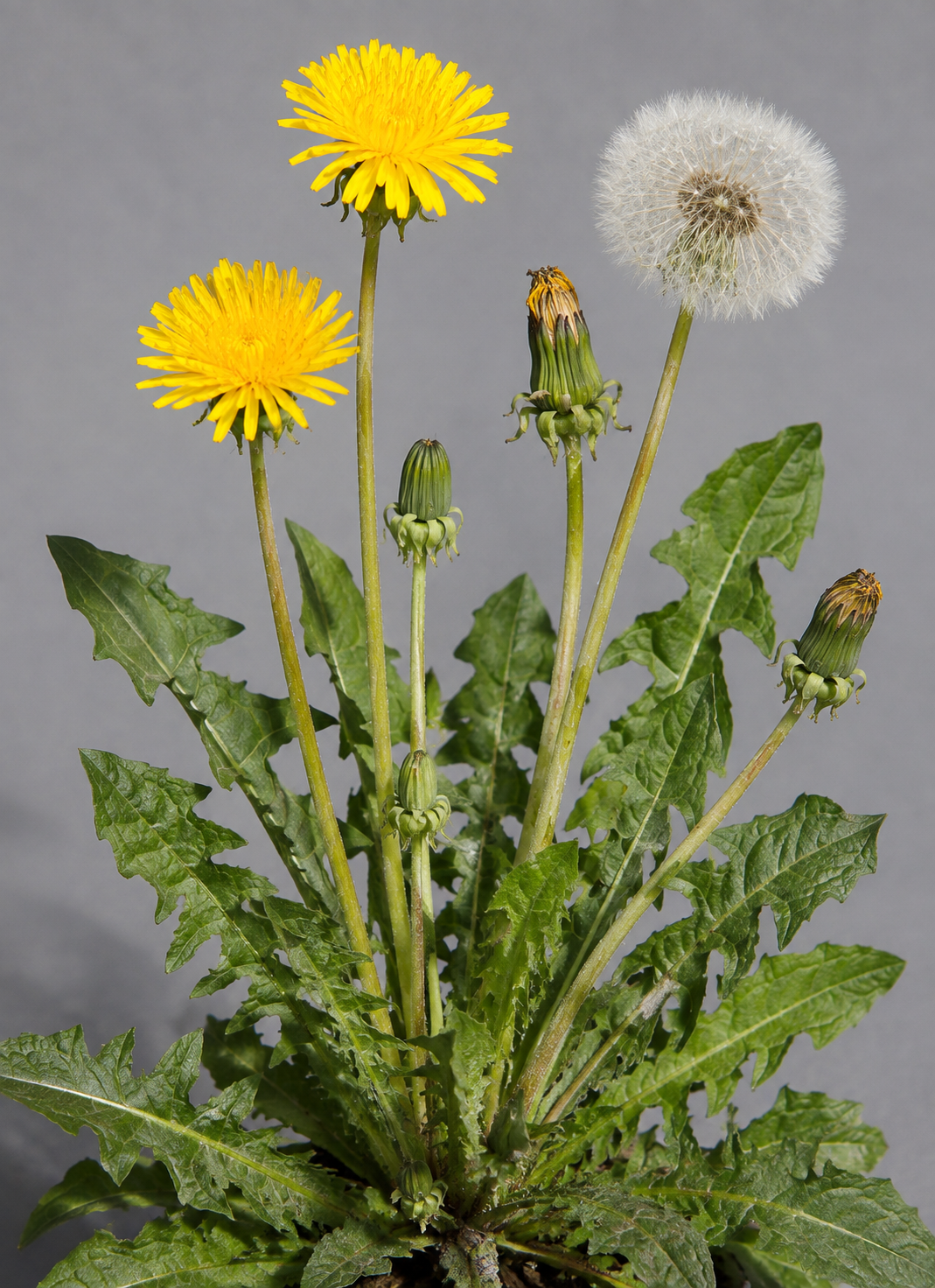
Dandelion is a perennial member of the Asteraceae family recognized by its basal rosette of toothed leaves, hollow leafless flower stalks, yellow composite heads, milky latex, deep taproot, and spherical seed head. It has become established across much of the temperate world and is simultaneously treated as food, medicine, pollinator resource, lawn weed, and symbol of persistence.
Taxonomy requires unusual care. Taraxacum officinale F.H.Wigg. remains the dominant name in herbal monographs and product labels, while Kew currently treats that name as a synonym within the accepted Taraxacum sect. Taraxacum. Dandelions also form a taxonomically complex genus with many microspecies and regional forms.
Professional monographs distinguish root, leaf, and root-with-herb preparations. EMA materials describe traditional-use contexts involving temporary loss of appetite, mild digestive complaints, and increased urine flow as an adjunct in mild urinary complaints. These conclusions apply only to the specified plant part and preparation.
NCCIH states that very little human research exists and that there is no compelling scientific evidence supporting dandelion for any health condition. Food-level use is likely safe, while the safety of larger supplemental amounts is less certain.
Culpeper placed dandelion under Jupiter. The plant’s abundant flowering, broad dispersal, generous food value, deep rooting, and repeated return support later symbolic readings of expansion held within grounded persistence.
Within HRMTC ALKMY ™, dandelion is studied as a plant of rooted openness: the root descends deeply, the leaves spread close to the earth, the flower opens visibly, and the seed moves freely through air.
In This Monograph
01
Botanical Identity and Authentication
The familiar name dandelion conceals a complex genus. This entry follows professional herbal usage by using Taraxacum officinale F.H.Wigg., while recording Kew’s current placement of that name within accepted Taraxacum sect. Taraxacum.
Botanical Profile
- Common Names
- Dandelion, lion’s tooth, blowball
- Editorial Botanical Name
- Taraxacum officinale F.H.Wigg.
- Kew Treatment
- Synonym of Taraxacum sect. Taraxacum F.H.Wigg.
- Plant Family
- Asteraceae
- Growth Form
- Temperate perennial herb
- Primary Product Parts
- Root, leaf, and root with herb
- Other Materials
- Flower, latex, seed, roasted root, and whole plant should be documented separately
- Plant Condition
- Fresh or dried; processing changes the material profile
Geographic Profile
- Accepted Section Native Range
- Macaronesia, Europe to Siberia, and northwestern Africa according to Kew.
- Introduced Range
- Widely introduced throughout temperate regions of the world.
- Preferred Habitat
- Lawns, meadows, paths, fields, roadsides, disturbed soil, and open grassland.
- Soil
- Highly adaptable, though productive growth is often associated with fertile or compacted disturbed ground.
- Ecology
- Flowers provide food for invertebrates and the plant is also used as human and animal food.
Harvest Profile
Root
Harvest timing affects inulin, bitterness, moisture, and other constituents. Record season, fresh or dried status, and whether root is raw or roasted.
Leaf
Young and mature leaves differ in texture and bitterness. Medicinal leaf material should not be assumed equivalent to salad greens.
Collection Conditions
Avoid lawns or roadsides treated with herbicides, pesticides, fertilizers, animal-waste exposure, or industrial contamination.
Identification
Leaves
Leaves arise in a basal rosette and vary from shallowly toothed to deeply lobed, commonly with lobes angled toward the crown.
Flower Stalk
Each hollow, leafless stalk generally carries one yellow composite flower head and releases milky latex when broken.
Root
A strong descending taproot may regenerate when a portion remains in the soil.
Taste
Leaves and root are characteristically bitter, with season and processing affecting intensity.
Flower
The yellow head consists entirely of ray florets and closes in response to environmental conditions.
Seed Head
Mature achenes carry a white pappus, forming the familiar spherical “clock” adapted for wind dispersal.
Latex
White milky latex appears from damaged leaves, stalks, and root.
Growth Pattern
A low rosette persists close to the ground while flowering stalks rise above surrounding vegetation.
Commonly Confused Plants
Cat’s-ear, hawkbit, sow-thistle, hawkweed, chicory relatives, and other yellow-flowered Asteraceae may be confused with dandelion. Branched flowering stems or leafy stalks are important warning signs.
Adulteration and Substitution
Root material may be mixed with other roasted roots or excessive foreign matter. Leaf material may contain related Asteraceae. Require plant part, botanical label, lot, origin, contaminant testing, and processing information.
02
Ethical Sourcing and Conservation
- Wildcrafted or Cultivated
- Both; common abundance does not guarantee clean or legal collection
- Conservation Context
- Generally abundant and widely introduced; local habitat and microspecies diversity still matter
- Primary Sourcing Concern
- Herbicides, roadside contaminants, animal waste, incorrect plant part, and weak traceability
- Pollinator Consideration
- Leave flowering plants available to insects, particularly where early-season floral resources are limited
Wild Collection
Do not collect from sprayed lawns, roadsides, industrial sites, drainage zones, golf courses, dog-walking areas, or land without permission. A common weed may still concentrate environmental contaminants.
Root Harvest and Regeneration
Root harvesting removes the plant. Where dandelion is ecologically abundant or invasive this may present little conservation concern, but harvest should still avoid sensitive habitats and rare regional taxa.
Commercial Traceability
Prefer suppliers documenting botanical name, plant part, harvest season, origin, drying or roasting method, extract ratio, alcohol content, and identity or contaminant testing.
03
Hermetic Correspondences
- Primary Planetary Ruler
- Jupiter
- Historically Documented Source
- Culpeper states that dandelion is under Jupiter
- Metal
- Tin
- Primary Elemental Reading
- Air through pappus, wind dispersal, openness, and expansion
- Secondary Elemental Reading
- Earth through taproot, mineral body, persistence, and edible bitterness
- Symbolic Sphere
- Expansion, resilience, nourishment, cleansing, rooted hope, release, and return
Historical Attribution
Historically Documented Culpeper explicitly places dandelion under Jupiter. His medical claims concerning liver, gall, spleen, urinary passages, and other conditions belong to seventeenth-century practice.
Correspondence Rationale
Jupiter appears through abundance, broad distribution, generous food value, repeated flowering, and the plant’s capacity to occupy neglected ground. Air is visible in the seed’s movement; Earth in the root’s descent.
Alternative Readings
Modern sources may emphasize the Sun because of the golden flower or Saturn because of bitterness and persistence. These are later symbolic readings and should not erase the historically documented Jupiterian attribution.
04
The Tria Prima
This interpretation separates observable plant qualities from Hermetic reading and does not disclose laboratory or spagyric procedures.
SULFUR
Soul
Philosophical Expression
Golden flower, bitter intensity, milky latex, solar visibility, and the plant’s forceful return after cutting.
Material Expression
Sesquiterpene lactones, triterpenes, sterols, pigments, phenolic compounds, and the distinct bitter and latex-bearing fractions.
Interpretation
Sulfur appears in the flower’s radiance and the root’s bitterness: two visible forms of concentrated identity.
MERCURY
Spirit
Philosophical Expression
Wind dispersal, rapid colonization, seasonal movement, adaptability, and translation among food, medicine, weed, and symbol.
Material Expression
Mobile water-soluble phenolics, preparation-dependent bitter fractions, moisture movement, and the airborne pappus.
Interpretation
Mercury is most visible when the rooted plant releases seed into air without surrendering its capacity to return.
SALT
Body
Philosophical Expression
Taproot, rosette, mineral nourishment, endurance, memory, and regeneration from remaining root tissue.
Material Expression
Inulin-rich root carbohydrate, fibrous tissues, minerals, ash, fixed structural matter, and nonvolatile polysaccharides.
Interpretation
Dandelion’s Salt is unusually explicit: the deep root holds continuity while the visible plant repeatedly changes.
05
Doctrine of Signatures
Doctrine-of-signatures material is historical or symbolic interpretation. It is not evidence of efficacy.
Interpretive Meaning
Modern Symbolic Interpretation The leaf’s teeth point toward the root, while the seed moves outward through air. This creates an image of attention returning inward before action expands outward.
Counter-Reading
Persistence can become invasion. Cleansing can become punitive “detox” culture. Expansion can become excess. The plant’s symbolism should not be used to market unsupported health promises.
06
Botanical and Chemical Profile
Major Constituent Groups
Part-Specific Chemistry
Root is especially associated with inulin and bitter constituents. Leaves differ in mineral, flavonoid, and phenolic composition. Flowers contain pigments and polyphenolic compounds. Whole-plant products combine materially different tissues.
Solubility Considerations
- Water-Accessible Fractions
- Inulin, minerals, some phenolics, flavonoid glycosides, and bitter constituents
- Alcohol-Accessible Fractions
- Broader bitter, phenolic, triterpenoid, and sesquiterpene-lactone fractions depending on solvent strength
- Roasting Effects
- Heat changes aroma, color, moisture, carbohydrate profile, and bitter character; roasted root is not raw root
- Processing Sensitivity
- Drying, storage, harvest season, root age, leaf maturity, and extraction materially change composition
Known Variability
Variation arises from taxonomic form, geography, soil, plant part, harvest season, leaf maturity, root carbohydrate cycle, drying, roasting, storage, and extraction method. Product-specific information is therefore essential.
Chemical and regulatory literature reviewed through: August 2026.
07
Traditional and Contemporary Virtues
Professional Traditional-Use Contexts
Established Traditional Use EMA dandelion-root materials identify traditional contexts involving temporary loss of appetite, mild digestive disorders, and increased urine flow as an adjunct in mild urinary complaints.
Historical Claims
Historical Claim Culpeper described dandelion as opening and cleansing and connected it with liver, gall, spleen, and urinary passages. These claims remain historical rather than clinical conclusions.
Contemporary Herbal Context
Contemporary practitioners may describe root as a bitter digestive herb and leaf as a urinary or mineral-rich herb. These frameworks must remain separated by plant part and should not be promoted as proven treatment for liver, kidney, metabolic, or inflammatory disease.
Energetic Qualities
- System
- Later Western herbal interpretation
- Temperature
- Cooling to neutral
- Moisture
- Drying in urinary contexts; root may be described as moistening through inulin-rich nutritive qualities
- Tonicity
- Gently stimulating and toning
- Movement
- Downward through root and elimination; outward through flower and seed
- Primary Traditional Affinity
- Digestive and urinary spheres, differentiated by plant part
Spiritual and Ritual Associations
Hermetic Interpretation Wishes, divination, resilience, release, rooted hope, expansion, survival in neglected places, and the return of life after disturbance.
08
Evidence Classification
Authoritative Monograph
EMA maintains separate materials for dandelion root, leaf, and root with herb. Their definitions and traditional indications should not be merged.
Established Traditional Use
Defined root preparations have long-standing traditional contexts for appetite, mild digestive complaints, and increased urine flow in mild urinary complaints.
Clinical Evidence
NCCIH states that very little human research exists and that there is no compelling scientific evidence supporting dandelion for any health condition.
Pharmacological Evidence
Laboratory research has explored anti-inflammatory, antioxidant, antiviral, metabolic, and other activity. Such findings do not establish clinical effectiveness.
Historical Claim
Culpeper and other traditions record broad digestive, biliary, urinary, and systemic claims that should remain historically labeled.
Hermetic Interpretation
Jupiter is historically documented; Air, Earth, tin, rooted hope, wishes, and release are correspondence-based readings.
09
Therapeutic and Preparation Context
Professional-Monograph Contexts
- Temporary loss of appetite for specified root preparations.
- Symptoms related to mild digestive disorders for specified root preparations.
- Increased urine flow as an adjunct in mild urinary complaints, with adequate fluid intake and appropriate exclusions.
- Preparation-specific use only; these contexts do not validate broad “detox,” liver-cleansing, kidney-cleansing, or disease-treatment claims.
Preparation Forms
Whole-Plant Liquid Extract
Confirm whether the product contains root, leaf, flower, or whole plant; review extraction ratio, solvent, alcohol, serving, and warnings.
Root Capsules
Confirm raw versus roasted root, powder versus extract, amount per serving, excipients, and product-specific directions.
Root Decoction
A water preparation of authenticated root. It is not equivalent to a capsule or hydroalcoholic extract.
Leaf Infusion
Leaf-based preparation with a different traditional and chemical profile from root.
Roasted-Root Beverage
A processed food or beverage material whose chemistry and sensory profile differ from raw medicinal root.
Food
Young leaves, flowers, and root may appear in food contexts. Food-level exposure is distinct from concentrated supplementation.
When Professional Guidance Is Appropriate
Seek guidance for gallstones, gallbladder disease, bile-duct obstruction, liver disease, kidney disease, fluid restriction, diabetes medicines, anticoagulant or antiplatelet therapy, diuretics, pregnancy, breastfeeding, significant allergy, or persistent urinary or digestive symptoms.
10
Safety Profile
Asteraceae Allergy
Allergic reactions are possible. NCCIH notes conflicting evidence concerning cross-reactivity in people sensitive to ragweed, chrysanthemums, marigolds, and daisies, and reports possible topical allergy in people with eczema.
Pregnancy and Lactation
Little is known about the safety of supplemental amounts greater than those found in food. Discuss concentrated products with a qualified clinician.
Medicine Interactions
NCCIH identifies theoretical interaction concerns involving antidiabetes, anticoagulant, antiplatelet, and water-pill medicines, among others.
Biliary Conditions
Traditional root use has involved bile-related digestive concepts. People with bile-duct obstruction, gallbladder empyema, gallstones, or significant gallbladder disease should seek medical guidance before use.
Fluid Restriction
Products used to increase urine flow require adequate fluid intake. They are inappropriate when a clinician has advised restricting fluids.
Urinary Warning Signs
Fever, painful urination, spasms, blood in urine, flank pain, inability to urinate, or worsening symptoms require medical evaluation.
Children
Age limits depend on plant part and preparation. EMA root materials do not recommend use in children under twelve in specified traditional contexts.
Digestive Effects
Bitter or inulin-rich products may produce digestive discomfort in some users. Stop use for significant pain, vomiting, persistent diarrhea, or allergic symptoms.
Alcohol-Containing Extracts
Liquid extracts may contain alcohol and require separate consideration for children, pregnancy, liver disease, recovery, religious restrictions, or alcohol avoidance.
Product Identity
Do not assume that a product named “Dandelion” contains root. Verify plant part, extraction, serving, excipients, and label warnings.
Route-Specific Safety
- Food Use
- Amounts commonly found in food are considered likely safe by NCCIH, subject to allergy and contamination concerns
- Oral Extract / Capsule
- Review plant part, medicine interactions, biliary conditions, fluid status, pregnancy/lactation, and age limits
- Topical Use
- May cause allergy, particularly in susceptible skin; discontinue for irritation or rash
- Urinary Traditional Use
- Requires adequate fluid intake and exclusion of warning signs or conditions requiring fluid restriction
11
Historical, Cultural, and Ritual Context
Food History
Dandelion leaves, roots, and flowers have been used as seasonal foods in multiple regions. Young greens appear in salads and cooked dishes; roots may be roasted; flowers may be used in beverages and preserves.
Historical Herbal Record
Culpeper described the plant’s appearance, deep root, common growth, Jupiterian rulership, and numerous digestive and urinary claims. His account should be preserved as a historical system, not modern prescribing guidance.
Common-Name History
“Dandelion” derives from the French image of the lion’s tooth, referring to the jagged leaf. Other folk names refer to urine flow, the spherical seed head, and children’s games.
Wish and Divination Traditions
The seed head has become associated with wishes, breath, counting, time, dispersal, messages, and release. These meanings emerge from the visible act of blowing the pappus into air.
Cultural Caution
Do not merge European herbalism, North American traditional use, East Asian Taraxacum species, modern detox marketing, lawn culture, and children’s folklore into one undifferentiated history.
12
Symbolic Reading
Botanical Symbolism
The root descends while the seed ascends and travels. Between them, the rosette rests close to earth and the flower opens toward light. Dandelion therefore presents a complete vertical symbolism of depth, surface, ascent, and release.
Hermetic Interpretation
Jupiterian expansion is disciplined by the taproot. The plant spreads widely not because it lacks a center, but because each plant is strongly centered beneath the soil.
The Lesson of Commonness
Dandelion challenges the assumption that value belongs only to rarity. It grows in neglected places and remains available to children, insects, animals, cooks, gardeners, and herbalists.
Shadow or Counter-Reading
Resilience can become refusal to adapt. Expansion can become invasion. Cleansing language can become shame-based marketing. The mature symbolic reading retains proportion and context.
13
Study Questions
- Why does Kew’s section-level treatment matter to publication-grade naming?
- How do root, leaf, flower, and whole-plant products differ?
- What makes Jupiter a historically documented attribution?
- How do the taproot and airborne pappus create a dual elemental reading?
- What traditional-use contexts are recognized for dandelion root?
- What does NCCIH conclude about clinical evidence?
- Which medicine interactions are theoretically concerning?
- Why do biliary conditions and fluid restrictions matter?
- How do Salt and Mercury interact in the plant’s form?
- What does dandelion teach about commonness, resilience, and unsupported “detox” claims?
15
References and Source Record
Botanical References
Professional and Governmental Sources
Historical and Correspondence Sources
Product Resources
- Herb Pharm — Dandelion liquid extract, linked through Fullscript.
- Nature’s Way — Dandelion Root capsules, linked through Fullscript.
Archive Notes
Dandelion preserves the relationship between descent and release. Its root enters deeply, its leaves remain close to earth, its flower opens without concealment, and its seed departs upon air.
The archive must exercise the same discipline. It must be rooted in identity, open about evidence, careful with products, and willing to release inherited claims that cannot be responsibly sustained.
Revealed in Practice.