
HERBARIUM / ADVANCED PLANT MONOGRAPH
Milk Thistle
Silybum marianum (L.) Gaertn.
A tall, armored annual or biennial of Jupiterian protection, white-veined leaves, medicinal fruit, boundary, abundance, and the careful distinction between whole-fruit preparations and standardized silymarin extracts.
MONOGRAPH PROFILE
Quick Reference
- Botanical Name
- Silybum marianum
- Botanical Authority
- (L.) Gaertn.
- Plant Family
- Asteraceae
- Historical Synonym
- Carduus marianus L.
- Primary Planetary Ruler
- Jupiter
- Element
- Earth through fixed fruit and structure; Fire through purple flower, bitterness, and protective intensity
- Metal
- Tin through Jupiterian correspondence
- Tria Prima Emphasis
- Salt / Sulfur
- Primary Part Discussed
- Mature fruit without pappus; commonly called seed in commerce
- Other Parts
- Leaves, stems, root, and young plant belong to separate culinary or historical contexts
- Preparations Discussed
- Liquid extract, fruit powder, dry extract, and standardized silymarin capsules
- Safety Classification
- Practitioner Guidance Recommended
- Primary Safety Concerns
- Liver symptoms requiring diagnosis, Asteraceae allergy, gastrointestinal effects, medicine use, pregnancy/lactation uncertainty, and product-quality variability
- Conservation / Sourcing
- Widely cultivated and introduced; invasive potential, pesticide residues, mycotoxins, microbiological quality, and inaccurate standardization require attention
ENTRY SUMMARY
Milk Thistle at a Glance
Milk thistle, Silybum marianum (L.) Gaertn., is an accepted annual or biennial species in the Asteraceae family. Kew records a broad native range extending from Macaronesia and the Mediterranean through Central Asia and India, with Ethiopia also included, and documents extensive introduction beyond that range.
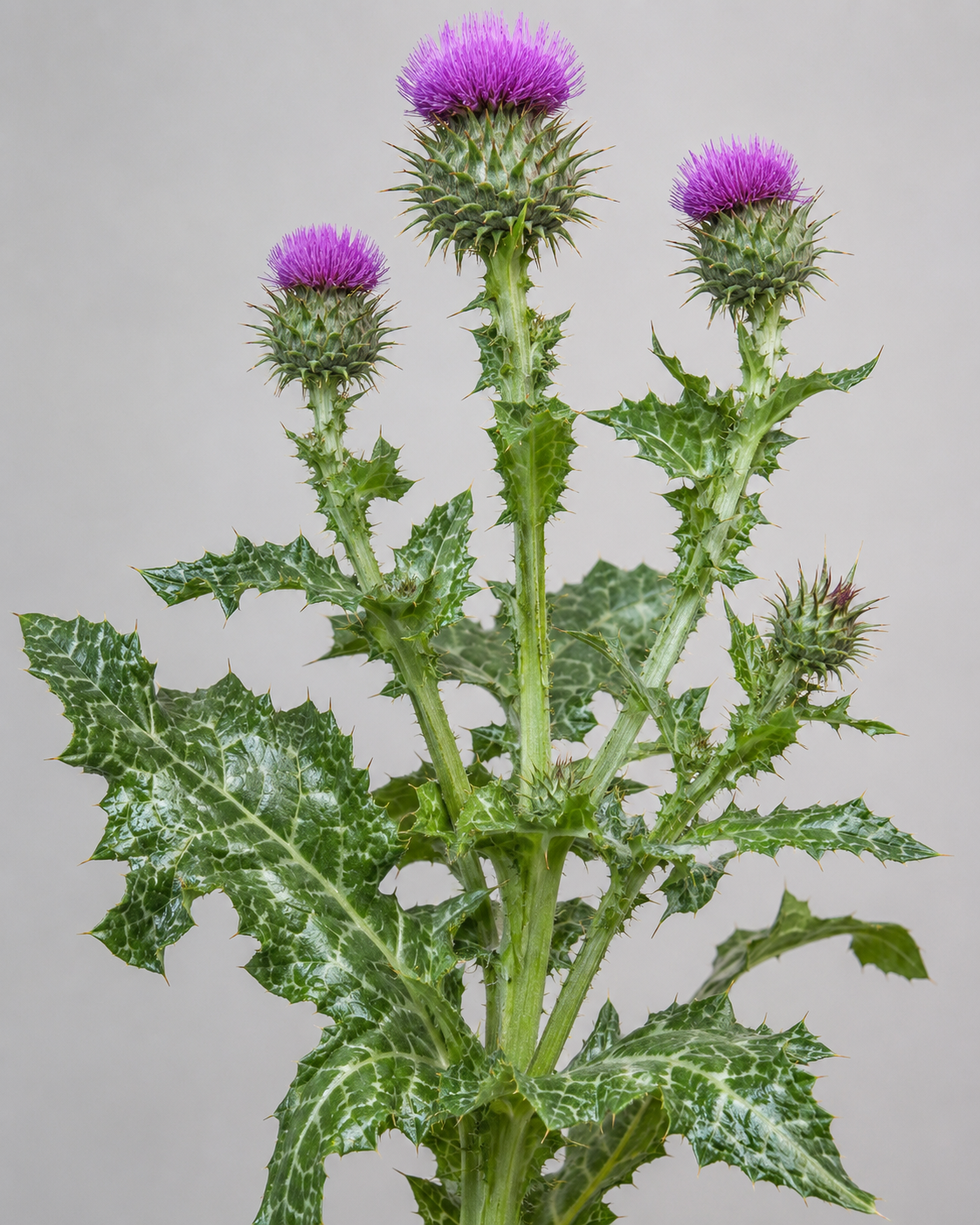
The plant is recognizable by its large glossy green leaves marked with conspicuous white marbling, sharply spined margins, tall winged stems, and purple thistle-like flower heads surrounded by formidable bracts. The mature one-seeded fruits are the principal medicinal material and are often called “seeds” in commerce.
The fruit contains a flavonolignan complex commonly called silymarin. Silymarin is not a single compound and may include silybin isomers, isosilybins, silychristin, silydianin, and related constituents. Standardized extracts differ from fruit powder, tea, tincture, and food use.
EMA recognizes specified fruit preparations on the basis of long-standing use for relief of fullness, indigestion, and digestive discomfort and to support liver function after serious disease has been excluded. NCCIH concludes that there is not enough high-quality evidence to draw definite conclusions about effects on health conditions and notes that major liver-disease trials have been conflicting or negative.
Nicholas Culpeper described “Our Lady’s Thistle,” identifiable by its white-streaked spiny leaves and purple head, as an herb under Jupiter. The plant’s size, abundance, armoring, nourishment, and historical association with protection support the Jupiterian attribution.
Within HRMTC ALKMY ™, milk thistle is studied as a plant of guarded abundance: nourishment and medicine are held behind spines, while white markings across the leaf create an image of purity moving through an armored body.
In This Monograph
01
Botanical Identity and Authentication
This entry concerns Silybum marianum (L.) Gaertn. The common name “thistle” is shared by many unrelated or only distantly related plants, including blessed thistle, Scotch thistle, cotton thistle, and multiple Cirsium species.
Botanical Profile
- Common Names
- Milk thistle, Mary thistle, Our Lady’s thistle, holy thistle
- Botanical Name
- Silybum marianum
- Botanical Authority
- (L.) Gaertn.
- Plant Family
- Asteraceae
- Accepted Status
- Accepted species in Plants of the World Online
- Historical Synonym
- Carduus marianus L.
- Primary Medicinal Part
- Mature fruit, generally with pappus removed
- Commercial Terminology
- Often called seed, though botanically the material is a dry one-seeded fruit
Geographic Profile
- Native Range
- Macaronesia and the Mediterranean through Central Asia and India, with Ethiopia included in Kew’s recorded native distribution.
- Introduced Range
- Widely introduced in Europe, the Americas, Australia, New Zealand, and parts of Asia and Africa.
- Preferred Habitat
- Open disturbed ground, field margins, roadsides, waste places, dry slopes, and cultivated soil.
- Growth Form
- Large annual or biennial herb, often forming a rosette before producing tall branched flowering stems.
- Ecological Role
- Flowers provide resources for invertebrates; dense introduced stands may compete with local vegetation.
Harvest Profile
Fruit Maturity
Medicinal material is obtained from mature fruits. Harvest timing affects moisture, oil, flavonolignan development, and storage stability.
Pappus Removal
Professional drug definitions generally specify mature fruit without the pappus. Excess fluff, flower parts, or stem reduce consistency.
Collection Conditions
Use legally sourced, correctly identified material free from mold, pesticide residues, roadside contamination, and excessive foreign matter.
Identification
Leaves
Large, glossy green leaves marked with conspicuous white veins or marbling and armed with sharp marginal spines.
Stems
Tall, robust, branched, and often winged by spiny leaf tissue.
Growth Habit
Annual or biennial, beginning as a substantial basal rosette before flowering.
Taste
The fruit and other plant parts are bitter; historical descriptions also emphasize the bitter character of the whole plant.
Flowers
Large purple to reddish-purple composite heads surrounded by rigid, outward-pointing spiny bracts.
Fruit
Flattened, smooth, dark to mottled achenes or cypselae, each containing one seed and originally attached to a silky pappus.
Root
A strong taproot supports the large rosette and flowering stem.
Latex / Sap
The plant’s common name arises from white leaf markings rather than a requirement that the medicinal fruit exude milk.
Commonly Confused Species
Blessed thistle, Scotch thistle, cotton thistle, bull thistle, spear thistle, and other Asteraceae may be confused by common name or overall appearance.
Adulteration and Quality Problems
NCCIH notes concerns about poor chemical and microbiological quality in commercial supplements, including inaccurate silymarin content and contamination by pesticides, microorganisms, or mycotoxins. Require current lot testing.
02
Ethical Sourcing and Conservation
- Wildcrafted or Cultivated
- Both; cultivated fruit offers stronger traceability and harvest control
- Conservation Context
- Widely distributed and cultivated; local invasive status may be more relevant than scarcity
- Primary Sourcing Concern
- Invasive spread, pesticide residues, fungal contamination, mycotoxins, microbiological quality, and inaccurate standardization
- Plant-Part Impact
- Fruit harvest may permit plant completion, but unmanaged seed dispersal can spread introduced populations
Invasive and Agricultural Context
Milk thistle may behave as an invasive or regulated plant in some jurisdictions. Cultivation and harvest should prevent uncontrolled seed dispersal and comply with local weed law.
Fruit Quality
Because the medicinal material is oil-bearing fruit, moisture control and clean storage are essential. Mold, poor drying, damaged fruit, and prolonged warm storage can degrade quality and increase contamination risk.
Supplement Traceability
Prefer products disclosing botanical identity, fruit source, extraction solvent, extract ratio, silymarin assay method, amount per serving, excipients, lot number, and testing for pesticides, microorganisms, mycotoxins, and heavy metals.
03
Hermetic Correspondences
- Primary Planetary Ruler
- Jupiter
- Historically Documented Source
- Culpeper’s “Our Lady’s Thistle” entry
- Metal
- Tin
- Primary Elemental Reading
- Earth through fruit, fixed oil, structure, and embodied protection
- Secondary Elemental Reading
- Fire through bitterness, purple flower, spines, vigor, and protective intensity
- Symbolic Sphere
- Protection, abundance, guarded nourishment, dignity, purification, maternal imagery, and resilience
Historical Attribution
Historically Documented Culpeper describes Our Lady’s Thistle with white-streaked leaves, strong prickles, purple heads, and fruit in soft white down, then explicitly places it under Jupiter.
Correspondence Rationale
Jupiter appears in the plant’s large scale, robust growth, expansive range, food value, medicinal reputation, and protective architecture. Tin follows through the traditional planetary-metal system.
Alternative Interpretations
Later sources may add Mars because of spines or the Moon because of Marian and milk symbolism. These interpretations may be useful when labeled, but they should not replace Culpeper’s documented Jupiterian rulership.
04
The Tria Prima
This interpretation separates observable plant and fruit qualities from Hermetic symbolism and does not reveal laboratory or spagyric procedures.
SULFUR
Soul
Philosophical Expression
Bitterness, purple flowering, protective fierceness, white-veined identity, vitality, and the plant’s commanding presence.
Material Expression
Flavonolignan-rich extractive matter, pigments, phenolic constituents, bitter fractions, and oil-soluble compounds.
Interpretation
Milk thistle’s Sulfur is both radiant and guarded: a vivid flower and medicinal fruit held within an armored form.
MERCURY
Spirit
Philosophical Expression
Movement between fruit and extract, dispersion by pappus, translation across food, medicine, devotion, and modern supplement science.
Material Expression
Solvent-dependent movement of flavonolignans, variable absorption, preparation differences, and the dispersal of mature fruit.
Interpretation
Mercury appears through conversion: fruit becomes powder, tincture, dry extract, or standardized silymarin, each with a different identity.
SALT
Body
Philosophical Expression
Spines, leaf structure, fruit, boundary, endurance, fixed nourishment, and the physical protection of the reproductive body.
Material Expression
Fruit oil, proteins, carbohydrates, minerals, fibrous tissues, ash, and nonvolatile structural matter.
Interpretation
Salt is dominant in the fruit and armor: value preserved by boundary, structure, and maturation.
05
Doctrine of Signatures
Doctrine-of-signatures material is symbolic or historical interpretation. It is not evidence that the plant treats a corresponding organ or disease.
Interpretive Meaning
Modern Symbolic Interpretation White veins crossing the green leaf suggest a luminous pattern carried through matter. Spines suggest discernment: nourishment is offered, but not without boundary.
Counter-Reading
Protection can become isolation. Abundance can become invasion. Purification can become unsupported “liver detox” marketing. Symbolic correspondence must never substitute for diagnosis or evidence.
06
Botanical and Chemical Profile
Major Constituent Groups
Silymarin Complex
Silymarin is a mixture rather than a single molecule. It commonly includes silybin A and B, isosilybin A and B, silychristin, isosilychristin, silydianin, and related flavonolignan constituents, with taxifolin and other flavonoids also present.
Fruit versus Standardized Extract
Whole fruit contains fixed oil, protein, carbohydrate, flavonolignans, and structural matter. Standardized silymarin extracts selectively concentrate flavonolignan fractions and may use solvents and extract ratios that produce a materially different preparation.
Solubility Considerations
- Water Preparation
- Whole-fruit tea may extract water-accessible constituents but does not necessarily deliver the same flavonolignan profile as concentrated extracts
- Alcohol / Solvent Extracts
- Extraction solvent and ratio strongly influence flavonolignan yield and composition
- Oil Fraction
- Fruit contains a substantial fixed-oil fraction with unsaturated fatty acids and other lipophilic constituents
- Bioavailability
- Absorption and formulation vary; phospholipid complexes and other delivery systems should not be equated automatically with ordinary silymarin powder
Known Variability
Variation arises from cultivar, geography, climate, fruit maturity, storage, oil content, extraction solvent, extract ratio, assay method, standardization target, formulation, and contamination. The word “silymarin” alone does not fully define a product.
Chemical and regulatory literature reviewed through: August 2026.
07
Traditional and Contemporary Virtues
Professional Traditional-Use Context
Established Traditional Use EMA recognizes defined milk-thistle-fruit preparations for relief of fullness, indigestion, and digestive discomfort and to support liver function after serious medical conditions have been excluded.
Historical Record
Historical Claim Culpeper recorded uses involving liver and spleen obstruction, jaundice, urine, stone, dropsy, pain, and spring food. These claims belong to seventeenth-century medicine and should not be repeated as treatment recommendations.
Contemporary Herbal Context
Milk thistle and silymarin are commonly promoted for liver support, metabolic health, toxin exposure, and digestive wellness. NCCIH concludes that evidence is insufficient for definite conclusions, and specific liver-disease trials have been conflicting or negative.
Energetic Qualities
- System
- Later Western herbal interpretation
- Temperature
- Neutral to gently cooling
- Moisture
- Drying through bitterness, with nourishing fixed oil in the fruit
- Tonicity
- Toning and restorative in traditional practitioner language
- Movement
- Protective, consolidating, and gently dispersing
- Primary Traditional Affinity
- Digestive and hepatobiliary spheres within historical and traditional systems
Spiritual and Ritual Associations
Hermetic Interpretation Protection, maternal shelter, abundance, purification, dignity, boundary, suffering transformed into service, and value concealed within difficulty.
08
Evidence Classification
Authoritative Monograph
EMA maintains an herbal monograph and assessment record for milk-thistle fruit, covering defined fruit preparations, adult use, traditional indications, contraindications, and warnings.
Established Traditional Use
Specified fruit preparations have long-standing use for fullness, indigestion, digestive discomfort, and support of liver function after serious disease has been excluded.
Clinical Evidence
NCCIH reports insufficient high-quality evidence for definite conclusions. Trials in multiple liver conditions have been conflicting, limited, or negative.
Hepatitis C Evidence
NCCIH reports that studies of silymarin in hepatitis C did not show benefit and that no dietary supplement has been shown effective for hepatitis C.
Pharmacological Evidence
Laboratory and mechanistic research supports antioxidant, stress-response, inflammatory-signaling, and other biological effects. These do not establish clinical treatment efficacy.
Historical Claim
Culpeper’s claims concerning plague, jaundice, liver, spleen, urinary conditions, and blood cleansing remain historical.
Hermetic Interpretation
Jupiter is historically documented; tin, guarded abundance, maternal protection, Earth, and Fire are correspondence-based readings.
09
Therapeutic and Preparation Context
Professional-Monograph Contexts
- Relief of fullness and indigestion for specified fruit preparations.
- Relief of mild digestive discomfort.
- Traditional support of liver function after serious conditions have been excluded by a physician.
- Adult use; EMA does not recommend use in people under eighteen because adequate data are lacking.
Preparation Forms
Liquid Fruit Extract
Confirm plant part, extraction solvent, ratio, alcohol content, serving, duration, and whether silymarin content is stated.
Fruit Powder
Contains whole-fruit material and fixed oil but is not equivalent to a standardized concentrated extract.
Standardized Silymarin
A concentrated extract standardized to a stated flavonolignan complex. Assay method and composition matter.
Tea / Infusion
A water preparation that should not be assumed to deliver the same silymarin exposure as solvent extracts.
Phospholipid Complex
A specialized delivery formulation with different absorption characteristics from ordinary fruit or silymarin powder.
Combination Formula
Evidence and safety depend on every ingredient and cannot be attributed to milk thistle alone.
When Medical Guidance Is Essential
Consult a clinician before use for diagnosed or suspected liver disease, abnormal liver tests, hepatitis, cirrhosis, gallbladder or bile-duct disease, cancer treatment, pregnancy, breastfeeding, multiple medicines, severe allergy, or persistent digestive symptoms.
10
Safety Profile
Urgent Liver Warning Signs
Jaundice, dark urine, pale stool, significant abdominal pain, fever, vomiting, swelling, confusion, unusual bleeding, or rapid deterioration require medical assessment.
Asteraceae Allergy
Milk-thistle medicines must not be used by people allergic to milk thistle or related Asteraceae plants. Severe reactions including anaphylaxis and asthma have been reported.
Digestive Adverse Effects
NCCIH and EMA report bloating, nausea, gas, dry mouth, upset stomach, stomach irritation, and diarrhea among possible effects.
Skin and Respiratory Reactions
Dermatitis, itching, rash, urticaria, asthma, and severe allergic reaction may occur. Stop use and seek urgent care for breathing difficulty or swelling.
Pregnancy and Lactation
Safety has not been established. EMA does not recommend medicinal use during pregnancy or lactation when sufficient data are absent.
Children and Adolescents
EMA does not recommend use under eighteen because adequate safety and efficacy data are lacking.
Medicine Use
NCCIH advises discussing milk thistle with a healthcare provider when taking any medicine. Product-specific interaction potential depends on formulation, dose, and the individual’s condition.
Product Quality
Commercial supplements have shown inaccurate silymarin content and contamination with pesticides, microorganisms, or mycotoxins. Choose independently tested products when possible.
Alcohol-Containing Extracts
Liquid extracts may contain ethanol and require separate consideration for alcohol avoidance, liver disease, pregnancy, children, recovery, and interacting medicines.
Symptom Duration
EMA advises medical or qualified professional consultation if symptoms persist longer than two weeks or worsen during use.
Route- and Preparation-Specific Safety
- Whole-Fruit Powder
- Review serving, oil content, digestive tolerance, allergy, contamination testing, and medicine use
- Liquid Extract
- Review solvent, alcohol content, extract ratio, fruit identity, serving, interactions, and warnings
- Standardized Silymarin
- Review assay method, stated standardization, extract source, formulation, serving, clinical context, and independent testing
- Liver-Related Use
- Requires diagnosis and appropriate medical follow-up; supplements must not replace indicated treatment
11
Historical, Cultural, and Ritual Context
Historical Herbal Record
Culpeper’s “Our Lady’s Thistle” entry accurately emphasizes the white-streaked leaves, strong prickles, purple head, fruit, bitter taste, and Jupiterian government. His broad therapeutic claims remain historical evidence rather than modern instructions.
Marian Legend
European tradition interpreted the white markings on the leaves as drops of the Virgin Mary’s milk. This devotional narrative shaped common names such as Mary thistle, Our Lady’s thistle, and holy thistle.
Food Context
Historical sources record young plant parts as seasonal food after removal of spines. Modern medicinal products focus primarily on mature fruit and its extracts.
Liver Symbolism and Modern Marketing
Milk thistle has become strongly associated with “liver support.” That cultural reputation must not be translated into claims that it cures hepatitis, cirrhosis, toxin injury, fatty liver disease, or other diagnosed conditions.
Cultural Caution
Do not merge Marian folklore, Culpeperian astrology, Mediterranean food use, pharmaceutical extract research, and modern detox marketing into one seamless tradition.
12
Symbolic Reading
Botanical Symbolism
The plant combines broad glossy leaves with sharp margins, soft white patterns with rigid spines, and nourishing fruit with difficult access. It symbolizes value protected by discernment.
Hermetic Interpretation
Jupiter expands, nourishes, protects, and governs. Milk thistle gives Jupiter a boundary: generosity need not mean indiscriminate openness.
The Lesson of Standardization
Modern silymarin products demonstrate that concentrating one fraction creates a new material identity. The name of the plant remains, but proportion and preparation change.
Shadow or Counter-Reading
Protection can become defensiveness. Purification can become moral judgment. Liver symbolism can become fear-based marketing. Abundance without quality control can become contamination or mislabeling.
13
Study Questions
- What features distinguish milk thistle from other thistles?
- Why is the medicinal material called fruit rather than seed?
- What is silymarin, and why is it not a single compound?
- How does standardized extract differ from whole-fruit powder?
- What traditional uses does EMA recognize?
- What does NCCIH conclude about liver-disease evidence?
- Which product-quality problems have been documented?
- Why does liver-related use require practitioner guidance?
- How do Jupiter, Salt, and protective boundary appear in the plant?
- What does milk thistle teach about the difference between support, symbolism, and treatment?
15
References and Source Record
Botanical References
Professional and Governmental Sources
Historical and Correspondence Sources
Product Resources
- Herb Pharm — Milk Thistle liquid extract, linked through Fullscript.
- Pure Encapsulations — Silymarin capsules, linked through Fullscript.
Archive Notes
Milk thistle presents value behind boundary. Its broad leaves are visibly marked, yet armed; its purple flower is open, yet surrounded by spines; its medicinal fruit is abundant, yet requires maturity, authentication, and careful preparation.
The archive must practice the same guarded generosity. Knowledge should be accessible, but claims must be tested. Product links may be offered, but diagnosis remains with qualified care. Tradition may be preserved, but evidence determines what can responsibly be said.
Revealed in Practice.