
HERBARIUM / ADVANCED PLANT MONOGRAPH
Rosemary
Salvia rosmarinus Spenn.
An evergreen Mediterranean herb of remembrance, clarity, warmth, preservation, solar vitality, and disciplined continuity.
MONOGRAPH PROFILE
Quick Reference
- Botanical Name
- Salvia rosmarinus
- Botanical Authority
- Spenn.
- Historical Botanical Name
- Rosmarinus officinalis L.
- Plant Family
- Lamiaceae
- Primary Planetary Ruler
- Sun
- Alternative Attributions
- Mercury or Jupiter in some later systems
- Element
- Fire in common later Western correspondence
- Metal
- Gold through solar correspondence
- Tria Prima Emphasis
- Sulfur / Mercury
- Parts Used
- Primarily the leaves and flowering aerial portions
- Plant Condition
- Fresh or dried
- Primary Preparations Discussed
- Leaf infusion, liquid extract, capsules, culinary herb, topical and aromatic preparations
- Safety Classification
- Significant Caution for supplemental and concentrated preparations
- Conservation / Sourcing
- Not generally threatened; verify species, plant part, origin, and product quality
ENTRY SUMMARY
Rosemary at a Glance
Rosemary, Salvia rosmarinus Spenn., is an aromatic evergreen shrub in the mint family, Lamiaceae. The historically familiar name Rosmarinus officinalis L. is now treated by Plants of the World Online as a synonym of the accepted name. The species is native to the Mediterranean region and widely cultivated for culinary, ornamental, aromatic, and traditional medicinal use.
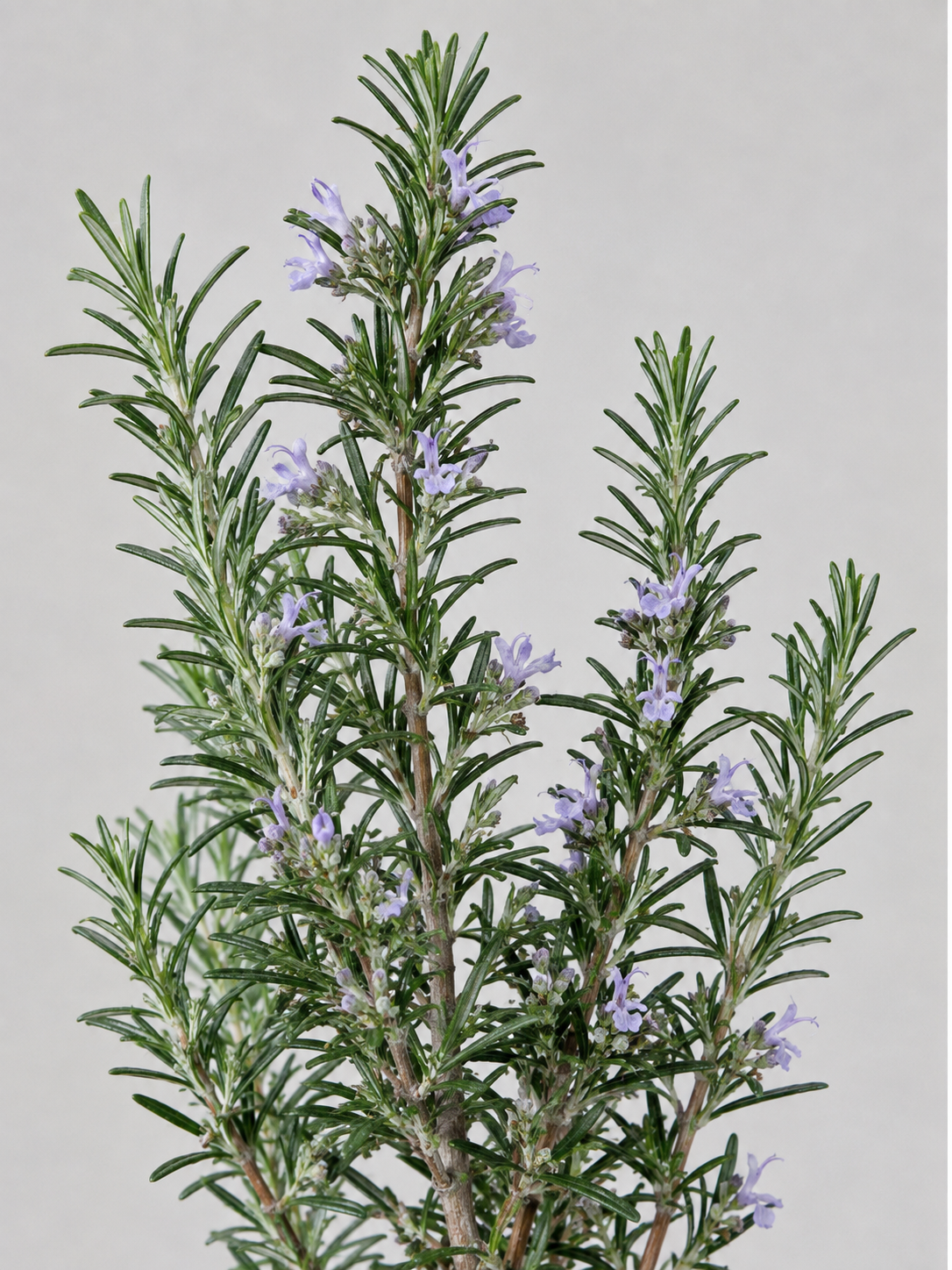
Its narrow, strongly revolute leaves are green above and pale or whitish beneath. The plant produces small, two-lipped flowers that are commonly blue or white and sometimes pink. Its resinous, penetrating aroma and drought-tolerant evergreen habit have made rosemary one of the most recognizable plants of Mediterranean cultivation.
Nicholas Culpeper placed rosemary under the Sun and Aries, making the solar attribution historically documented within his seventeenth-century astrological-herbal system. Later symbolic traditions emphasize remembrance, protection, fidelity, clarity, purification, and continuity.
The European Medicines Agency recognizes rosemary leaf preparations within a traditional-use framework for symptomatic relief of dyspepsia and mild spasmodic gastrointestinal complaints, and as a bath additive for minor muscular, articular, and peripheral circulatory complaints. This is an authoritative traditional-use classification, not proof that every rosemary supplement has the same composition, indication, or evidence.
Within HRMTC ALKMY ™, rosemary is studied as a plant of solar presence, aromatic preservation, memory, disciplined attention, and endurance. Botanical fact, traditional use, modern evidence, symbolic interpretation, and product information remain visibly separate.
In This Monograph
01
Botanical Identity and Authentication
Correct identity is essential because older monographs, labels, and products may use Rosmarinus officinalis while current botanical sources accept Salvia rosmarinus. This monograph treats them as the same species name in different taxonomic periods, not as separate plants.
Botanical Profile
- Common Name
- Rosemary
- Accepted Botanical Name
- Salvia rosmarinus
- Botanical Authority
- Spenn.
- Historical Botanical Name
- Rosmarinus officinalis L.
- Plant Family
- Lamiaceae
- Growth Form
- Evergreen aromatic shrub
- Parts Used
- Primarily leaves and flowering aerial portions
- Plant Condition
- Fresh or dried
Geographic Profile
- Native Range
- Mediterranean region.
- Cultivated Range
- Widely cultivated in temperate and subtropical regions.
- Preferred Habitat
- Sunny, dry, well-drained sites; Mediterranean scrub and rocky slopes.
- Climate
- Temperate Mediterranean; tolerant of heat and seasonal drought.
- Soil Preference
- Light, well-drained soils; poorly suited to prolonged waterlogging.
Harvest Profile
Harvest Season
Leaves may be gathered across much of the growing season; exact timing should match the intended preparation and source standard.
Harvest Stage
Leaf and flowering aerial material should be documented separately because chemistry and aroma may vary with developmental stage.
Collection Conditions
Use authenticated, uncontaminated material from a documented cultivated or responsibly managed source.
Identification
General Appearance
A woody, branching, evergreen shrub that may reach approximately two metres under suitable conditions.
Leaves
Linear, sessile, entire, strongly revolute leaves, dark green above and pale or whitish beneath.
Stems
Young stems are flexible; older growth becomes woody and may form a substantial trunk.
Aroma
Strongly aromatic, resinous, camphoraceous, pine-like, and penetrating.
Flowers
Small, two-lipped flowers, usually blue or white and occasionally pink, arranged in short whorls.
Fruit
The fruit divides into four dry nutlets, characteristic of many Lamiaceae.
Taste
Bitter, aromatic, warming, and astringent. Taste should not be used as a field-identification method.
Commonly Confused Material
Other aromatic Lamiaceae, ornamental rosemary cultivars, and products labeled only with the older botanical name may create confusion. Confirm the complete botanical name, plant part, and preparation.
Known Substitution Concerns
Powdered or extracted products cannot be reliably authenticated by appearance alone. Prefer products with transparent botanical identity, plant-part information, lot documentation, and quality testing.
02
Ethical Sourcing and Conservation
- Wildcrafted or Cultivated
- Commonly cultivated; wild collection also occurs regionally.
- Conservation Status
- Not generally regarded as threatened.
- Primary Sourcing Concern
- Identity, contamination, extraction quality, and traceability rather than scarcity.
- Preferred Source
- Documented cultivated material or responsibly managed regional harvest.
Sustainable Harvesting Considerations
Leaf and young aerial harvesting can be compatible with regeneration when plants are established and not overcut. Avoid damaging the woody crown or repeatedly stripping a plant beyond its capacity to recover.
Quality and Ethical Considerations
Because rosemary is widely cultivated and traded, ethical sourcing should emphasize species verification, pesticide and contaminant control, worker conditions, geographic transparency, and truthful labeling of extracts and essential oils.
03
Hermetic Correspondences
- Primary Planetary Ruler
- Sun
- Historical Zodiac Attribution
- Aries in Culpeper’s system
- Element
- Fire in common later Western correspondence
- Metal
- Gold through solar correspondence
- Primary Symbolic Themes
- Memory, clarity, fidelity, vitality, purification, continuity, protection
- Editorial Classification
- Historically documented solar attribution; later elemental and symbolic interpretations labeled separately
Historically Documented Attribution
Historically Documented
Nicholas Culpeper wrote that “The Sun claims privilege in it” and placed rosemary under Aries. This provides a direct early-modern source for the solar correspondence.
Correspondence Rationale
Rosemary’s persistent evergreen body, warming aromatic character, intense fragrance, culinary usefulness, and historical association with memory and vital spirits support later solar and fiery readings. These interpretations belong to symbolic and historical study rather than clinical evidence.
Conflicting Attributions
Some later systems assign Mercury because of rosemary’s association with memory, cognition, speech, and aromatic mobility; others use Jupiter for expansion, protection, and ceremonial dignity. HRMTC ALKMY ™ retains the Sun as primary because Culpeper’s statement is explicit and historically traceable.
04
The Tria Prima
This section presents philosophical and material interpretation while withholding laboratory and spagyric procedures reserved for later publication.
SULFUR
Soul
Philosophical Expression: Warmth, aromatic identity, penetrating presence, vitality, and solar individuality.
Material Expression: Volatile oils, resinous aroma, lipophilic phenolic diterpenes, and other strongly characteristic aromatic fractions.
Interpretation: Rosemary’s Sulfur announces itself immediately through scent, heat, and recognizable individuality.
MERCURY
Spirit
Philosophical Expression: Movement, communication, attention, recollection, circulation, and sensory awakening.
Material Expression: Volatile aromatic compounds move readily from leaf into air and vary with cultivar, climate, harvest, and extraction.
Interpretation: Mercury appears in rosemary’s capacity to carry fragrance, association, and memory through atmosphere.
SALT
Body
Philosophical Expression: Evergreen structure, woody endurance, boundary, preservation, and long memory.
Material Expression: Fibrous leaf tissue, woody stems, fixed mineral residue, and the durable architecture of a drought-adapted shrub.
Interpretation: Salt is visible in rosemary’s persistence: a stable body capable of carrying aroma and meaning across seasons.
05
Doctrine of Signatures
Doctrine-of-signatures material is historical or symbolic interpretation. It is not independent proof of medical effectiveness.
Interpretive Meaning
Modern Symbolic Interpretation
The evergreen habit has been read as continuity, fidelity, and memory that does not fade. The narrow leaves and penetrating aroma suggest focus, discernment, and concentrated attention. Its preference for sun and dry ground reinforces solar and fiery interpretations.
06
Botanical and Chemical Profile
Major Constituent Groups
- Volatile oils and monoterpenes
- Phenolic diterpenes
- Phenolic acids
- Flavonoids
- Triterpenes
- Tannins and related polyphenols
Frequently Discussed Constituents
Rosemary literature commonly discusses 1,8-cineole, camphor, α-pinene, borneol, verbenone, carnosic acid, carnosol, and rosmarinic acid. The relative abundance of these compounds varies with cultivar, chemotype, geography, plant part, harvest stage, storage, and extraction method.
Solubility and Preparation Considerations
- Water-Oriented Preparations
- Emphasize a different constituent profile from concentrated alcohol extracts or essential oil.
- Alcohol-Oriented Preparations
- May concentrate a broader range of aromatic and phenolic constituents depending on solvent strength and extraction ratio.
- Oil-Soluble Fractions
- Include volatile and lipophilic constituents; concentrated essential oil is not equivalent to leaf preparations.
- Volatile Constituents
- Can be lost or altered through prolonged heat, poor storage, oxidation, or inappropriate processing.
Known Variability
Do not assume that culinary leaf, tea, tincture, capsule, standardized extract, topical product, and essential oil have the same chemical composition or safety profile.
Chemical Literature Current Through: July 2026
07
Traditional and Contemporary Virtues
Traditional Actions
Established Traditional Use
European herbal traditions have described rosemary as warming, aromatic, carminative, stimulating, and externally supportive for muscular comfort and circulation. These are traditional classifications and do not automatically apply to every modern product.
Authoritative Traditional-Use Context
The European Medicines Agency’s rosemary-leaf monograph recognizes traditional use for symptomatic relief of dyspepsia and mild spasmodic gastrointestinal disorders. It also recognizes use as a bath additive as an adjunct for minor muscular and articular pain and minor peripheral circulatory disorders.
Energetic Qualities
- System
- Later Western herbal interpretation
- Temperature
- Warming
- Moisture
- Drying
- Tonicity
- Stimulating / toning
- Movement
- Circulating / ascending / dispersing
- Taste
- Aromatic, bitter, astringent
Psychological and Ritual Associations
Rosemary is widely associated with remembrance, mental clarity, fidelity, mourning, protection, and ceremonial continuity. These associations belong to historical, literary, and symbolic study, not to medical evidence.
08
Evidence Classification
Human studies exist for selected preparations and outcomes, but they do not establish broad effectiveness for all rosemary products or claims.
Extensive laboratory and preclinical research exists for extracts, essential oil, and isolated constituents.
EMA traditional-use monograph for specific rosemary-leaf preparations and indications.
Long European culinary, aromatic, medicinal, and ceremonial record.
Culpeper and other historical texts record many claims that should not be repeated as modern treatment guidance.
Solar, fiery, mnemonic, protective, and purifying readings belong to symbolic interpretation.
09
Therapeutic and Preparation Context
Preparation Forms
- Culinary fresh or dried leaf
- Herbal infusion
- Liquid extract or tincture
- Capsules or powdered leaf
- Standardized extract
- Topical preparation
- Bath additive
- Essential oil
- Aromatic or ritual material
Preparation Distinctions
Whole leaf, liquid extract, capsule, bath additive, topical preparation, and essential oil are not interchangeable. The composition and risk of a concentrated volatile oil differ materially from culinary use or an ordinary leaf infusion.
Situations Requiring Professional Guidance
Seek individualized guidance before supplemental use during pregnancy or lactation; for children; with gallstones, bile-duct obstruction, cholangitis, liver disease, significant allergy, or multiple medications; and before using concentrated aromatic preparations.
10
Safety Profile
Prominent Safety Summary
The EMA rosemary-leaf monograph lists hypersensitivity as a contraindication and states that oral use requires medical supervision in bile-duct obstruction, cholangitis, liver disease, gallstones, and other biliary disorders. Safety during pregnancy and lactation has not been established; use is not recommended in the absence of sufficient data. Use in children under 12 is not recommended in the EMA leaf monograph.
Pregnancy
Supplemental medicinal use is not recommended because safety has not been established. Culinary exposure is a different context from concentrated products.
Lactation
Safety has not been established for medicinal or supplemental use.
Children
The EMA leaf monograph does not recommend use in children under 12 because of inadequate data and the need for medical advice.
Biliary and Liver Conditions
Oral use requires medical supervision with bile-duct obstruction, cholangitis, liver disease, gallstones, or other biliary disorders.
Allergy and Sensitization
Hypersensitivity, contact dermatitis, and occupational asthma have been reported.
Drug and Supplement Interactions
The EMA monograph reports none, but limited reporting does not establish that interactions are impossible, especially with concentrated extracts or multi-ingredient products.
Essential Oil
Do not equate essential oil with leaf preparations. Internal use and undiluted topical use may create substantially greater risk.
Bath and Topical Use
Full baths are contraindicated with large skin injuries, open wounds, acute skin disease, high fever, severe infection, severe circulatory disturbance, or cardiac failure. Hot baths require caution with hypertension.
Product-Specific Review
Always review the exact product label, complete ingredient list, extraction ratio, excipients, serving information, warnings, and manufacturer documentation. Multi-ingredient products require evaluation of every ingredient, not only rosemary.
Safety Literature Current Through: July 2026
11
Historical, Cultural, and Ritual Context
Historical Record
Rosemary has been cultivated and used for centuries as food, fragrance, ornament, and medicine. Historical claims should be preserved as evidence of past practice, not repeated as contemporary treatment instructions.
Remembrance and Continuity
Rosemary became strongly associated with remembrance and has appeared in customs surrounding study, weddings, funerals, mourning, fidelity, and household protection. Its evergreen form and lasting aroma readily support themes of continuity and memory.
Culpeper’s Solar Rosemary
Culpeper’s entry places rosemary under the Sun and Aries and describes it as useful for both “physical” and “civil” purposes. The medical claims belong to seventeenth-century history; the solar attribution remains relevant to the archive’s correspondence study.
12
Symbolic Reading
Primary Symbolic Themes
Botanical Symbolism
Rosemary remains green where other plants may withdraw, holds fragrance in narrow leaves, and releases that fragrance through touch and warmth. These characteristics support symbolic readings of preserved memory, disciplined attention, and enduring presence.
Hermetic Interpretation
Hermetic Interpretation
As a solar plant, rosemary may be contemplated as clarity given form: a persistent body carrying concentrated warmth and aroma. Its memory symbolism is not passive nostalgia. It is the active preservation of what must remain available to consciousness and practice.
Shadow or Counter-Reading
Clarity can harden into certainty. Discipline can become rigidity. Preservation can become refusal to change. Aromatic stimulation can become irritation, and symbolic protection can become avoidance.
13
Study Questions
- Why does this monograph use Salvia rosmarinus while many products use Rosmarinus officinalis?
- Which botanical features distinguish rosemary from superficially similar aromatic shrubs?
- What makes Culpeper’s solar attribution historically documented?
- How does rosemary’s evergreen habit contribute to remembrance symbolism?
- Why must culinary use remain separate from concentrated supplemental use?
- Which EMA statements represent traditional use rather than well-established clinical efficacy?
- How do Sulfur, Mercury, and Salt appear in rosemary without disclosing laboratory procedure?
- Why are liquid extract, capsules, tea, and essential oil not interchangeable?
- Which safety conditions should be reviewed before supplemental use?
- How can a product resource remain subordinate to scholarship and safety?
15
References and Source Record
Botanical References
Professional and Regulatory Monographs
Chemical and Safety Reviews
Historical Herbal Sources
Product Resources
- Herb Pharm — Rosemary liquid extract, linked through Fullscript.
- Nature’s Way — Rosemary Leaves capsules, linked through Fullscript.
Archive Notes
Rosemary demonstrates how a familiar household herb can hold multiple records at once: accepted botanical identity, culinary practice, traditional medicine, regulatory monograph, historical planetary attribution, literary memory, and modern commerce.
The work of the archive is not to collapse these records into one claim. It is to preserve their differences, establish their sources, and place practice beneath discernment.
Revealed in Practice.