
HERBARIUM / ADVANCED PLANT MONOGRAPH
Yarrow
Achillea millefolium L.
A finely divided perennial herb of wound lore, protection, gathered strength, boundary, bitter discernment, and the disciplined separation of traditional use from modern evidence.
MONOGRAPH PROFILE
Quick Reference
- Botanical Name
- Achillea millefolium
- Botanical Authority
- L.
- Plant Family
- Asteraceae
- Primary Planetary Ruler
- Venus in Culpeper’s system
- Alternative Attributions
- Mars appears in some later wound-herb interpretations; not historically standardized
- Element
- Water in common modern Western correspondence; Earth also appears
- Metal
- Copper through Venusian correspondence
- Tria Prima Emphasis
- Sulfur / Salt
- Parts Used
- Flowering aerial parts; flowers may also be treated separately
- Plant Condition
- Fresh or dried
- Primary Preparations Discussed
- Infusion, liquid extract, dried herb, compress, wash, and topical preparations
- Safety Classification
- Significant Caution
- Primary Safety Concern
- Asteraceae allergy, pregnancy/lactation uncertainty, and preparation-specific exposure
- Conservation / Sourcing
- Generally widespread; regional taxonomy, wild collection, and cultivar identity require attention
ENTRY SUMMARY
Yarrow at a Glance
Yarrow, Achillea millefolium L., is an aromatic herbaceous perennial in the Asteraceae family. Plants of the World Online accepts the species name and records a native range including Greenland and broad subarctic and temperate regions of Eurasia. The species complex is taxonomically complicated in North America, where native infraspecific forms, introduced material, cultivars, and hybridization may overlap.
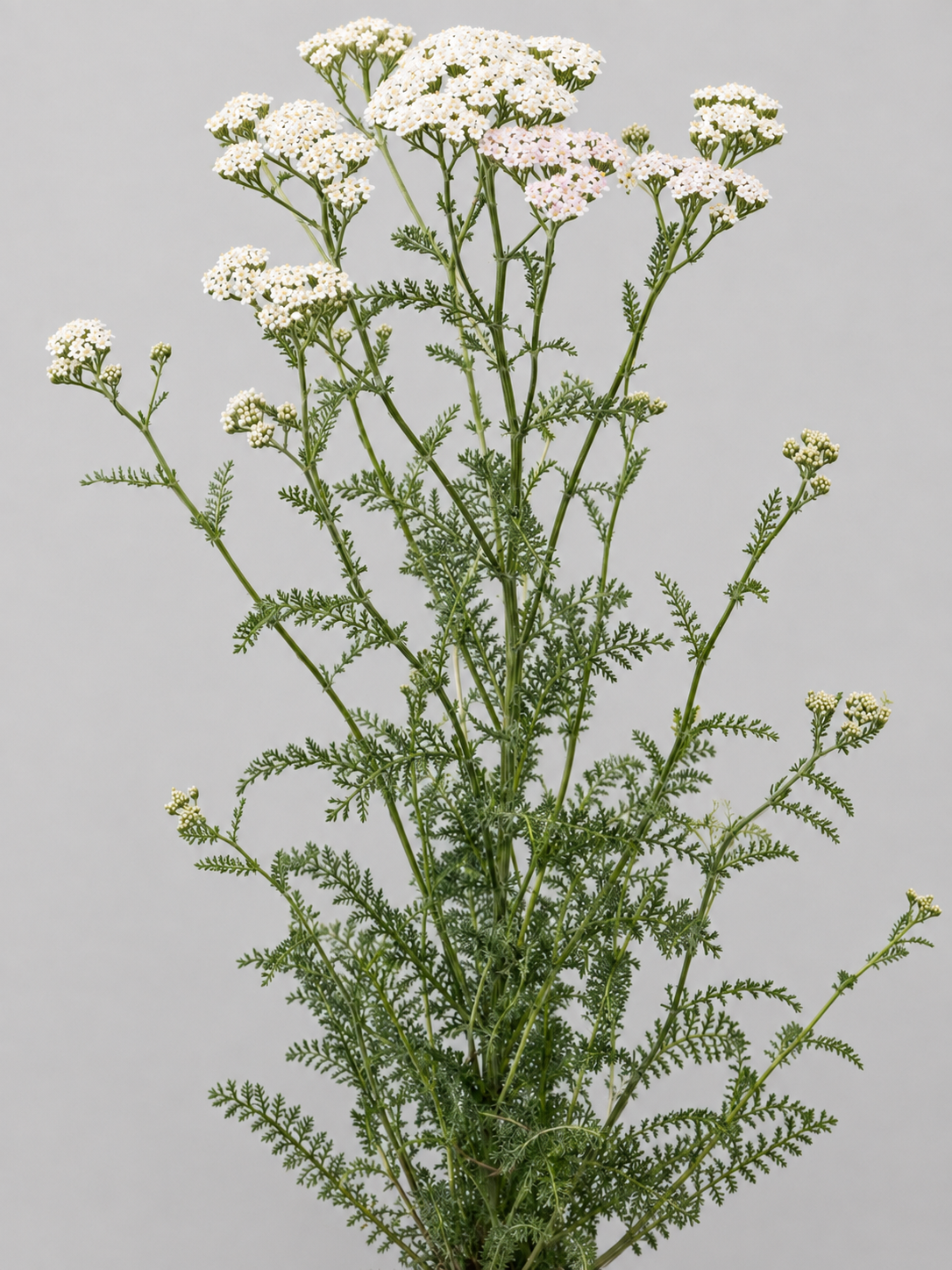
The plant is recognized by erect stems, finely divided fern-like leaves, a persistent aromatic or bitter character, rhizomatous spread, and flattened clusters of many small composite flower heads. Wild-type flowers are commonly white or pale pink, while horticultural selections may display stronger pink, red, yellow, or orange coloration.
Nicholas Culpeper recorded yarrow under the influence of Venus and preserved its older English names, including nose-bleed, milfoil, and thousand-leaf. He associated it strongly with wound care, binding, and drying. Those statements belong to seventeenth-century medicine and are treated here as historical evidence rather than contemporary clinical instruction.
The European Medicines Agency’s yarrow-herb assessment places its uses in the category of traditional herbal medicine, including loss of appetite, mild gastrointestinal complaints, minor menstrual spasms, and small superficial wounds. Traditional-use recognition does not mean that broad modern claims have been established through strong clinical trials.
Within HRMTC ALKMY ™, yarrow is studied as a plant of the gathered field: many divided leaves, many small flowers, and many historical meanings held within one persistent form. It teaches boundary, protection, wound memory, disciplined selection, and the difference between a traditional reputation and a proven therapeutic conclusion.
In This Monograph
01
Botanical Identity and Authentication
This entry concerns Achillea millefolium L. specifically. The common name yarrow is also applied to related Achillea species, regional forms, hybrids, and horticultural cultivars, so the complete botanical identity should be recorded for publication and product review.
Botanical Profile
- Common Name
- Yarrow, common yarrow
- Accepted Botanical Name
- Achillea millefolium
- Botanical Authority
- L.
- Plant Family
- Asteraceae
- Growth Form
- Aromatic rhizomatous herbaceous perennial
- Other Historical Names
- Milfoil, thousand-leaf, nose-bleed, soldier’s woundwort
- Parts Used
- Flowering aerial parts; flowers may be specified separately
- Plant Condition
- Fresh or dried
Geographic Profile
- Kew-Recorded Native Range
- Greenland, subarctic Eurasia, and temperate Eurasia.
- Introduced Range
- Widely introduced and cultivated beyond the accepted native range.
- Preferred Habitat
- Meadows, grasslands, roadsides, lawns, disturbed sites, open woodland, and field margins.
- Climate
- Temperate; adaptable across a wide range of seasonal conditions.
- Soil Preference
- Generally adaptable, often thriving in well-drained soils and open sun; established plants may tolerate dryness.
Harvest Profile
Harvest Season
Flowering aerial parts are commonly gathered during bloom. Exact timing should match the professional monograph, product specification, or documented tradition being discussed.
Harvest Stage
Record whether the material consists of pre-flowering leaf, flowering tops, whole aerial herb, or flowers alone because these are not automatically interchangeable.
Collection Conditions
Use authenticated, uncontaminated material collected legally and away from roads, sprayed lawns, industrial sites, animal waste, and unknown land-management practices.
Identification
General Appearance
An upright to spreading perennial, commonly one to three feet tall, arising from creeping rhizomes and often forming colonies.
Leaves
Alternate, aromatic, narrow in overall outline, and divided repeatedly into many small segments, producing the characteristic fern-like or feathered appearance reflected in the name “thousand-leaf.”
Stems
Erect, generally unbranched below and branching nearer the flower clusters; surfaces may be sparsely to noticeably hairy depending on the population.
Aroma
Distinctly aromatic, bitter-green, and sometimes described as camphoraceous or resinous when foliage is crushed.
Flowers
Numerous small composite heads arranged in broad, flattened or gently rounded clusters. Wild forms are commonly white or pale pink; each head contains central disk florets and a small number of ray florets.
Fruit
A small dry one-seeded cypsela lacking the showy pappus familiar in some other Asteraceae.
Roots and Rhizomes
Creeping rhizomes allow persistence, vegetative spread, and the development of colonies.
Taste
Bitter, aromatic, and astringent. Taste should not be used as a field-identification method.
Commonly Confused Material
Other Achillea species, ornamental yarrow cultivars, tansy-like Asteraceae, Queen Anne’s lace at a distance, and unrelated plants with finely divided foliage may cause confusion. Flower-head structure and leaf arrangement should be examined closely.
Commercial Identity Risk
Products may use flowering herb, leaf, flower, powdered herb, extracts, essential oil, or multi-herb blends. Record the botanical name, plant part, extract ratio or standardization when supplied, alcohol content, lot number, and all additional ingredients.
02
Ethical Sourcing and Conservation
Yarrow is widespread and commonly cultivated, but abundance alone does not establish ethical sourcing. Regional taxonomy, habitat sensitivity, pesticide exposure, roadside contamination, and the ecological role of flowering stands should all be considered.
- Wildcrafted or Cultivated
- Both; cultivated material offers stronger traceability for supplements
- Global Conservation Concern
- No broad global scarcity signal in the Kew record
- Primary Sourcing Concern
- Identity, contamination, regional collection pressure, and habitat disturbance
- Regeneration
- Perennial and rhizomatous; repeated removal of all flowering tops can still affect pollinators and seed production
- Preferred Publication Source
- Documented cultivated or responsibly managed material with complete botanical labeling
- Supplier Record
- Species, plant part, source region, lot, processing method, and testing where available
Sustainable Harvesting Considerations
Do not strip an entire stand. Leave flowering material for pollinators, seed development, and habitat function. Avoid collecting from rare local populations, protected lands without permission, restoration sites, or places where the species identity is uncertain.
Regional and Cultural Considerations
Yarrow traditions are not culturally uniform. European herbal records, classical mythology, modern Western esotericism, and Indigenous North American uses should be documented as distinct bodies of knowledge rather than combined into a single generalized narrative.
03
Hermetic Correspondences
- Primary Planetary Ruler
- Venus
- Historical Basis
- Culpeper explicitly places yarrow under Venus
- Alternative Attribution
- Mars in some later interpretations emphasizing wounds, soldiers, and blood
- Element
- Water in many modern correspondence systems; Earth also appears
- Metal
- Copper through Venusian correspondence
- Symbolic Sphere
- Protection, binding, healing memory, boundaries, divination, and reconciliation
Historically Documented Attribution
[Historically Documented] Nicholas Culpeper writes that yarrow is “under the influence of Venus.” His discussion emphasizes wounds, inflammation, binding, drying, and bodily retention within the medical framework of his period.
Later Western Correspondence
[Common in Later Western Herbalism] Water is frequently assigned because of yarrow’s relationship with blood, fluid boundaries, emotional protection, divination, and the regulation of flow. Earth appears where emphasis falls on astringency, persistence, tissue, rhizomes, and the physical closing of boundaries.
Alternative Martial Reading
[Modern Hermetic Interpretation] Mars may appear through the Achilles legend, soldier’s woundwort, blood symbolism, and battlefield associations. This is an intelligible symbolic reading, but it should not replace Culpeper’s explicit Venusian attribution when the historical source is being discussed.
Correspondence Rationale
Venus may be read through yarrow’s power to gather, reconcile, bind, and restore a damaged boundary. The plant’s many-parted leaves and many-flowered clusters suggest multiplicity brought into relationship. Its wound lore gives Venus a protective and reparative aspect rather than a merely ornamental one.
04
The Tria Prima
The Tria Prima section distinguishes philosophical interpretation from observable material characteristics. It does not disclose laboratory procedures or book-reserved spagyric practice.
SULFUR
Soul
Philosophical Expression
Aromatic identity, bitterness, warming presence, flower, color, and the active reputation of the plant as protector and wound herb.
Material Expression
Volatile oils, proazulenes, sesquiterpene lactones, aromatic terpenes, pigments, and other lipophilic constituents.
MERCURY
Spirit
Philosophical Expression
Movement through divided leaves, fragrance carried through air, adaptation across habitats, and mediation between open wound and restored boundary.
Material Expression
Volatile aromatic fractions, water- and alcohol-soluble constituents, and the changing sensory profile of fresh, dried, infused, or extracted material.
SALT
Body
Philosophical Expression
Astringency, boundary, persistence, rhizomatous return, structural memory, and the historical language of binding and closing.
Material Expression
Fibrous tissue, mineral residue, tannins, fixed matter, and the perennial root-and-rhizome system.
05
Doctrine of Signatures
[Historical and Symbolic Interpretation] Doctrine-of-signatures material records how plant features have been interpreted. It is not independent proof of medical efficacy.
- Growth Pattern
- Rhizomatous, persistent, colony-forming
- Leaf Form
- Deeply and repeatedly divided into many fine segments
- Flower Form
- Many small heads gathered into a broad flattened cluster
- Color
- Grey-green foliage; white or pale-pink wild flowers
- Aroma
- Penetrating, bitter-green, aromatic
- Habitat
- Open fields, margins, disturbed places, and grasslands
Interpretive Meaning
The “thousand-leaf” form suggests division without loss of identity: one leaf appearing as many, and one plant extending through many stems. The flower cluster repeats the pattern by gathering many small heads into a visible plane. This supports symbolic readings of coordination, community, disciplined multiplicity, and the restoration of a broken whole.
The pale flower marked by a long history of blood and wound symbolism creates a strong contrast between visible delicacy and martial reputation. Its presence in paths, lawns, roadsides, and margins supports the image of a boundary plant—one that inhabits places of crossing and repair.
06
Botanical and Chemical Profile
Major Constituent Groups
- Volatile oils and terpenoids
- Proazulenes and azulene-related compounds
- Sesquiterpene lactones
- Flavonoids, including apigenin- and luteolin-related compounds
- Phenolic acids
- Tannins and other astringent constituents
- Coumarin-related compounds
- Polyacetylenes and sterols reported in the literature
Solubility and Preparation Considerations
Water-Accessible Fraction
Infusions emphasize water-soluble and dispersible constituents but do not reproduce the composition of an alcohol extract or essential oil.
Alcohol-Accessible Fraction
Liquid extracts may draw a broader combination of aromatic, bitter, and polyphenolic constituents depending on alcohol percentage and extraction ratio.
Volatile Fraction
Essential-oil composition is highly variable and concentrated. It should not be treated as equivalent to tea, tincture, dried herb, or topical whole-herb preparations.
Fixed and Astringent Fraction
Tannins, fibrous material, minerals, and less volatile constituents contribute to the plant’s material and traditional binding character.
Known Variability
Yarrow chemistry varies with subspecies, cytotype, chemotype, geography, soil, climate, harvest stage, plant part, drying, storage, and extraction method. Essential-oil profiles may differ substantially between populations. Product conclusions should therefore remain tied to the actual preparation studied or sold.
Potentially Concerning Constituents
Sesquiterpene lactones can contribute to allergic contact reactions in susceptible individuals. Some volatile-oil profiles may contain constituents that require additional caution when concentrated. Whole-herb familiarity should not be used to infer essential-oil safety.
Chemical literature reviewed through: August 2026.
07
Traditional and Contemporary Virtues
This section documents use and interpretation. It does not guarantee effectiveness and does not instruct the reader to self-treat.
Traditional Actions
[Established Traditional Use / Historical Claim] Yarrow has been used in identifiable European herbal traditions as a bitter aromatic herb, a digestive preparation, a menstrual herb, a topical wash or compress, and a wound-related plant. The EMA assessment recognizes several preparation-specific uses on the basis of long-standing traditional use rather than strong clinical-trial evidence.
Contemporary Herbal Actions
Modern herbal practice commonly describes yarrow as bitter, aromatic, astringent, diaphoretic, circulatory, antispasmodic, and vulnerary. These terms belong to professional herbal frameworks and must not be converted automatically into disease-treatment claims.
Energetic Qualities
- System
- Later Western herbal interpretation
- Temperature
- Often described as warming or mixed
- Moisture
- Drying / astringent
- Tonicity
- Toning and stimulating, depending on preparation
- Movement
- Circulating, dispersing, then consolidating
- Taste
- Bitter, aromatic, astringent
Psychological and Spiritual Associations
[Modern Hermetic Interpretation] Yarrow is associated with boundary-setting, psychic protection, divination, courage after injury, emotional repair, and the ability to remain open without remaining unprotected. These are symbolic associations, not clinical indications.
08
Evidence Classification
Human research exists for selected preparations and outcomes, but the overall body is limited, heterogeneous, and insufficient for broad therapeutic claims.
Substantial laboratory and preclinical literature explores anti-inflammatory, antispasmodic, antioxidant, wound-related, and other mechanisms. These findings do not establish clinical effectiveness of ordinary supplements.
The EMA has published a yarrow-herb assessment based on traditional use for defined preparation forms and limited indications.
Yarrow has a long record in European herbalism and other regional traditions, particularly around digestive, menstrual, topical, and wound-related uses.
Culpeper and other historical authors record binding, drying, wound, bleeding, and retention-related claims that should remain historically labeled.
Venusian, watery, protective, boundary, and wound-symbolism readings belong to correspondence and symbolic study rather than medical evidence.
09
Therapeutic and Preparation Context
Traditional-Use Context
The EMA yarrow-herb page lists therapeutic areas that include loss of appetite, gastrointestinal disorders, urinary or genital complaints, and skin disorders or minor wounds. The detailed monograph frames these as traditional-use applications for defined preparations, not as universal recommendations for every yarrow product.
Preparation Forms
Infusion
A water preparation of dried herb. Composition depends on plant part, amount, steeping conditions, and source quality.
Liquid Extract
An alcohol-water or other solvent extract. Review the extract ratio, alcohol content, serving size, botanical part, and label warnings.
Topical Preparation
Compresses, washes, creams, or other products have route-specific safety and should not be treated as equivalent to swallowed preparations.
Dried Herb or Powder
May contain flowering aerial parts or other specified material. Powdered identity is harder to verify visually.
Essential Oil
A highly concentrated volatile preparation requiring separate safety analysis and professional caution.
Combination Product
Safety and suitability depend on every ingredient, not yarrow alone.
When Additional Guidance Is Appropriate
Seek individualized guidance before medicinal or supplemental use during pregnancy or lactation; in children; with known Asteraceae allergy; when taking prescription medicines; before surgery; for persistent gastrointestinal, menstrual, urinary, skin, or bleeding concerns; or when selecting essential oils and concentrated multi-ingredient products.
10
Safety Profile
Contraindications
Known hypersensitivity to yarrow or other members of the Asteraceae family is a primary contraindication in professional monograph material.
Pregnancy
Safety has not been established. The published European monograph advises against use during pregnancy in the absence of sufficient data.
Lactation
Safety has not been established. Avoid medicinal use unless specifically directed by a qualified healthcare professional.
Children and Adolescents
Age-specific use depends on the preparation and professional monograph. Do not extrapolate adult supplement directions to children.
Allergies and Cross-Reactivity
Contact dermatitis and other allergic responses may occur, particularly in people sensitive to Asteraceae or sesquiterpene lactones.
Drug Interactions
Reliable clinical interaction data are incomplete. Review supplemental yarrow with a healthcare professional when using prescription medicines or multiple botanicals.
Adverse Effects
Possible reactions include skin irritation, allergic rash, or other sensitivity. Discontinue use and seek care for significant or escalating symptoms.
Duration of Use
Follow the preparation-specific label or professional monograph. Persistent symptoms require medical evaluation rather than indefinite self-treatment.
Internal Use
Confirm botanical identity, plant part, concentration, serving size, alcohol content, and all additional ingredients.
Topical Use
Do not apply an unverified preparation to deep, infected, heavily bleeding, or serious wounds. Minor-wound tradition does not replace modern wound care.
Essential Oil
Do not ingest or apply undiluted. Essential-oil safety requires separate formulation and exposure assessment.
Surgery and Bleeding Concerns
Because wound and bleeding contexts are medically significant, discuss supplemental use with a clinician before surgery or when managing a bleeding disorder or anticoagulant therapy.
Regulatory and Product Notes
Dietary supplements are not evaluated in the same way as approved medicines before sale in the United States. Review the full label, complete ingredient list, botanical part, extraction details, warnings, serving size, and manufacturer information. A Fullscript link does not certify that a product is suitable for a particular person or condition.
Safety literature reviewed through: August 2026.
11
Historical, Cultural, and Ritual Context
Historical Record
Yarrow’s long European record is reflected in names such as milfoil, thousand-leaf, nose-bleed, bloodwort, and soldier’s woundwort. Culpeper’s entry places it under Venus and records wound, inflammation, binding, and drying uses characteristic of early-modern medicine.
Achilles Tradition
The genus name Achillea is connected with Achilles. Later botanical and mythographic tradition presents the plant as a battlefield wound herb taught through Chiron. The story gives yarrow a martial image, but mythic etymology and historical medical practice should remain distinguished from clinical evidence.
Folk and Divinatory Context
Later European and Western folk traditions associate yarrow with protection, love divination, courage, boundaries, weddings, dream practice, and the ability to identify or preserve relationship. Such traditions vary by place and period.
Cultural Caution
Document Indigenous North American uses by named community, source, and species or regional form. Do not present diverse nations and practices as one universal “Native American use,” and do not assume that European A. millefolium material is interchangeable with every North American yarrow population.
12
Symbolic Reading
Primary Symbolic Themes
- Protection
- Boundary
- Wound memory
- Reconciliation
- Gathered strength
- Discernment
- Divination
- Courage
- Binding
- Repair
- Persistence
- Multiplicity within unity
Botanical Symbolism
One yarrow leaf divides into so many narrow segments that its unity is almost concealed. One flower cluster gathers many small heads into a single surface. The plant repeats the same lesson at two scales: the whole is not the erasure of parts, but their disciplined relationship.
The rhizome extends unseen beneath the ground, sending up repeated stems. This invites a reading of continuity after injury, memory held below visibility, and restoration that begins before it is seen.
Hermetic Interpretation
[Hermetic Interpretation] Yarrow may be read as Venus working through Salt: relationship restored by the re-establishment of boundary. Sulfur gives aroma and active identity; Salt closes, binds, and preserves; Water governs the passage between flow and containment.
Shadow or Counter-Reading
Protection can become isolation. Binding can become rigidity. Wound identity can become attachment to injury. Divination can become projection, and martial folklore can romanticize harm. The plant’s lesson is not to remain closed, but to create a boundary capable of healing and renewed relationship.
13
Study Questions
- Why is the common name “yarrow” insufficient for publication-grade authentication?
- Which characteristics distinguish yarrow from superficially similar white-flowered plants?
- How does the Achillea millefolium species complex complicate North American sourcing?
- Why is Culpeper’s Venus attribution historically important?
- How does the Achilles legend create a later Martial counter-reading?
- Which EMA uses are classified as traditional use rather than established clinical treatment?
- How do divided leaves and gathered flower heads support the theme of multiplicity within unity?
- Why are whole herb, liquid extract, topical preparation, and essential oil not interchangeable?
- What allergy concern follows from yarrow’s membership in Asteraceae?
- What does yarrow teach about the difference between a protective boundary and isolation?
15
References and Source Record
Botanical References
Professional and Governmental Sources
Chemical, Pharmacological, and Safety Reviews
Historical and Correspondence Sources
Product Resource
- Herb Pharm — Yarrow liquid extract, linked through Fullscript.
Archive Notes
Yarrow holds together several kinds of memory: the divided leaf, the gathered flower, the persistent root, the battlefield legend, the domestic herbal, the divinatory charm, and the modern bottle.
The archive preserves those layers without allowing one to impersonate another. Myth remains myth, history remains history, tradition remains tradition, evidence remains evidence, and safety remains the boundary through which responsible practice becomes possible.
Revealed in Practice.